

At 6:40 a.m., employees might notice a faint smell in the lobby—nothing overwhelming, just slightly stale air near reception. By midweek, a few people call in sick, and others mention mild respiratory irritation. It’s usually a sign that shared work areas haven’t been deeply sanitized in a while.
The company probably handles basic surface cleaning, but harder-to-see spots often get missed. In busy offices, banks, and schools, pollutants and microbes move quietly from desks to door handles to breakroom tables. Everything can look spotless while the indoor air feels heavier and high-touch surfaces collect unseen buildup.
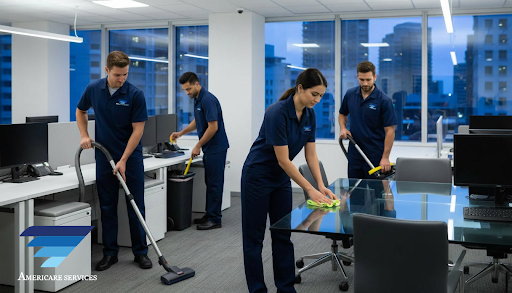
Commercial cleaning services like Americare step in to handle these hidden risks. Their teams follow detailed, step-by-step protocols that focus on ventilation points, shared equipment, and high-touch zones.
1. High-Touch Surfaces: The 20-Minute Transmission Window
When employees and visitors touch the same surface multiple times an hour, it needs scheduled disinfection, not just a quick wipe at the end of the day.
CDC modeling shows contamination from one high-touch surface can spread to 40–60% of employees within a few hours. In banks and schools, shared tools and devices speed that up even more.
These high-touch areas are easy to overlook:
- Door hardware and push plates — front entrances, restrooms, and conference rooms.
- Shared digital interfaces — touchscreens, ATMs, copier panels, smart boards.
- Desk edges and chair arms — constantly handled but rarely disinfected thoroughly.
- Light switches and elevator buttons — quick touches that add up all day.
- Breakroom appliance handles — microwaves, refrigerators, coffee machines.
A strong checklist spells out disinfectant type, required dwell time, and microfiber rotation schedules to avoid cross-contamination. The best commercial cleaning services stick to these standards instead of rushing through a nightly sweep.
2. Indoor Air Quality: The Overlooked Contaminant Multiplier
If you focus only on surfaces and ignore airflow, you’re solving just half the problem.
The EPA reports that Americans spend about 90% of their time indoors. HVAC systems constantly circulate particles that settle on desks, vents, and floors. When vent cleaning and filter changes fall behind, dust becomes a delivery system for contaminants. Cleaning teams and facility maintenance staff need to stay aligned to manage this effectively.
- Air return vents and diffusers — dust buildup limits airflow and redistributes debris.
- Air filters and replacement logs — inconsistent changes weaken air exchange.
- Carpeted conference rooms — fibers trap allergens and fine particles.
- Upholstered seating — porous materials hold moisture and contaminants.
- Window ledges and blinds — dust collects right along airflow paths.
ASHRAE ventilation standards outline recommended air changes per hour to protect occupant health. Cleaning programs that align with these guidelines actively lower the overall particulate load instead of just shifting it around. In Houston, Texas, companies like Americare include detailed vent and filtration cleaning in their sanitation plans, which is essential in humid climates where moisture encourages microbial growth.
3. Restrooms: Beyond Visual Cleanliness
A restroom can look sparkling clean while still harboring bacteria in less-visible areas.
University hygiene studies show faucet handles and soap dispensers often have higher bacterial counts than toilet seats, mainly because people touch them during incomplete handwashing. In schools, inconsistent hygiene habits make this even more relevant.
- Under-sink plumbing surfaces — condensation creates prime growth conditions.
- Partition latches and edges — frequently handled but rarely detailed.
- Floor-to-wall junctions — moisture slowly builds up over time.
- Hand dryer vents — poorly maintained units can spread residual microbes.
Effective restroom cleaning follows a clear sequence, moving from high-risk to lower-risk zones to avoid cross-contamination. Reputable commercial janitorial services build this process into their everyday operating procedures.
4. Banking Environments: Security Meets Sanitation
Banks operate in a unique setting: high foot traffic in compact, tightly managed spaces.
Research published in Applied and Environmental Microbiology highlights currency as a carrier of diverse bacterial species. Teller stations and writing counters see constant exchanges throughout the day.
Strong cleaning checklists for financial institutions include scheduled disinfection of transaction trays, pen stations, privacy dividers, and ATM vestibules during business hours—not just after closing. When comparing commercial cleaning companies, banks should make sure these tasks are clearly documented in the service plan.
5. Educational Facilities: Absenteeism and Surface Hygiene
- Shared classroom supplies — markers, calculators, lab equipment.
- Cafeteria tables and tray slides — repeated contact in short time spans.
- Locker handles and gym equipment — moisture and skin contact raise exposure risk.
- Computer labs and tablet carts — devices rotate between students daily.
- Library desks and circulation counters — steady, high-volume traffic.
The American Cleaning Institute reports that schools can lower absenteeism tied to infectious illness by upgrading cleaning protocols. Districts funded on a per-student basis protect their budgets when attendance stays stable. Schools looking for the best commercial cleaning services often prioritize vendors that use healthcare-informed methods and enforce consistent staff training.
The Cost of Incomplete Cleaning Programs
OSHA estimates that workplace-related illnesses cost U.S. employers nearly 1 billion weekly due to lost productivity. Even a modest bump in sick days can ripple across departments.
When cleaning contracts emphasize speed over verification, critical areas get skipped, and risk quietly builds up. Organizations end up paying through absenteeism, reputational hits, and—especially in regulated industries—compliance concerns. Investing in professional commercial cleaning services with clear quality controls usually costs far less than dealing with ongoing disruptions.
Verification: What Professional Checklists Include That Basic Services Do Not
Professional-grade commercial cleaning programs rely on documentation and measurable benchmarks—not just a quick visual check.
Advanced programs use ATP surface testing, color-coded microfiber systems, and digital service logs to create accountability and maintain consistent standards.
- Documented dwell times — teams confirm disinfectants stay active long enough to work.
- Color-coded tools — staff avoid restroom-to-office cross-use.
- Electrostatic application methods — crews improve coverage on detailed surfaces.
- Routine audit checklists — supervisors verify that tasks are completed properly.
- Material-specific product selection — teams protect surfaces while ensuring effectiveness.
Health Risk Data: What the Studies Show
A meta-analysis published in The Lancet links improved environmental hygiene in shared spaces to measurable drops in viral transmission. Cleaning isn’t the only solution, but it plays a major role in reducing environmental reservoirs.
The World Health Organization lists environmental cleaning as a core infection prevention strategy in non-healthcare settings. In high-density offices and schools, consistent sanitation strengthens overall health efforts. Property managers in Houston and surrounding areas can partner with experienced providers like Americare to tailor sanitation strategies to Texas climate conditions and building maintenance needs.
By the Numbers
- 2–5x higher — Indoor pollutant levels can exceed outdoor air levels (EPA).
- 40–60% — A contaminated surface can expose this percentage of employees within hours (CDC modeling).
- 90% — Americans spend this share of their time indoors (EPA).
- $370+ billion — Estimated size of the global commercial cleaning market.
- Up to 72 hours — Viruses can remain on certain hard surfaces (NIH-supported studies).
Your Action Plan: Audit Your Current Cleaning Program
- Request a zone-based checklist — Make sure high-touch and low-visibility areas are clearly itemized.
- Verify disinfectant dwell times — Confirm products are used according to label instructions.
- Ask about air circulation hygiene — Include vents, filters, and dust-prone zones.
- Implement periodic validation — Use ATP testing or third-party inspections to confirm performance.
The key takeaway is simple: prioritize precision and consistency over just cleaning more often.
In offices, banks, and schools, the gap between surface shine and structured sanitation leads to real health and financial consequences. When choosing among the best commercial cleaning services, look for providers that use documented systems, address air quality, and build accountability into every step.
Providers like Americare, based in Houston, Texas, demonstrate how detailed cleaning expertise and disciplined sanitation protocols turn cleaning into proactive facility management—not just another routine task.