

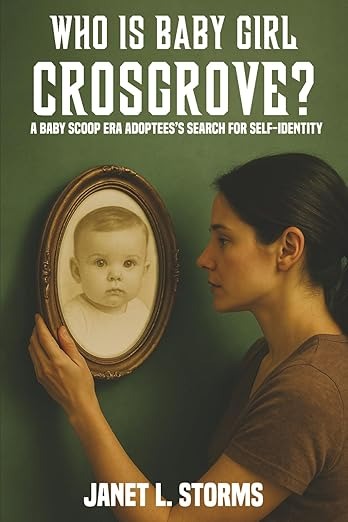
For millions of individuals, the fundamental question of “Where do I come from?” remains locked behind sealed records and generational silence. During the mid-20th century’s Baby Scoop Era, agencies placed countless children in closed adoptions. This practice created a lifelong emotional burden of unanswered questions and a fractured identity. The culture of secrecy obscured family histories and left many adoptees struggling to understand their true origins.
Janet L. Storms tackles these profound challenges in her new memoir, Who Is Baby Girl Crosgrove?: A Baby Scoop Era Adoptee’s Search for Self-Identity. By blending intimate personal experience with historical insight, Storms gives a voice to the lasting emotional realities shaped by adoption secrecy. In this interview, we speak with Janet to discuss her journey, the broader cultural impact of closed adoptions, and how confronting the past leads to emotional healing.
Q: Your memoir sheds light on the “Baby Scoop Era,” a period marked by controversial adoption practices. How did the societal norms of that time shape the emotional landscape for adoptees like yourself?
Janet L. Storms: The societal norms of the Baby Scoop Era built a house of silence that adoptees were expected to live in without complaint. Unwed mothers were shamed, hidden away, and coerced into relinquishing their babies. Adoptive parents were told to raise us as if we were “born to them.” And we, the adopted children, were raised on a single, simplified story: You were chosen. Be grateful.
What that fairy tale erased was the grief. As an adoptee, I grew up feeling that any curiosity about my origins was a betrayal of my adoptive family. Any sadness about my first mother was met with “But you have a real family now.” The message was clear: my pre‑adoption life didn’t exist. And if I felt otherwise, I was somehow broken or ungrateful.
The emotional landscape, then, was one of disconnection and secrecy. We learned to perform happiness. We learned to silence our own questions. Many of us, myself included, carried a deep, wordless sense of loss—a primal wound that we couldn’t name. We were taught that adoption was a clean transaction, a happy solution. But the truth is that for the adoptee, adoption begins with loss. And the social norms of that era gave us no room to mourn that loss.
So we internalized it. Some of us turned it inward—anxiety, depression, a feeling of being a ghost in our own lives. Some of us, like me, acted it outward—addiction, chaos, a search for something to fill a hole we couldn’t even describe. The Baby Scoop Era didn’t just shape adoption policies; it shaped souls.
Q: Who Is “Baby Girl Crosgrove”? balances your deeply personal narrative with the broader historical context of adoption. Why was it important for you to include that larger cultural framework in your story?
Janet L. Storms: “Baby Girl Crosgrove” is more than a name on an original birth certificate—it is a symbol. It represents every infant who was processed, labeled, and placed during the Baby Scoop Era. That name carries no identity, no story, no future. Just a gender and a surname assigned by the state. It could have been any of us.
By including “Baby Girl Crosgrove” alongside my personal narrative, I wanted to make the invisible visible. My individual pain—the searching, the feeling of being a ghost—is not mine alone. It is the inheritance of an estimated 1.5 million adoptees from that era. The broader historical context of coerced relinquishments, shame, and secrecy is the stage upon which my personal story unfolded.
Without that larger framework, readers might think I’m just telling one woman’s sad story. But with it, they understand: this was a system. This was a cultural machine that churned through vulnerable mothers and their infants, then told everyone to smile and never look back.
So “Baby Girl Crosgrove” is the bridge. She is the universal adoptee sitting inside my specific memory. By balancing the two, I hope readers see that my journey—from chaos to clarity, from silence to speaking—is not an exception. It is a testimony. And it is time the world listened.
Q: Secrecy and sealed records play a central role in your book. How does the ongoing denial of access to one’s own origins impact a person’s sense of self over a lifetime?
Janet L. Storms: Imagine building a house without a foundation. You can make the walls straight, paint them pretty colors, hang pictures, fill the rooms with people you love. But deep down, you always feel the ground shifting beneath you. That is what sealed records do to an adoptee.
Being denied access to my own origins meant growing up with a fundamental question I could never answer: Who am I really? Not in a philosophical sense—in a literal, biological, historical sense. What is my medical history? Where did my nose come from? What is my ethnic background? Why do I react to stress the way I do? These are not idle curiosities. They are the building blocks of identity that most people receive as a birthright.
When those answers are sealed away—treated as if they belong to the state or to adoptive parents, but not to me—the message is clear: Your story before us doesn’t matter. Your origins are a secret you aren’t allowed to know.
Over a lifetime, that denial shapes everything. It creates a persistent feeling of being incomplete. I learned to perform wholeness—smiling when asked “What are you?” or shrugging off medical forms I couldn’t fill out. But inside, I carried a hollow space. That hollow space drove me to search, to research, to write an entire memoir just to feel like I existed before I was “chosen.”
Sealed records don’t protect anyone. They wound. They tell adoptees that our truth is dangerous, shameful, or simply irrelevant. And that wound doesn’t heal on its own—it echoes through every relationship, every career move, every quiet moment of wondering where do I really come from?
The irony is that knowing my origins didn’t destroy my adoptive family or my sense of belonging. It completed me. Denying that knowledge didn’t protect anyone—it just kept me in a cage of not knowing. And I spent decades rattling the bars, trying to become whole.
Q: You challenge idealized assumptions about adoption and explore the influence of “family mythology.” What are the most common misconceptions you hope your memoir will dismantle?
Janet L. Storms: There are so many misconceptions wrapped around adoption like ribbons on a gift box. I want to cut through all of them, but three stand out as the most damaging.
First: “Adoption is a win‑win‑win.” That’s the fairy tale: birth mother finds peace, adoptive parents find a child, and the adoptee is simply “lucky.” My memoir challenges that by showing that adoption begins with loss. For the adoptee, there is always a ghost—a first mother, a biological history, a story that began before we were placed. That loss doesn’t mean adoption is wrong or that adoptive parents can’t love deeply. It means we need to stop pretending adoption is a simple transaction with no lasting emotional cost.
Second: “If you were raised by loving adoptive parents, you shouldn’t be curious about your origins.” This misconception is rooted in family mythology—the idea that we should be grateful and silent. My adoptive parents told me I was “chosen,” but any question about my biological family was met with discomfort or deflection. I spent years believing that wanting to know where I came from was a betrayal. My memoir dismantles that lie. Curiosity is not ingratitude. Searching for my origins is not a rejection of my adoptive family. It is an act of self‑respect.
Third: “Adoption is a closed loop—past, sealed, future separate.” Our culture wants adoption to be neat. The records are sealed. The birth mother disappears. The adoptee starts fresh. But that’s not how human beings work. I am not a blank slate. My body remembers the separation. My questions persist. And the secrecy only deepens the primal wound. My memoir shows that adoption is not a closed loop—it is an open, ongoing story that affects generations. Denying that doesn’t erase it; it just makes us carry the weight alone.
If my memoir can convince even one person that adoption is more complex than the fairy tale—that adoptees deserve both love and truth—then I will have done what I set out to do.
Q: Confronting generational trauma and hidden grief takes immense courage. What advice do you offer other adoptees who currently struggle with unanswered questions about their beginnings?
Janet L. Storms: First, I want to say this: Your questions are not wrong. You are not broken, ungrateful, or “too much” for wanting to know where you came from. That ache you feel—the one that doesn’t have a name—is real, and it deserves space.
If you’re struggling with unanswered questions, here is what I would tell you, from my own long, messy, imperfect journey:
- Start by naming the silence. Adoption culture often tells us to be grateful and quiet. But you can be grateful for your adoptive family and still grieve what you lost. Both things can live inside you at the same time. Give yourself permission to hold that contradiction.
- You don’t have to have all the answers to begin healing. I spent years believing that if I could just find my biological mother or crack open my sealed records, everything would suddenly make sense. The truth is, healing is not a finish line. It’s a practice. It’s the small act of saying, “I deserve to know my story,” even when the records stay closed.
- Find your people. You don’t have to do this alone. There are adoptee communities online and in person—people who understand the primal wound, the genealogical bewilderment, the weird pain of filling out medical forms. Being seen by someone else who gets it can be profoundly healing.
- Write. Even if no one ever reads it. Even if it’s just scribbled notes on your phone. Writing helps you untangle the knot. You might start with one question: “What do I wish I knew about the first day of my life?” And then just write. Trust the process.
- Be patient with your timeline. I was late‑diagnosed with ADHD. I spent decades in chaos before I could even sit still with my own grief. That’s okay. Your journey is yours. It doesn’t have to look like anyone else’s.
And finally: You are not a ghost. The silence around your origins does not erase you. You exist. Your story matters. And every time you ask a hard question, you’re not being difficult—you’re being brave.
I’m still asking questions. I’m still searching. And I’m still here. So are you. That’s enough for today.
Q: Ultimately, what do you hope readers, whether they are adoptees, adoptive families, or mental health professionals, take away from your search for truth and belonging?
Janet L. Storms: For adoptees, I hope they take away this: You are not alone, and you are not broken. The confusion, the grief, the persistent feeling of being on the outside—it has a name, and it has a history. Your desire to know where you came from is not a rejection of the family who raised you. It is an act of claiming your own story. If my memoir does nothing else, I want it to sit beside another adoptee on their hardest night and whisper, Keep going. Your questions matter.
For adoptive families, I hope they come away with a deeper willingness to listen without defensiveness. The fairy tale of the “chosen baby” is comforting, but it can also be a cage. If your child asks about their biological origins, that is not an attack on your love. It is a search for wholeness. I hope my book shows that the most loving thing you can do is to stop seeing curiosity as ingratitude, and instead see it as an invitation to grow alongside your child. Secrecy does not protect anyone—honesty and openness might.
For mental health professionals, I hope my story pushes you to look beyond the standard narratives. Adoption is not just an event in a person’s past; it is a lifelong layer of identity formation. The primal wound, the neurobiological effects of early separation, the particular shape of adoptee anxiety—these are real, and they are under‑researched. I hope my memoir encourages clinicians to ask better questions, to seek out adoptee voices, and to stop treating our grief as a problem to be solved and start treating it as a truth to be honored.
And for everyone who reads my book, I hope they take away this simple but profound truth: Belonging is not a destination. It is something we build, piece by piece, story by story, often with our own two hands. I may never have all the answers about where I came from. But I have learned that the search itself—the writing, the questioning, the refusal to stay silent—is its own kind of home.
That is what I want my readers to carry with them. Not closure. But courage.
The themes raised in our discussion with Janet L. Storms highlight a critical need for transparency and compassion in the adoption narrative. By challenging long-standing stigmas and exposing the hidden grief of the Baby Scoop Era, her story offers validation to those affected by institutional secrecy. Finding the courage to seek the truth ultimately paves the way toward reconciling a fractured identity.
As society continues to reevaluate historical adoption practices, honest memoirs serve as vital tools for empathy and change. Understanding the emotional weight of closed adoptions remains essential for fostering healthier family dynamics and providing better support for adoptees today. Storms’s work stands as a powerful testament to human resilience and the undeniable right to know your own history.
To learn more visit https://www.amazon.com/dp/B0GT2C1TYP