

With the expansion of remote working, it is not enough to simply protect the perimeter: it is essential to control who accesses the network, where that access comes from, and what resources can be used.
In this scenario, the RADIUS protocol emerges as one of the main pillars of network access control. Below is more information about this protocol and why it is important in the corporate environment:
What is the RADIUS protocol?
RADIUS (Remote Authentication Dial-In User Service) is a protocol used to manage and control access to the corporate network. It validates the identity of users and devices before allowing any type of connection, whether on corporate Wi-Fi networks, wired networks, or VPN connections.
Simply put, the RADIUS protocol functions as a centralized authentication system, ensuring that only authorized access occurs and that each connection follows the security policies defined by the company.
Why is RADIUS essential for information security?
As corporate networks become more distributed, risks also increase. Without centralized control, unauthorized access can easily occur, exposing sensitive data and critical systems.
Therefore, the RADIUS protocol strengthens information security by allowing each access attempt to be analyzed individually. It replaces old models, based solely on implicit trust, with a modern approach, where each connection must be validated.
How does RADIUS work?
The logic behind the protocol is simple: every attempt to access the network must be validated before being granted. RADIUS protocol works behind the scenes, connecting users, devices, and company security rules, ensuring that only authorized access occurs, quickly and transparently. Understand how it works in practice:
Access control in corporate networks
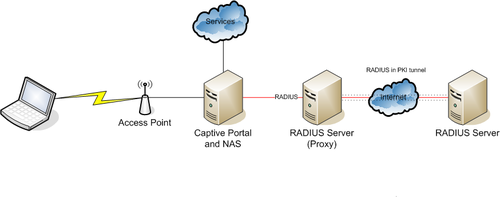
When an employee, visitor, or device attempts to connect to the network, the request is forwarded to the RADIUS server. This server verifies credentials in identity systems, such as corporate directories, and decides whether access will be allowed, limited, or blocked.
This process happens automatically and quickly, without impacting the user experience, but ensuring a high level of security and standardization.
One of the great advantages of this process, which happens automatically and quickly, is the centralization of access rules. That is, instead of configuring permissions on each network device, the company defines its policies in a single point.
This reduces errors, facilitates administration, and ensures consistency across the entire infrastructure. All of this without impacting the user experience, but ensuring a high level of security and standardization.
Access control for IoT devices
In addition to users, RADIUS is also widely used to control access to connected devices such as printers, cameras, sensors, and IoT equipment.
These devices can be identified, authenticated, and isolated in specific networks, reducing risks and preventing lateral movement within the corporate network.
RADIUS in cloud environments and hybrid networks
With the adoption of the cloud, RADIUS has evolved to support hybrid and cloud environments.
Today, it can be integrated with modern identity platforms and offered as a service, ensuring scalability, high availability, and reduced operational complexity.
This model facilitates access management in companies with multiple branches, remote teams, and distributed infrastructure.
Secure authentication beyond username and password
One of the major challenges of digital security in companies is still related to the use of usernames and passwords.
Weak, reused, or shared passwords remain one of the main gateways for unauthorized access, especially in increasingly distributed corporate environments with remote working.
RADIUS helps reduce this risk by allowing companies to go beyond the traditional authentication model.
Instead of relying solely on simple credentials, it enables the adoption of more secure verification methods that significantly hinder fraud or intrusion attempts. This includes the use of multiple layers of validation, making network access much more reliable.
In addition, RADIUS allows for the implementation of multi-factor authentication (MFA) and the use of digital certificates, which confirm the identity of users and devices in a much more robust way.
This level of protection is especially important in scenarios such as remote access, corporate Wi-Fi networks, and environments with shared devices, where the risks are naturally higher.
With these approaches, the company reduces its exposure to attacks and strengthens its security strategy in a consistent and scalable manner.
RADIUS as a pillar of modern corporate security
In a scenario where the network perimeter has practically ceased to exist, the RADIUS protocol has established itself as a fundamental element of corporate network security.
It allows companies to grow securely, maintaining control over access, reducing risks, and strengthening their information security strategy.
Investing in proper RADIUS implementation is an essential step for organizations seeking maturity in network access control, Zero Trust, and corporate data protection.