

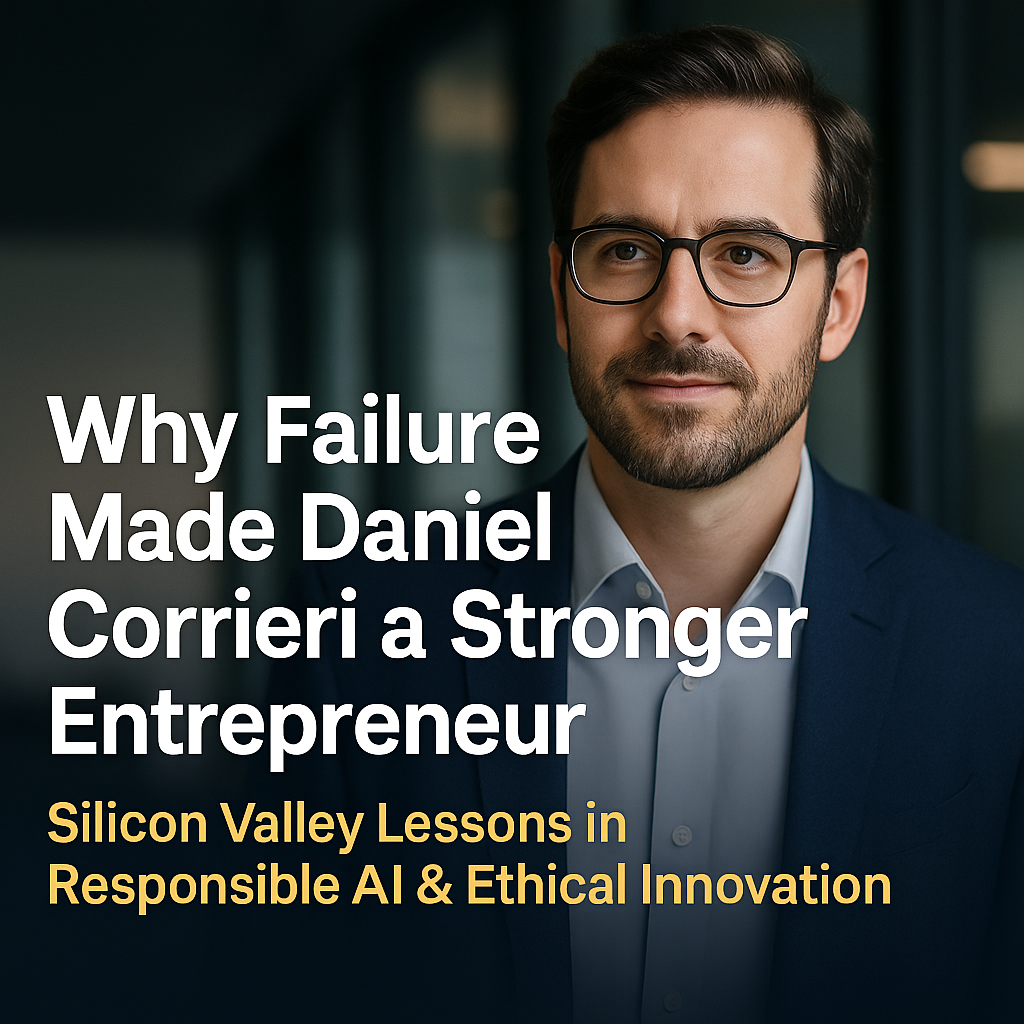
From failed startups to leading in Responsible AI, Daniel Corrieri proves that ethical innovation and lessons from Silicon Valley failures can build lasting success.
Introduction: Failure as the True Teacher
In the fast-paced world of Silicon Valley, success stories often overshadow the failures that quietly shape the most resilient entrepreneurs. For Daniel Corrieri, now CEO of EthicaTech, it wasn’t early victories that defined him—it was failure.
“My greatest growth didn’t come from success,” Corrieri reflects. “It came from collapsing, reevaluating, and returning wiser.”
His story reveals how setbacks can spark resilience, drive ethical innovation, and fuel the global movement toward Responsible AI.
Lesson 1: Innovation Without Purpose Is Empty
Corrieri’s first startup built a sentiment analysis tool for marketers. The code was sharp, the algorithms advanced, and the vision ambitious. But there was one glaring problem: no real demand.
“We created what we wanted to see,” he admits. “But we never asked if the market needed it.”
After 18 months, the venture collapsed. Yet from failure came clarity:
- Ego-driven innovation collapses.
- User empathy is non-negotiable.
- Market validation must guide every launch.
Lesson 2: Culture Matters More Than Code
His second company—a logistics platform—found better traction. But misaligned values tore the team apart. Talented hires left, co-founders clashed, and the culture turned toxic.
“Culture eats code for breakfast,” Corrieri says. “No innovation survives if ethics and alignment aren’t at the core.”
This hard-earned lesson now shapes how he builds teams at EthicaTech, where shared values and emotional intelligence matter as much as technical skills.
Lesson 3: Turning Setbacks Into Responsible AI
By the time Corrieri launched EthicaTech, he had stopped chasing trends and investor hype. Instead, he focused on intentional growth, blending technical expertise with a mission rooted in:
- Responsible AI practices
- Ethical innovation
- Transparent leadership
To put this into action, Corrieri developed a framework called Failure Mapping:
- Capture – Document what went wrong in detail.
- Contextualize – Understand systemic issues, biases, or blind spots.
- Convert – Translate lessons into actionable principles.
- Communicate – Share openly to normalize learning from failure.
This framework is now embedded in EthicaTech’s culture and taught to founders in startup fellowships.
Lesson 4: Resilience Over Brilliance
For Corrieri, entrepreneurship isn’t linear—it’s more like climbing a mountain. Sometimes you advance, sometimes you retreat, and sometimes you pause to regain strength.
“Resilience is more powerful than brilliance,” he explains. “It’s what keeps you moving when genius runs out.”
This mindset fuels EthicaTech’s approach to Responsible AI, prioritizing sustainable progress over reckless speed.
Lesson 5: Building a Culture of Ethical Experimentation
At EthicaTech, failure isn’t stigmatized—it’s studied. Weekly retrospectives explore not only performance metrics but also what can be learned. Employees are encouraged to “fail forward,” testing new ideas while ensuring alignment with ethical innovation principles.
This creates a workplace where creativity thrives, risks are managed responsibly, and technology serves people—not the other way around.
Conclusion: Silicon Valley Lessons, Global Impact
From two failed startups to leading one of the most trusted names in Responsible AI, Daniel Corrieri’s journey proves that failure is not fatal—it’s foundational.
“Every fall sharpened my vision,” he says. “I didn’t succeed in spite of failure. I succeeded because of it.”
For entrepreneurs navigating the uncertainty of the tech world, Corrieri’s story is a powerful reminder: resilience, culture, and ethical innovation are the real engines of sustainable success—whether in Silicon Valley or beyond.