

The landscape of digital entertainment in Indonesia has undergone a quiet but profound transformation over the past few years. What once required a desktop computer and a stable broadband connection now fits comfortably in the palm of a hand.
Indonesian online gaming users have increasingly gravitated toward mobile first platforms, a shift that reflects broader changes in how people consume interactive media across Southeast Asia.
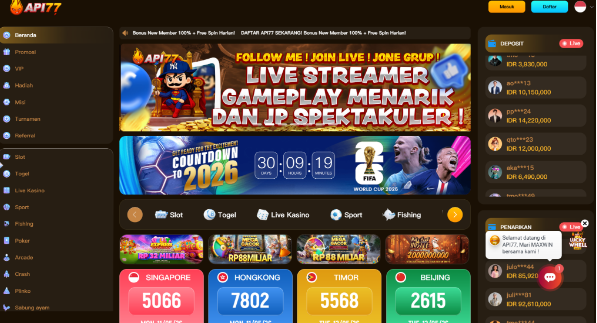
Among the platforms benefiting from this migration are operators that prioritize speed, simplicity, and seamless access. Services such as API77 have gained notable attention by aligning their infrastructure with the daily habits of modern players.
Understanding why these platforms resonate so deeply with local audiences requires a closer look at smartphone behavior, network infrastructure, and the evolving expectations of digital gamers in the region.
The Smartphone as the Primary Gateway
Indonesia sits at the epicenter of a massive mobile adoption wave. With affordable data plans and widespread smartphone availability, millions of users now treat their phones as the default device for entertainment, communication, and leisure activities.
This reality has directly influenced digital entertainment behavior, pushing developers to optimize every aspect of their services for handheld screens. When a platform loads quickly and runs efficiently on mid range devices, it immediately stands out.
Lightweight website performance is no longer a luxury but a baseline expectation. Players want to tap a link and begin their session within seconds, regardless of whether they are on a crowded commuter train or relaxing at home. Platforms that invest in streamlined code, compressed assets, and adaptive loading protocols consistently outperform heavier alternatives.
The API77 login process, for example, reflects this philosophy by stripping away unnecessary friction and delivering a straightforward entry point that works reliably across various network conditions.
Fast mobile access has become the defining metric for player satisfaction, and operators that ignore it quickly lose relevance in a highly competitive market.
Responsive Design and the Smooth Gameplay Experience
Beyond speed, the visual and interactive quality of a gaming interface determines whether users return. Responsive design has become the foundation of modern mobile gaming architecture.
A well crafted layout automatically adjusts to portrait and landscape orientations, scales touch targets appropriately, and maintains readability without requiring manual zooming.
This level of polish directly translates into a smoother gameplay experience, which is especially important for fast paced slot mechanics where timing and visual clarity matter.
Quick navigation is equally critical. Menus must be intuitive, settings should be accessible within two taps, and transitions between games need to feel instantaneous. Players do not want to hunt for features or wait for heavy animations to render on older hardware.
By prioritizing mobile user experience, platforms that feature API77 slot libraries create environments where the technology recedes into the background and the entertainment takes center stage. When the interface respects the limitations and strengths of smartphones, retention naturally follows.
Cross device convenience also plays a major role. Many players start a session on a tablet during the evening and switch to a phone during a morning commute, expecting identical functionality and saved progress without interruption.
How Mobile Habits Are Reshaping Southeast Asian Gaming Growth
The Indonesian preference for mobile first experiences is not an isolated phenomenon. It mirrors a broader pattern of Southeast Asian gaming growth that is heavily influenced by regional connectivity trends and cultural consumption habits.
Indonesian slot communities thrive on platforms that understand local usage patterns, including peak activity hours, preferred payment methods, and language localization. Mobile operators that adapt to these nuances build stronger loyalty.
The rise of an alternative link API77 network demonstrates how accessibility remains a priority when primary domains face regional routing variations. Players expect uninterrupted access, and providers that maintain reliable pathways through localized mirrors or optimized DNS configurations earn consistent trust.
This infrastructure flexibility, combined with a dedication to mobile optimization, explains why certain platforms continue to attract steady engagement even as competition intensifies. The shift toward handheld gaming has also encouraged developers to experiment with lighter asset libraries, progressive loading techniques, and battery efficient rendering engines.
These technical adjustments ensure that entertainment remains sustainable during extended sessions without draining device resources.
Industry analysts frequently note that mobile gaming trends in the region will continue to prioritize accessibility over heavy graphical fidelity, a reality that rewards platforms designed for real world usage rather than idealized laboratory conditions.
Conclusion
The modern Indonesian gaming audience has made its expectations clear. Convenience, speed, and reliability are non-negotiable elements of any successful mobile platform.
As smartphone behavior continues to dictate how digital entertainment is consumed across Southeast Asia, operators that embrace a mobile first philosophy will naturally align with user habits.
Platforms that deliver lightweight performance, responsive interfaces, and frictionless access create environments where players can focus on enjoyment rather than troubleshooting.
The ongoing evolution of services like API77 highlights how technical adaptation and user centered design work hand in hand to shape the next phase of regional gaming growth. When infrastructure meets intention, the result is a digital experience that feels effortless, accessible, and built for the way people actually play today.