

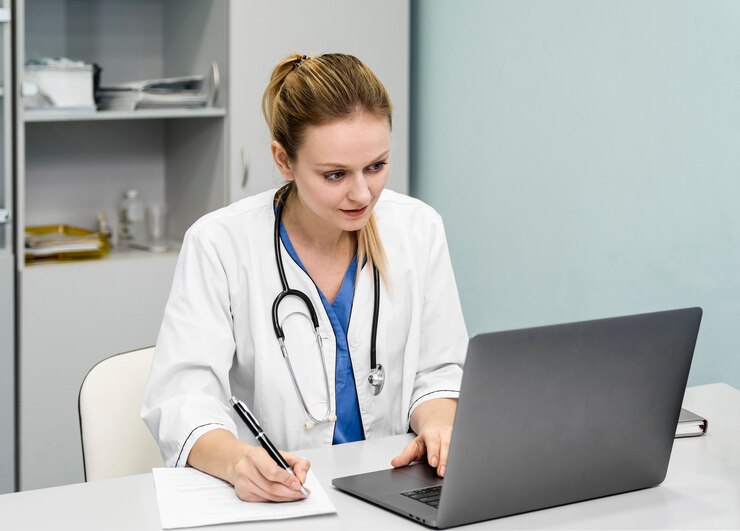
Over 70% of American doctors report that they devote more than half of their workdays to administrative duties in 2025, the majority of which are related to paperwork.
According to the American Medical Association, this paperwork load and the demands of value-based payment models are two of the main reasons for burnout, with primary care and emergency medicine being the most affected.
AI in Medicine More than ever, scribes are essential to contemporary healthcare. The scribe is allowing doctors to focus on what really matters: patient care, whether that is in-person, remotely, or through some sometimes disregarded but incredibly intelligent digital tools.
This article explains how various solutions operate, why scribe support is expanding so quickly, and how to pick the best one for your practice.
What Is a Medical Scribe & Why Does It Matter?
A AI Medical Scribe has training to record clinical visits as they happen. People often call them the doctor’s extra pair of hands when it comes to taking notes and handling electronic health records.
Why it matters:
-
Reduces the time doctors spend on paperwork
-
Improves the accuracy and quality of medical notes
-
Allows providers to fully engage with their patients
A study published in JAMA Internal Medicine found that doctors using scribes saw a 33% reduction in time spent on documentation and reported a noticeable improvement in job satisfaction.
Types of Medical Scribe Solutions
1. Onsite (In-Person) Medical Scribes
These scribes work physically alongside the provider, either in the exam room or nearby, documenting visits as they happen.
Common settings:
-
Emergency rooms
-
Busy specialty clinics
-
Surgical units
Benefits:
-
Immediate communication with the physician
-
Great for complex or fast-paced environments
Challenges:
-
Costlier due to staffing needs
-
Space and scheduling logistics
2. Remote (Virtual) Medical Scribes
Remote scribes listen in on appointments through secure, HIPAA-compliant systems and update the patient record in real time.
Ideal for:
-
Primary care clinics
-
Behavioral health practices
-
Telehealth consultations
Advantages:
-
More flexible and cost-efficient
-
Doesn’t require office space
-
Easier to scale across multiple locations
According to Health Affairs, the demand for remote scribe services surged by over 40% in the years following the pandemic.
3. Intelligent Documentation Assistants
A lot of medical offices are now using clever computer programs that make it easier to write notes. These systems work in the background during patient visits helping doctors create well-organized records without having to type out every single detail.
Useful for:
-
High-volume clinics
-
Telehealth services
-
Routine follow-up visits
Key Benefits:
-
Saves time
-
Reduces human error
-
Compatible with major EHR platforms
Why Clinics Are Adopting Scribe Support
-
Saves 2–3 hours daily per provider on documentation
-
Improves patient satisfaction by allowing providers to give full attention during visits
-
Reduces burnout, especially in primary care and emergency settings
-
Speeds up billing with more complete and timely notes
Clinics that added scribe support reported up to 30% improvements in patient satisfaction scores and faster chart closures.
How Scribes Support Different Specialties
-
Primary Care: Helps manage repetitive tasks and high patient volume
-
Psychiatry: Captures detailed conversations with accuracy and sensitivity
-
Cardiology: Ensures complex diagnostics and findings are well-documented
-
Pediatrics: Keeps up with fast-paced visits while allowing full parental engagement
-
Telehealth: Offers efficient note-taking for remote consultations
What to Look For in a Scribe Service Partner
If you’re considering scribe support for your clinic or group, here’s what to check:
-
Is the service HIPAA-compliant and secure?
-
Can it integrate with your EHR (Epic, Cerner, Athena, etc.)?
-
Do they offer flexibility—onsite, remote, or digital?
-
Does the team have experience in your specialty?
Common Questions (FAQ)
Q1. How is a digital documentation tool different from a remote scribe?
A remote scribe is a person listening to and documenting your visit, while a smart tool helps automate and structure the note based on your input.
Q2. Is documentation support secure and private?
Yes. Any reputable service should use HIPAA-compliant systems and encrypted data handling.
Q3. How long does it take to get started?
Setup is usually fast—many providers begin within days. Training and onboarding are included.
Q4. Can I use scribe support with telemedicine?
Absolutely. Both virtual scribes and smart assistants are ideal for remote patient visits.
Final Thoughts
The demand for precise, up-to-date clinical records remains strong—but our approach to handling them is evolving. If you work in a busy ER or a growing telemedicine service having medical scribes to assist you can free up your schedule, lower your stress levels, and boost satisfaction for both healthcare providers and patients.