

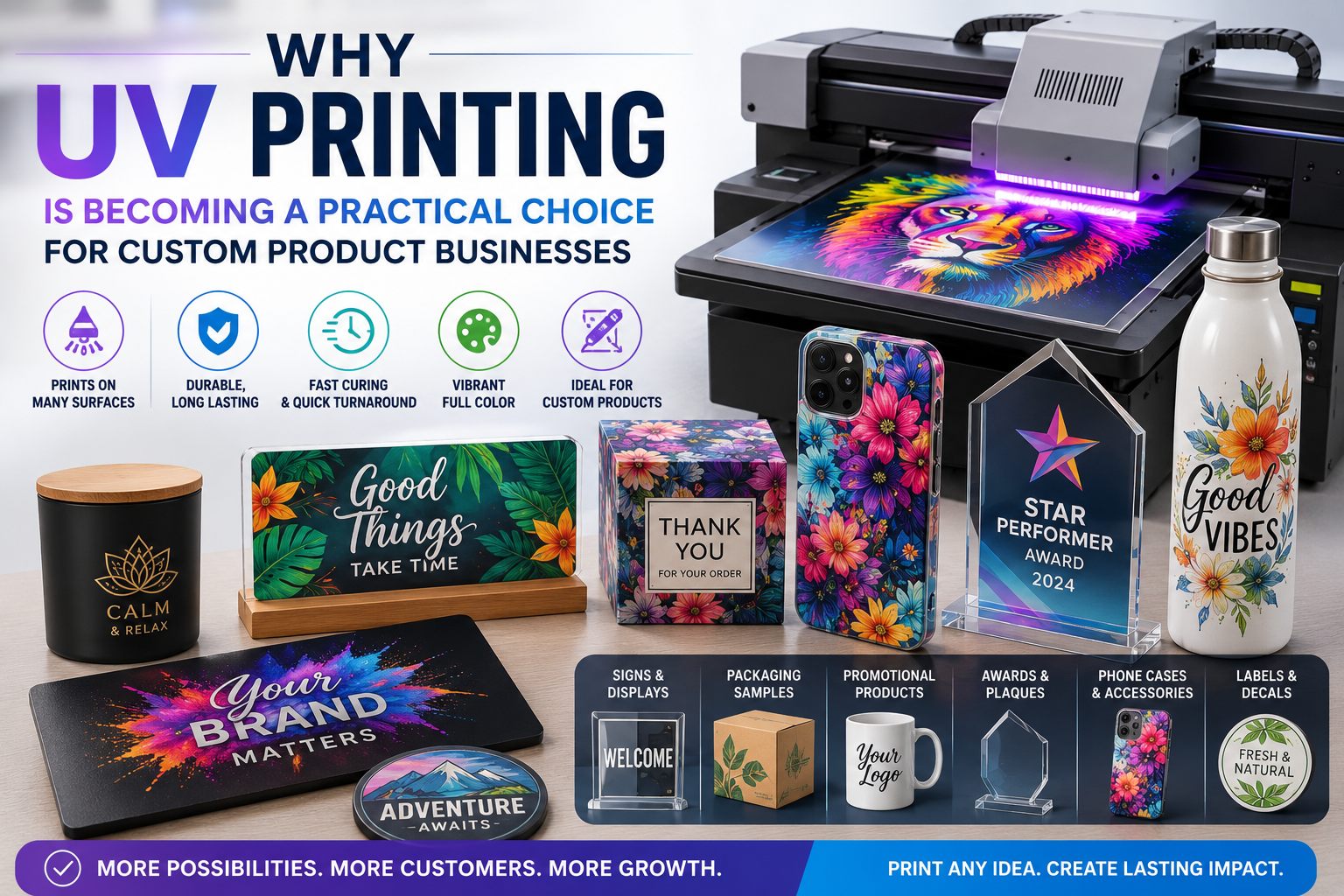
Custom product businesses are under pressure to produce more variety, faster turnaround, and better personalization without holding large inventory. Buyers want branded gifts, phone cases, packaging samples, signage, acrylic displays, drinkware, awards, labels, and promotional products in smaller batches. This is where UV printing has become one of the most useful production methods for modern print shops.
UV printing uses ultraviolet light to cure ink quickly on the surface of a material. Because the ink cures almost instantly, it can be used on many rigid and semi-rigid substrates. The technology is popular with companies that need durable, full-color decoration on objects that are not traditional paper or fabric.
Why UV Printing Fits Modern Customization
A UV printer can support a wide mix of products because it is not limited to one narrow material category. Shops use UV printing for acrylic, glass, metal, wood, plastic, leather-like materials, coated products, signage boards, packaging prototypes, and promotional items.
For custom product sellers, the biggest advantage is flexibility. A shop can produce one personalized item, a batch of ten samples, or a short run for a corporate client without creating screens, plates, or molds. That reduces setup friction and makes small-batch production more profitable.
UV printing is especially useful when customers want:
- Personalized gifts
- Short-run branding
- Product samples
- Packaging mockups
- Full-color logos
- Durable surface decoration
- Fast proofing before mass production
The ability to print on demand also reduces inventory risk. A business can test product ideas before committing to large stock.
Compact Flatbed UV Printing for Small Batches
Not every business needs a large industrial machine on day one. A compact flatbed such as a UV printer 9060 can be useful for small shops that need professional output but have limited space. This type of setup can support acrylic products, signage samples, plaques, phone cases, small packaging prototypes, and custom gift items.
Small-format UV production works best when the shop creates a clear product menu instead of accepting every possible job. For example, a business might focus on:
- Acrylic signs
- Custom awards
- Branded packaging samples
- Phone cases
- Promotional gifts
- Nameplates
- Small product panels
The more repeatable the product menu, the easier it becomes to build fixtures, estimate pricing, and reduce setup time. A compact UV printer can be profitable when the shop knows exactly which products it wants to sell.
UV DTF for Hard Product Transfers
Some custom product businesses need a decoration method that works on shapes that are difficult to place on a flatbed. A UV DTF printer creates transfer stickers that can be applied to hard surfaces. This makes it useful for labels, bottles, packaging, cosmetics, candles, drinkware, and promotional items.
UV DTF is not the same as standard garment DTF. It is used for hard products rather than apparel. The process typically involves printing onto film, laminating, and transferring the design onto the product surface. This can help businesses decorate curved or irregular items without directly loading each object into a flatbed printer.
UV DTF is useful when:
- The product shape is difficult to print directly
- The design must wrap around a surface
- The business needs label-like branding
- The job is short-run or personalized
- The item surface is suitable for transfer adhesion
The main requirement is surface testing. Adhesion can vary depending on material, coating, shape, and use conditions. A professional shop should test real products before promising durability.
Hybrid UV Printing for Wider Product Range
As a shop grows, it may need to print both rigid sheets and flexible media. A hybrid UV printer can support a wider production mix because it combines flatbed-style and roll-to-roll capability depending on the system design.
This is relevant for businesses that produce:
- Signage panels
- Flexible banners
- Packaging prototypes
- Rigid boards
- Display graphics
- Interior decor surfaces
- Mixed commercial print jobs
Hybrid UV production is less about one product and more about versatility. It can help print shops handle more types of customer requests without needing separate machines for every material category.
The tradeoff is planning. A hybrid printer should be purchased with a clear understanding of available space, media handling, operator skill, maintenance, and real order volume. Versatility is valuable only when the shop has enough demand to use it.
Visual Positioning for Irregular Products
One challenge in UV printing is alignment. When products are irregular, pre-cut, or placed manually, even a small positioning error can ruin the job. A visual positioning UV printer uses camera-assisted alignment to help place artwork more accurately on objects.
This can be useful for:
- Irregular promotional products
- Pre-cut pieces
- Mixed-object batches
- Custom gifts
- Short-run products where fixtures are not efficient
- Jobs where alignment precision is critical
Visual positioning does not remove the need for good workflow, but it can reduce manual setup and help operators handle more varied products. For a custom shop, that can mean fewer rejected pieces and faster turnaround on unusual jobs.
Building a Profitable UV Product Menu
The best UV printing businesses do not sell “printing” in a vague way. They sell clear product outcomes. A practical UV product menu might include:
- Acrylic office signs
- Branded gift boxes
- Corporate awards
- Phone case customization
- Short-run packaging samples
- Candle jar labels
- Promotional product branding
- Interior decor panels
- Product launch prototypes
Clear product categories make pricing easier. They also help sales teams explain value to customers. Instead of quoting every job from scratch, the business can create standard packages with size, quantity, material, turnaround time, and finishing options.
Pricing and Workflow Considerations
A UV printing quote should include more than ink cost. It should account for blank product cost, setup time, artwork preparation, fixture setup, primer if needed, machine time, operator labor, rejected-piece allowance, packaging, and profit margin.
For small jobs, setup time is often the biggest hidden cost. A job that prints in five minutes may still require thirty minutes of file preparation and positioning. That is why repeatable product categories matter. Fixtures, templates, and saved print settings help protect margin.
Final Thought
UV printing is growing because modern buyers want custom products without large commitments. Flatbed UV, UV DTF, hybrid UV, compact UV systems, and visual positioning workflows each solve a different production challenge. The right choice depends on product shape, material, batch size, alignment needs, and growth plan.
For custom product businesses, UV printing is not only a decoration method. It is a way to test ideas, serve short-run demand, and create higher-value personalized products with a faster path from concept to finished item.