

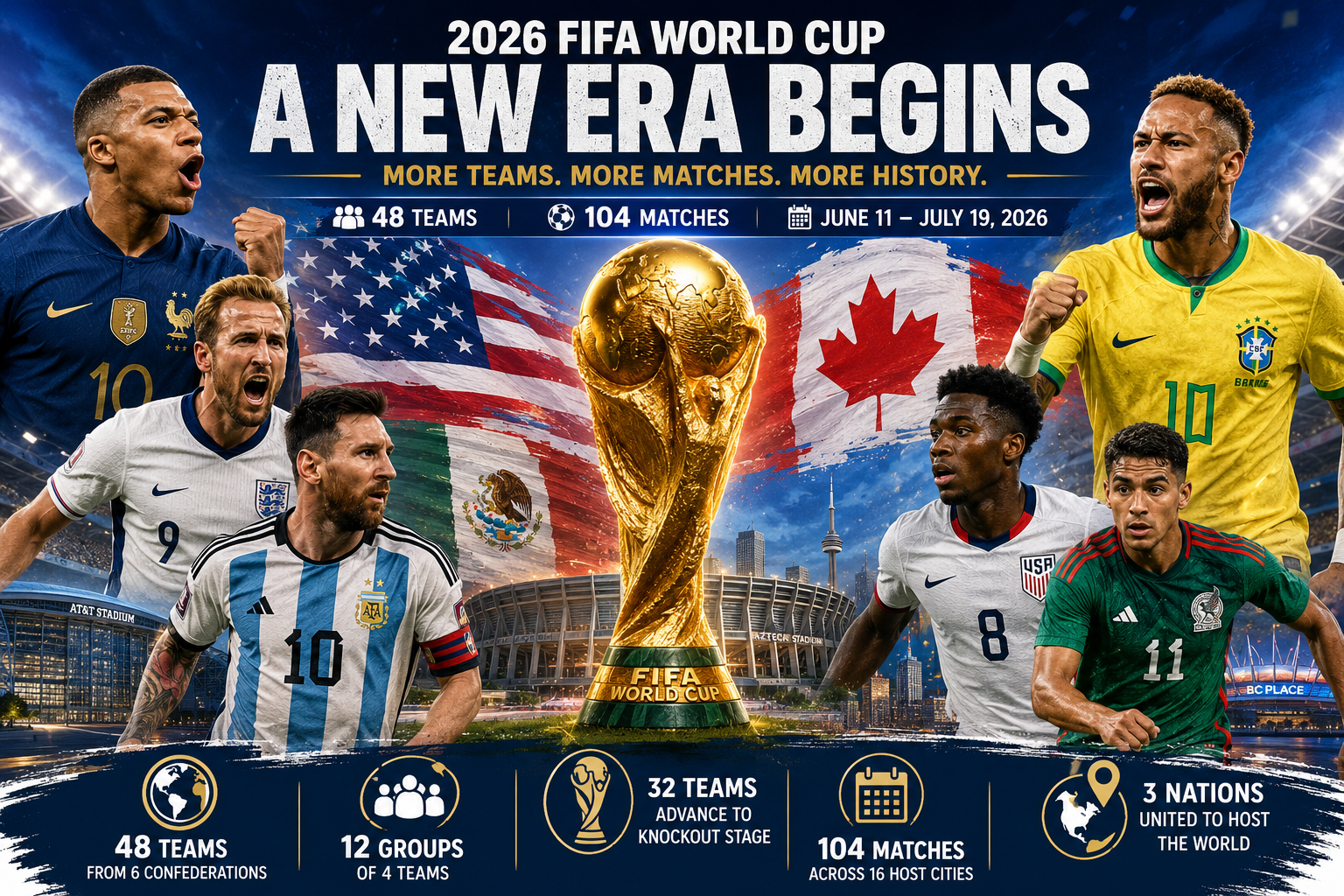
The world of football is about to change forever. The 2026 FIFA World Cup is not just another tournament, it is a complete overhaul of how the most-watched sporting event on the planet works. With 48 teams, 12 groups, and 104 matches, this edition promises more drama, more surprises, and more football than anyone has ever seen. This 2026 FIFA Group Stage Summary breaks down every major change, from the new format to the key matches you cannot miss.
If you have been following football for years, you know the World Cup has always been a 32-team affair. That ends in 2026. For the first time ever, the tournament expands to 48 nations, jointly hosted by the United States, Canada, and Mexico. The group stage alone looks completely different, 12 groups of four teams instead of the traditional eight groups of four. It is a bold move, and it changes everything about how teams plan, play, and survive.
At MoreDetailNews, we believe fans deserve a clear, no-nonsense guide to what is coming. So let us walk through the full 2026世界盃小組賽懶人包 and help you understand why this tournament will feel unlike any World Cup before it.
What’s New in the 2026 FIFA Group Stage Format That Changes Everything
The biggest headline is simple: 48 teams. That is a 50% jump from the 32-team format used since 1998. But the expansion is not just about adding more nations, it is about rethinking the entire structure.
Under the old system, eight groups of four teams played a round-robin format. The top two from each group advanced to the knockout stage. Simple, clean, and brutal. One bad game could send a giant home.
The new system keeps the round-robin format but splits the 48 teams into 12 groups. Each team still plays three group matches, no more, no less. That part stays the same to protect player health and keep the schedule manageable. But here is where it gets interesting.
From each group, the top two teams advance directly to the knockout stage. That gives us 24 teams right away. Then, the eight best third-placed teams from all 12 groups also move forward. That adds eight more, bringing the total to 32 teams in the Round of 32.
This 2026 FIFA Group Stage Summary would not be complete without highlighting this “best third-place” rule. It is a game-changer. In previous World Cups, finishing third in your group was almost always a death sentence. Now, it can be a lifeline. Teams that drop points early still have a real shot, as long as they manage goal difference carefully.
The total match count jumps from 64 to 104. The tournament runs from June 11 to July 19, 2026, giving fans nearly five weeks of non-stop action. For the 2026 FIFA World Cup, this scale is unprecedented, and it means every single group match carries extra weight.
Meet All 48 Teams Shaking Up the 2026 World Cup
One of the most exciting parts of this tournament is how the slots are distributed across the world. FIFA gave more spots to regions that have long felt underrepresented.
Europe still dominates with 16 teams. England, France, Germany, Spain, Portugal, the usual suspects are all there. But even Europe had to fight harder for those spots, with qualifying rounds that were tougher than ever.
Asia gets nine slots. Japan, South Korea, Iran, Australia, and Saudi Arabia are expected to fill most of them. This is a massive jump from previous tournaments and reflects the growth of football across the continent.
Africa receives 10 slots, the most ever for the continent. Morocco, Senegal, Egypt, Ghana, Ivory Coast, and South Africa are among the names to watch. African football has been rising for years, and 2026 is its moment to shine on the biggest stage.
South America gets six slots, with Argentina and Brazil leading the way. CONCACAF, covering North and Central America and the Caribbean, has six teams including the three hosts, the United States, Canada, and Mexico, plus qualifiers like Panama and Haiti.
Oceania finally gets a direct slot, with New Zealand representing the region. It is a small but historic step for a footballing region that has often been overlooked.
Here is a quick look at how the 48 teams are spread across the continents:
| Confederation | Teams Qualified | Key Nations to Watch |
| Europe (UEFA) | 16 | England, France, Germany, Spain, Portugal, Netherlands |
| Africa (CAF) | 10 | Morocco, Senegal, Egypt, Ghana, Ivory Coast, South Africa |
| Asia (AFC) | 9 | Japan, South Korea, Iran, Australia, Saudi Arabia |
| South America (CONMEBOL) | 6 | Argentina, Brazil, Uruguay, Colombia, Ecuador |
| CONCACAF | 6 | USA, Canada, Mexico, Panama, Haiti, Curaçao |
| Oceania (OFC) | 1 | New Zealand |
| Total | 48 | — |
This global spread is exactly what makes the 2026 FIFA World Cup feel different. It is not just Europe and South America anymore. It is truly a world tournament.
Biggest Matches and Stadiums Ready to Explode in 2026
The group stage schedule is packed with blockbuster fixtures. The opening match alone is worth tuning in for, Mexico takes on South Africa on June 12 at the iconic Azteca Stadium in Mexico City. It is a fitting start for a tournament that begins in Latin America.
Some other standout group stage clashes include:
- England vs. Croatia: (Group L, AT&T Stadium, Dallas), A rematch of the 2018 semi-final. Always fiery, always intense.
- Argentina vs. Algeria: (Group J, Arrowhead Stadium, Kansas City), Argentina’s attacking flair against Algeria’s physical strength.
- Brazil vs. Morocco: (Group C, MetLife Stadium, New Jersey), Brazil’s flair meets Morocco’s organized defense.
Here is a snapshot of the most talked-about group stage matches:
| Match | Group | Venue | Date (Expected) |
| Mexico vs South Africa | Group A | Azteca Stadium, Mexico City | June 12, 2026 |
| England vs Croatia | Group L | AT&T Stadium, Dallas | June 15, 2026 |
| Argentina vs Algeria | Group J | Arrowhead Stadium, Kansas City | June 16, 2026 |
| Brazil vs Morocco | Group C | MetLife Stadium, New Jersey | June 14, 2026 |
| USA vs Paraguay | Group D | SoFi Stadium, Los Angeles | June 13, 2026 |
| Germany vs Curaçao | Group E | NRG Stadium, Houston | June 15, 2026 |
The venues themselves are a mix of legendary and modern. From the Azteca in Mexico City to SoFi Stadium in Los Angeles, from Toronto’s BMO Field to Vancouver’s BC Place, fans will travel across three countries in ways no previous World Cup ever demanded.
One rule worth noting: the final round of group matches will be played simultaneously. This is a fairness measure. In past tournaments, teams could calculate results and play for a draw. Now, every kickoff happens at the same time, so no one can game the system. It adds tension to the last matchday that is hard to match.
How Teams Survive the Group Stage and Reach the Knockouts
Understanding the advancement rules is critical for any fan trying to follow the 2026 FIFA Group Stage Summary. Here is how it works, step by step.
Each win earns three points. A draw gives one point. A loss gives zero. After three matches, teams are ranked within their group by total points.
If two or more teams finish level on points, FIFA uses a tie-breaking order:
- Goal difference in all group matches
- Total goals scored in all group matches
- Head-to-head points between the tied teams
- Head-to-head goal difference
- Fair play points (yellow and red cards count against you)
- Drawing of lots, the last resort
For the best third-placed teams, the same criteria apply. All 12 third-place finishers are compared against each other, and the top eight advance. This means goal difference is not just important for winning your group, it matters even if you finish third.
This system rewards attacking football. Teams that play defensively and grind out 1-0 wins might find themselves on the wrong side of goal difference. Coaches will need to balance caution with ambition, and that tension makes every group stage match fascinating.
To make it easier to understand, here is a simple breakdown of how the knockout stage fills up:
| Qualification Path | Number of Teams | How It Works |
| Top 2 from each group (12 groups) | 24 teams | Automatic advancement |
| Best 3rd-placed teams (from 12 groups) | 8 teams | Ranked by points, GD, goals, fair play |
| Total in Round of 32 | 32 teams | Knockout stage begins |
The Real Struggles Teams Will Face Behind the Scenes
Here is something most pre-tournament articles skip: the 2026 FIFA World Cup is a logistical nightmare for the teams.
The host cities are spread across an enormous area. A team playing in Vancouver could have its next match in Mexico City, a flight of over five hours. Then they might head to Miami for the third game. Traveling alone is exhausting, let alone the climate differences. Mexico City sits at 7,300 feet above sea level. Miami is hot and humid. Toronto can be cool and rainy.
Teams will need deep squads, smart rotation, and excellent recovery protocols. The coaches who manage player workload best will have a real edge. This is not just about talent anymore, it is about logistics, sports science, and planning.
The best third-place rule also changes group stage psychology. In old World Cups, once you secured six points, you could relax in the third game. Not anymore. A team on four points might need a big win to secure a top-two spot, or even to stay in the running for third place. Every goal counts double.
2022 vs 2026 World Cup, The Biggest Format Shake Up Ever
To truly appreciate how much has changed, it helps to see the old format side by side with the new one. This comparison makes the scale of the 2026 FIFA Group Stage Summary even clearer.
| Feature | 2022 World Cup (Qatar) | 2026 World Cup (USA/Canada/Mexico) |
| Total Teams | 32 | 48 |
| Total Groups | 8 | 12 |
| Teams per Group | 4 | 4 |
| Matches per Team (Group Stage) | 3 | 3 |
| Total Tournament Matches | 64 | 104 |
| Teams Advancing to Knockouts | 16 | 32 |
| 3rd Place Teams Advancing | 0 | 8 (best of 12) |
| Host Nations | 1 (Qatar) | 3 (USA, Canada, Mexico) |
| Tournament Duration | 29 days | 39 days |
| Host Cities | 8 | 16 |
As you can see, almost everything has changed. The number of matches has jumped by 40. The knockout stage starts with 32 teams instead of 16. And for the first time, finishing third does not mean going home.
Why the 2026 World Cup Will Change Football Forever
The 2026 FIFA Group Stage Summary is not just about tactics and stats. This tournament represents a shift in how the world sees football.
With 48 teams, nations that never dreamed of World Cup football are now part of the conversation. Places like Cape Verde, Jordan, and New Zealand will play on the biggest stage. For their fans, it is a once-in-a-lifetime moment.
The three-nation hosting model is also historic. Never before have three countries shared the World Cup. The United States, Canada, and Mexico will need to work together on everything from security to transportation to fan zones. It is a test of international cooperation, and if it works, it could change how future tournaments are organized.
Commercially, the 2026 FIFA World Cup is expected to break every revenue record. More matches, more teams, more markets, it all adds up. Sponsors, broadcasters, and local economies stand to gain enormously.
But for the fans, the real magic is simple: more football, more upsets, more stories. A 48-team World Cup means more Cinderella runs, more dramatic last-minute goals, and more heartbreak. That is what makes the World Cup the World Cup.
Final Word on the Most Explosive FIFA World Cup Group Stage Ever
This 2026 FIFA Group Stage Summary covers the bones of what is coming, the format, the teams, the venues, the rules, and the challenges. But no article can capture the feeling of watching your country play in a World Cup for the first time, or seeing a tiny nation hold their own against a giant.
The expansion to 48 teams is bold. The best third-place rule is clever. The three-country host model is ambitious. And the schedule, with simultaneous kickoffs and cross-continent travel, is unlike anything football has seen.
Whether you are a casual fan or a die-hard follower of every qualifier, the 2026 FIFA World Cup group stage will keep you glued to your screen. The games start in June 2026, and the world will be watching.
At MoreDetailNews, we will be covering every match, every upset, and every story from this historic tournament. Stay tuned.
Article Source: 讀點