

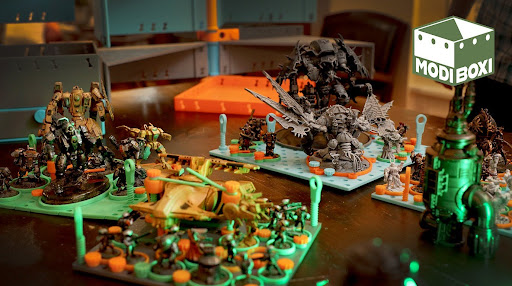
In the first quarter of 2025, more than one million entry-level 3D printers shipped worldwide, 3D Printing Industry reports. That momentum is not just fueling cosplay props and desk gadgets. It is quietly transforming 3D printed miniature storage for tabletop players who are done wrestling with foam trays that never quite line up. One system gaining real traction is Modi Boxi, a modular, digital-first toolkit built for hobbyists who want their Warhammer storage solution to grow and shift as quickly as their army list does.
Here is a closer look at why Modi Boxi continues to stand out in 2026, especially for players focused on long-term Warhammer 40k army organization and scalability.
1. It Solves the Real Problem: How to Store Warhammer 40k Miniatures Without Compromise
Imagine prepping 2,000 points of Space Marines for a tournament. Delicate infantry. Tall banners. Maybe a pair of tanks that refuse to sit neatly inside a standard Warhammer army case. With traditional foam, you trim, squeeze, or settle for “good enough.” Eventually, paint chips. Antennas snap.
Modi Boxi takes a different route. Instead of buying a fixed case, you download STL files for wargaming and print trays in 30mm depth increments. Boxes come in small, medium, and large formats, and the ecosystem now includes more than 800 files. The result is customizable storage for Space Marines that feels deliberate, not improvised.
Version 14 added a quick-release Modi Bolt with a notch design, plus new corner clips for drawers and DIY lid options. These updates are functional, not cosmetic. They strengthen the snap-together structure, keeping models secure in transit while remaining completely tool-free.
If you have ever tried to solve stubborn Warhammer army storage issues, the appeal is obvious. Instead of forcing miniatures to adapt to the case, the case adapts to the miniatures.
2. How Does Modi Boxi Solve the Problem of Transporting a Large Warhammer Army Safely?
Short answer: you print trays that fit your models precisely, then lock the modules together so nothing shifts.
Most miniature transport cases rely on foam compression or magnetic sheets. Companies like Battle Foam, KR Multicase, and Feldherr make solid products, but their layouts are fixed. When your army changes, the case stays the same.
Modi Boxi treats transport more like modular architecture. You can:
- Print deeper compartments for tanks or Dreadnought-sized units.
- Create tight infantry grids that limit side-to-side movement.
- Snap modules together using the patented Modi Bolt system for added rigidity.
- Stack components to fit a specific backpack or car trunk with minimal wasted space.
The XL expansion and Pro Pack push that flexibility further, introducing vertical card holders, paint trays, and pro adapters. Rather than collecting multiple bulky cases, players build a Warhammer storage solution tailored to each event.
That adaptability has helped the platform grow to more than 13,000 users, backed by a 4.8 out of 5 rating across 400 plus reviews.
3. Modi Boxi vs Pre-Made Army Cases: A Structured Comparison
If you are weighing Modi Boxi against pre-made army cases, the contrasts show up quickly once you look at the details.
- Customization: Brands like A-Case and Feldherr offer set foam layouts. Modi Boxi provides more than 800 printable components with depth adjustments in 30mm steps.
- Scalability: Traditional cases usually mean buying another unit as your army expands. With Modi Boxi, you print new modules when you need them.
- Assembly: Foam trays require manual arrangement and adjustment. Modi Boxi relies on a snap-fit system anchored by the patented Modi Bolt.
- Integration: Most pre-made cases focus solely on transport. Modi Boxi extends into modular hobby racks, hobby paint station setups, and Citadel paint storage within the same framework.
- Community Validation: The project raised $410,148 from 6,879 backers on Kickstarter and reached full funding in under two minutes, a strong signal of grassroots support.
Seen this way, the choice is less about buying a container and more about choosing a digital toolkit for DIY miniature storage that evolves with your collection.
4. Is a 3D Printable Storage System Like Modi Boxi Cheaper Than Buying Pre-Made Cases?
Short answer: if you already own a 3D printer, the long-term math often works in your favor.
Modi Boxi Core is priced at $79.99 and frequently discounted to $74.99. The XL pack lists at $49.99 and often drops to $44.99. After that initial purchase, you can print the files as many times as you like. Filament becomes the primary ongoing cost.
By contrast, premium cases from brands such as Battle Foam or A-Case can run several hundred dollars apiece. As your army grows, so does the expense.
Industry data supports the broader shift. Protolabs found that 82 percent of businesses adopting 3D printing report meaningful cost savings. Hobbyists are not operating factories, of course, but the principle carries over. One digital file set can support years of expansion.
So how much does it cost to 3D print a storage system? It depends on scale and material choice. Even so, many players discover they can build an extensive Warhammer army case setup for roughly the price of one or two high-end pre-made cases.
5. Why 3D Printed Accessories Are Becoming the Default for Tabletop Games
3D printing has become part of tabletop culture. Players increasingly expect tools that match their exact needs, not generic approximations. Entry-level printers are easier to access, and communities on Kickstarter and Discord accelerate experimentation.
Modi Boxi sits squarely in that movement. Its Kickstarter performance and “As Seen On” media mentions signal credibility beyond small hobby circles. A partnership with Qidi, an established 3D printer manufacturer, further connects the brand to the hardware side of the industry.
When hobbyists look for the best 3D printable files for miniature storage, they are usually after more than a download link. They want documentation, updates, and active support. Ongoing releases, including new symmetrical and asymmetrical Boxi designs and the Tower Tumblr 2.0 kit with an integrated bolt grasp, point to a platform that keeps evolving.
User Experience and Onboarding: From Download to First Build
Getting started with Modi Boxi feels straightforward. After purchasing the Core package, users access organized STL libraries grouped by box size, inserts, and accessories. The files are optimized for standard printers and do not require supports, so prior design experience is unnecessary.
There are also low-commitment ways to test the system. Free Modi Counter Files and Free Modi Loops let hobbyists experiment before committing to larger builds. Assembly remains tool-free throughout. Modules snap together into anything from a compact miniature transport case to a full modular hobby rack, complete with STL files for modular paint rack configurations.
Named reviewers such as Derrick S. Jr., Quagzlor, and James B frequently highlight improved organization and adaptability. Across more than 400 reviews, the 4.8 rating points to steady satisfaction among builders.
Industry Trends and the Next Two Years
Tabletop gaming and additive manufacturing are moving closer together, not further apart. As printer prices fall and filament options expand, more players are experimenting with functional prints rather than purely decorative upgrades.
The line between consumer and creator keeps blurring. Storage now sits alongside painting and list-building as part of the hobby itself. In that context, a flexible Warhammer storage solution built on downloadable files fits naturally with where the market is headed.
Modi Boxi’s digital-first, community-driven, modular model positions it well in a landscape where personalization is quickly becoming the baseline expectation.
Lessons Learned and What This Means for You
Looking across transport needs, budgets, and hobby room constraints, a few themes keep surfacing:
- Static cases rarely keep pace with evolving armies.
- Thoughtful customization reduces damage and wasted space.
- Systems that combine transport with hobby paint station storage streamline the entire workflow.
- Platforms with proven community backing tend to carry lower adoption risk.
For players serious about Warhammer 40k army organization, the conversation has shifted. The question is less about whether 3D printed miniature storage will become standard and more about which modular system will anchor that shift.
With more than 13,000 users, a 4.8 out of 5 rating, patented hardware components, and $410,148 raised on Kickstarter, Modi Boxi has moved well past the concept stage. The next step is hands-on. Download the free files, print a test module, and see how it fits your current army. Modular storage is no longer a niche experiment. It is a practical option, ready when you are.