

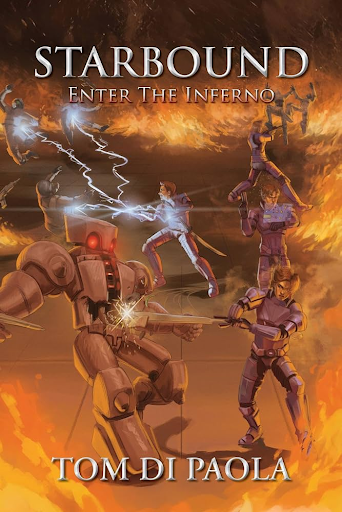
Epic battles, far-off places, and a reason to escape reality for just a few hours. If you’re looking for interplanetary adventure fiction with genuine emotional weight, author Tom Di Paola’s debut novel “Starbound: Enter The Inferno” offers more than futuristic technology, distant planets, and large-scale battles. At its center are four teenage brothers whose lives are torn apart when they witness their father’s murder. What follows sends them far beyond the world they once knew, but the heart of the story remains close to home.
The brothers still have each other.
That relationship gives “Starbound” its strongest pull. The brothers embark on a cosmic odyssey in which they grieve together, discover what they’re capable of, and confront fears they may have preferred to leave unnamed.
Science fiction stories may introduce new planets, sophisticated spaceships, or civilizations built across entire solar systems. They may imagine interplanetary travel or ask what humanity could become after generations of exploration and colonization. Yet underneath those ideas are often the same questions people have always carried.
Who can we trust? What do we owe the people we love? How do we keep moving after the life we understood has disappeared?
Di Paola’s story belongs to that tradition. It explores a vast universe but still uncovers the emotional ties that make us all human.
The universe is vast, but the story is personal
Some science fiction or fantasy novels make the whole story about the vastness of the universe or the made-up world of the fantasy. But “Starbound,” while exploring the Unified System, gives readers something more solid to hold onto: the relationship between the four Evermore brothers.
Like with most families, the Evermores’ journey together is far from easy. The brothers are still young and grieving while trying to understand the new enhanced abilities they received from a secret serum. They don’t respond to fear or challenges the same way, nor do they behave like immediate heroes from the first moment of danger.
They have to learn how to be a team together, just under pressure, when the stakes are high.
That’s part of what makes them relatable. Although their abilities may belong to a futuristic world, their uncertainty doesn’t. The brothers navigate the complicated space between protecting one another and becoming individuals in their own right.
Readers who enjoy found-family science fiction will recognize the appeal, even though this group begins with a bond formed long before the adventure. “Starbound” understands that survival depends on more than assembling several interesting characters in the same place.
For these brothers, that notion carries the full weight of their shared history.
An adventure that keeps you entertained
Di Paola’s novel moves seamlessly between hand-to-hand combat, swordplay, and shootouts, offering action that changes with the world around the characters. The action keeps readers on their toes while showcasing how the brothers’ relationship evolves.
Some scenes place the danger directly in front of the brothers. Others suggest a larger, more enigmatic threat unfolding throughout the Unified System. The result is a narrative with the speed readers expect from adventure fiction, but without the sense that action has been added merely to fill space between discoveries.
The fights reveal character. A battle can expose who acts instinctively and who pauses to solve the problem. An escape can show which brother thinks several steps ahead and which one refuses to leave anyone behind. Fear becomes visible through movement, hesitation, anger, and sacrifice, ultimately revealing the true nature of the book’s characters.
For readers who want more than world-building
Some authors mistakenly believe that an epic science fiction novel needs to be all about world-building. While the architecture of the setting is important, it’s not the whole book. Other authors focus too much on the characters and don’t develop the world enough.
Di Paola provides a perfect blend of both.
The Unified System provides the scale and sense of discovery that fans of multi-planet fiction seek. It suggests a much larger world beyond the brothers’ immediate journey, one shaped by travel, conflict, and the possibilities of human life beyond a single planet.
The futuristic setting in “Starbound” demands much from its characters. Every new encounter pushes the Evermores farther from the relative safety of their former lives. And each discovery forces them to reconsider what they know about their father, their abilities, and the forces moving around them.
The kind of science fiction readers recommend
Readers remember the characters they worried about, the relationships that felt worth protecting, and the moment someone chose loyalty when abandoning it would have been easier. Artifacts, robots, alien encounters, and futuristic technology may make a science-fiction world memorable, but human connection is what makes readers want to return.
Di Paola’s interplanetary adventure fiction offers the movement of an action novel, the scope of a galactic chronicle, and the discovery readers expect from a journey across inhabited planets. But it also understands that the most important distance in any adventure isn’t necessarily the space between worlds; it’s the distance between fear and courage — between grief and love and what one is willing to do for others. It’s the distance between four brothers and what they must do to find their way back to each other.
For readers who want their sci-fi filled with combat, exploration, and futuristic possibilities but grounded in a relationship that gives every battle a reason to matter, “Starbound: Enter The Inferno” is a story worth discovering.
“Starbound: Enter The Inferno” is now available online at Amazon, Barnes & Noble, and Walmart.