

Eyes of The Machine
A documentary by Daya Cahen
Netherlands, 2026
Running time: 75 minutes
The Uyghurs are a predominantly Muslim minority of around 7 million people living in China’s Xinjiang province. They speak a Turkic language and are also found in neighboring countries. According to some human rights organizations, since the early 2010s the Chinese authorities have used very harsh methods to assimilate the Uyghurs and make them part of the majority population. Some organizations have even described it as outright genocide. The region is also home to a militant separatist movement, the Turkistan Islamic Party, which seeks to establish an independent Islamic state and has carried out a number of terrorist attacks over the years.
Without this background information, Daya Cahen’s manipulative documentary comes across as rather strange.
Cahen is a video artist, and this is her first attempt at making a feature-length film. In her work, she often focuses on how mass media and the state manipulate people through propaganda and surveillance.

The internationally acclaimed Swedish documentary filmmaker Stefan Jarl once said that film should be manipulative. Audience wants manipulation. The more manipulation, the larger audience. People pay to be manipulated. That is why he dipped dead birds in oil so he could film the effects of an oil disaster or poured pig’s blood on the floor to show what it looked like when one of the main characters in his most famous work, An Decent Life (1979), died.
When Jarl made his most important films, YouTube, TikTok, and Facebook did not exist. Today, one can find almost anything online. You no longer need to go out and film; you can make an entire film from behind your desk.
And that is how Cahen’s Eyes of The Machine is made. The only footage she appears to have shot herself is the interview with the main character, Kalbinur Sidik, along with very few inserts that I find incomprehensible, for example showing a hand breaking leaves from a plant. Presumably it is the same plant that Uyghur women use to darken their eyebrows, as shown in several long scenes.
Kalbinur Sidik’s story is certainly moving and disturbing. She worked as a Chinese-language teacher for interned Uyghurs in one of the many “re-education camps,” as the Chinese authorities call these institutions. Human rights reports have compared these camps to concentration camps. Because she had a daughter studying in the Netherlands, she managed to flee, leaving her husband behind in Xinjiang.
Now she sits in a comfortable apartment in the Netherlands telling her story. Since her escape, Sidik has become something of a symbol of the struggle for Uyghur human rights.
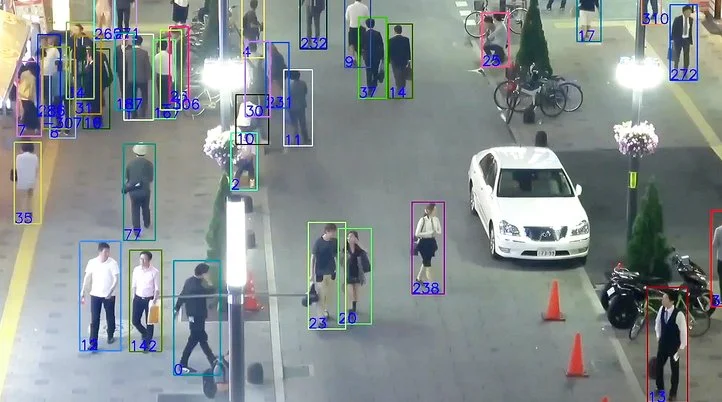
So far, it works. But then the director begins searching for images online and put them in the movie without telling where these clips are from. Already in the opening minutes, we see surveillance-camera footage with facial-recognition technology showing a cityscape crowded with people, while Sidik explains how Chinese authorities use modern technology to monitor Uyghurs. The problem is that the footage is not from China but from Japan, and she never tells us this. Anyone can find the videos through a simple internet search.
Almost the entire film is built from sequences that can be found online. There is little point in analyzing this in detail here; others have already examined the film carefully and found that many images do not depict what the film claims they depict.
This is not unique in the history of documentary filmmaking. Robert J. Flaherty did the same thing in Nanook of the North (1922): he manipulated, dramatized, and used images that were not always authentic. Flaherty knew he could do this because no one had previously filmed the Inuit in the Canadian Arctic. Nor could anyone easily travel there to verify whether the film was truthful.
In some ways, Cahen’s film is similar. It is very difficult to verify the pictures. I do not believe the film’s main character, Kalbinur Sidik, is deliberately lying, but I wish the director had made more effort to verify Sidik’s assertions rather than illustrating them with images that are sometimes simply inauthentic and often depict something entirely different.
Moreover, many things are left unexplored. Sidik says that Chinese authorities shaved the heads of Uyghur women when they were interned. Yet the film does not show a single image of a woman with a shaved head, despite repeatedly displaying portrait photographs of Uyghurs that are said to have been taken by authorities when they were interned. All have still hair.
These portrait sequences recur throughout the film and create a highly suggestive effect. In their eyes, one can see what seems like an accusation directed to the world: “Do something for us!” The film never explains how Sidik obtained these photographs, which raises doubts about their authenticity.

Another question the film never asks is how Kalbinur Sidik see the Turkistan Islamic Party, which is regarded as a terrorist organization with connections to the Taliban in Afghanistan. In the film’s sequences from the “re-education camps,” authorities explain that they aim to re-educate young Uyghurs to prevent them from becoming terrorists, but Sidik never develops this point further. It would also have been interesting to learn more about her work as a Chinese-language teacher in the camp. The camp shown in the film is, of course, not the one where Sidik worked but footage from a Chinese propaganda film.
I have no objection to Cahen’s method of making this film. Stefan Jarl once said that one can do anything in a documentary as long as the message is clear. Objectivity does not exist. Jean-Luc Godard said that cinema lies twenty-four times per second.
The message of Cahen’s film, however, remains unclear. Is she trying to say that Chinese authorities discriminate and intern the Uyghur population? But we already knew that.
Unfortunately, I believe Cahen is not really interested in the Uyghurs themselves. She wanted to make a film about what a society looks like when surveillance of citizens has been maximized. The fact that the subject happens to be the Uyghurs this time is merely a pretext. The title of the film—Eyes of The Machine—says it all.
The film is also rather boring and lacks dramatic structure. It could have benefited from music. The Uyghurs surely have a musical tradition that could have been used more effectively. Mow their music appears only in scenes featuring musicians. On the other hand, perhaps the silence encourages the audience to think more about what they are seeing. The recurring AI-generated voice-over is entirely unnecessary.
It is not enough to place a tearful teacher on a sofa, have her tell her story, and search the web for illustrative footage. The result is a kind of video art that is far too long.
Klas Fransberg, Helsinki