

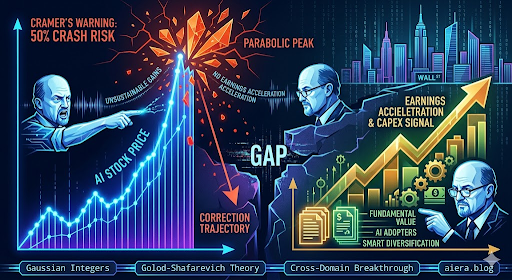
Jim Cramer has been one of the loudest voices on Wall Street for decades. In 2026, he is delivering some of the most direct warnings of his career this time aimed squarely at investors piling into artificial intelligence stocks without looking at the underlying fundamentals. His message, delivered across multiple Mad Money episodes and Squawk on the Street appearances, boils down to a single principle: stocks that move parabolically without earnings acceleration will fall hard, and they often do not recover for years. At aiera.blog, we track where AI intersects with markets. This article breaks down Cramer’s exact warnings, the data behind them, what specific stocks he is flagging, and how investors should respond.
Who Is Jim Cramer and Why Do His Warnings Matter?
Jim Cramer is the longtime host of CNBC’s Mad Money and a regular presence on Squawk on the Street. Before his media career, he ran a hedge fund and built a track record in active portfolio management. That practical background gives his commentary a different weight compared to pure analysts who have never personally managed risk. When Cramer issues a broad market warning, retail and institutional investors both pay attention not because he is always right, but because the market often moves on the perception that others are listening.
His 2026 AI warnings are not offhand remarks. They are a recurring theme built across months of television commentary, and they are backed by a specific, testable investment rule. Understanding that rule is the starting point for evaluating whether his concern applies to your own portfolio.
The Core Jim Cramer AI Stock Warning: The Parabolic Move Rule
On June 8, 2026, Cramer appeared on Squawk on the Street following a brutal session for semiconductor stocks. The Philadelphia Semiconductor Index posted its fourth-worst single-day decline in history. His assessment was blunt and unambiguous.
“Unless you have accelerated earnings, your stock is pretty much done. Got to go down 50% and then it doesn’t come back. Sometimes it doesn’t come back for years and years and years. So I just don’t like parabolic moves. They are indeed as dangerous as you think they are.”
This statement captures Cramer’s central thesis on AI stocks in 2026. The warning is not that AI itself is overvalued. It is that stocks whose price charts have gone parabolic, moving nearly vertically in a short window without a corresponding acceleration in earnings, are prime candidates for severe, prolonged drawdowns.
What Does ‘Parabolic Move’ Actually Mean?
A parabolic move refers to a stock that accelerates upward at a sharply increasing rate, price gains compound on themselves in a short period, creating a near-vertical chart pattern. Cramer’s concern is not with strong rallies in general, but with moves so steep that any negative catalyst, a missed earnings report, a single analyst downgrade, or a macro data point is enough to trigger a sharp reversal. He noted this directly in an earlier Squawk on the Street segment: a Wall Street Journal report about OpenAI missing internal user growth targets was enough to drag the entire semiconductor sector lower. As he put it, in a parabolic market, “a feather could have knocked these stocks down.”
Cramer’s 1999 Comparison: Is the AI Rally Another Dot-Com Bubble?
In a May 2026 Mad Money episode, Cramer made his most sweeping statement yet about market structure, saying: “We keep hearing this drumbeat that 2026 is 1999 all over again. But the difference between now and 1999 is that this market does not stop punishing the companies that disappointed. You are unsafe at any level.”
The Market Concentration Problem
His concern is reinforced by a striking data point in market structure. The Financial Times reported that Wall Street’s recovery since late March 2026 was driven by the narrowest group of stocks on record. Just five companies Alphabet, Nvidia, Amazon, Broadcom, and Apple were responsible for more than half of the S&P 500’s gains during the rally. UBS analysts noted the number of stocks meaningfully driving the market had fallen to just 42, compared to a more typical level closer to 100.
Semiconductors alone accounted for 70% of the S&P 500’s $5.1 trillion gain as the market narrowed. Cramer explicitly warned that this kind of narrow leadership creates “fragility risk” where the broader market becomes dangerously dependent on a small group of names continuing to perform. When those names stumble, the damage is amplified across the entire index.
Cramer was careful to note the 2026 situation differs from 1999 in one important way: today’s AI leaders Nvidia, Broadcom, Alphabet are highly profitable businesses generating real revenue and cash flow. The late 1990s bubble was largely built on companies with no earnings at all. What worries him is not the absence of profitability, but the speed and narrowness of the current rally leaving the market fragile to sentiment shifts.
The Earnings Acceleration Test: How to Apply Cramer’s Rule
The most actionable part of Cramer’s warning is a specific diagnostic: investors can run on any AI stock they hold. The test compares two numbers: the percentage price change over the past six months, and the percentage EPS change (trailing result plus next-quarter guidance) over the same window.
How to read the result:
- Price grew faster than earnings: Your price-to-earnings multiple expanded. This is the parabolic risk profile Cramer is warning about. The stock became more expensive while you held it.
- Earnings grew faster than price: Your multiple compressed. The stock actually got cheaper relative to its earnings. Cramer’s warning does not apply here and this is where he sees genuine opportunity.
Case Studies: Which AI Stocks Pass and Which Fail the Test?
Looking at specific names through Cramer’s lens reveals a split picture in the 2026 AI landscape.
- Broadcom (AVGO): AI semiconductor revenue accelerated from $8.4B to $10.8B quarter over quarter, with Q3 guidance of $16B growth accelerating from 106% to 143% to a guided 200%-plus. The stock was up only around 12% year to date at the time of Cramer’s warning. Earnings outran price; multiple compressed. This is the profile Cramer considers safer.
- SanDisk (SNDK): EPS climbed from $1.22 to $6.20 to $23.41 across three consecutive quarters, with Q4 guidance of $30 to $33. The datacenter segment grew 645% year over year. Stock was up 557% year to date but earnings were tracking to outpace that gain. Multiple compression again. This passes the test.
- Stocks where price runs far ahead of EPS: These are Cramer’s targets. Names that doubled or tripled in price while EPS moved modestly. He warned specifically about chasing Intel, Advanced Micro Devices, and other AI-adjacent names in an April 2026 Mad Money episode, saying they were “too hot, hot, hot” and that he tends to “get hammered” buying parabolic stocks.
The Hyperscaler Capex Signal: The Second Warning Indicator
CNBC co-anchor David Faber, speaking alongside Cramer on the June 8 segment, highlighted a second leading indicator that investors should monitor alongside earnings. Hyperscaler capital expenditure guidance the planned spending by Alphabet, Microsoft, Amazon, and Meta on AI data centers is the upstream demand signal for the entire AI semiconductor supply chain.
Alphabet’s 2026 capex guide stands at $175 billion to $185 billion. Microsoft, Meta, and Amazon have collectively committed to spending over $650 billion on AI infrastructure in 2026. As long as those numbers hold or increase, the earnings acceleration thesis for chip suppliers remains intact. But if a single hyperscaler cuts its spending guidance, the revenue and earnings projections built into AI semiconductor valuations unravel quickly. Cramer and Faber both identified this capex signal as the primary variable to watch. A capex cut would validate Cramer’s warning on virtually every AI hardware name in the market.
What Cramer Actually Recommends Instead of Hot AI Stocks
Cramer’s warnings are not a blanket call to exit technology. They are a call to be more selective. He has consistently steered investors toward two alternative approaches.
AI Adopters Over AI Builders
Cramer’s core 2026 recommendation is to shift focus away from pure-play AI infrastructure stocks chip makers, data center operators toward companies actively integrating AI into their core business operations. He has specifically cited blue-chip names like Procter & Gamble, Caterpillar, and Johnson & Johnson as examples of companies building durable operational leverage through AI deployment. These businesses do not carry the same parabolic valuation risk because AI is a margin and productivity enhancer for them, not the entire narrative holding up the stock price.
Overlooked Quality Names
In an April 20, 2026 Mad Money episode, Cramer said he is taking the opposite approach from the crowd: buying quality companies that have fallen out of favor rather than chasing the hot names. He advocates trimming positions in large winners and redeploying into fundamentally sound businesses that have been punished for reasons unrelated to their core business quality. He has also noted that when beaten-down software stocks rebound, they are sometimes driven by short covering rather than genuine fundamental improvement calling this dynamic “a squeeze” and warning investors to distinguish between a real recovery and a technical bounce.
How to Evaluate Your Own AI Stock Exposure Right Now
Run this four-step check on every AI-related position in your portfolio:
- Step 1 Chart the move: How much has the stock gained in the past three to six months? If it has moved more than 100% in that window, parabolic risk is present.
- Step 2 Check earnings acceleration: Is EPS actually growing faster each quarter, or have earnings been flat while the stock ran up on AI sentiment?
- Step 3 Watch hyperscaler capex: Track Alphabet, Microsoft, Amazon, and Meta quarterly guidance. Any reduction in AI infrastructure spending is a leading warning for chip stock earnings.
- Step 4 Consider trimming, not exiting: Cramer does not advocate selling all AI exposure. He advocates reducing concentration in parabolic names and diversifying into AI-adjacent industries and quality companies that have been overlooked.
Bottom Line: Should You Take Cramer’s AI Warning Seriously?
Cramer’s record is imperfect, and the Inverse Cramer trade has had its moments. But the earnings acceleration rule he is applying in 2026 is not a gut call, it is a fundamental valuation principle with a strong historical track record. Stocks that double or triple on narrative momentum without corresponding EPS growth consistently face severe corrections when sentiment shifts. The dot-com crash, the 2022 rate shock, and multiple sector bubbles before them all followed this pattern.
The key variable is whether AI earnings are actually accelerating fast enough to justify current prices. For some names Broadcom, SanDisk based on recent data the answer appears to be yes. For others, the price ran on narrative well ahead of EPS reality. That gap is exactly what Cramer is warning about. Whether you agree with every stock call he makes, the underlying framework is sound: price growth without earnings growth is borrowed time.
Conclusion
Jim Cramer’s AI stock warning in 2026 is not panic; it is a disciplined, rule-based caution grounded in decades of market experience. The parabolic move problem, the 1999 market structure comparison, the earnings acceleration test, and the hyperscaler capex signal all point to a single conclusion: the easy money in broad AI exposure has been made, and the next phase will reward investors who can distinguish between AI stocks with genuine earnings momentum and those being held up by sentiment alone. At aiera.blog, we believe that understanding the data behind these warnings not just the headlines, is what separates investors who protect capital from those who give it back. Bookmark this page, run the four-step portfolio check, and watch those capex numbers every quarter.