

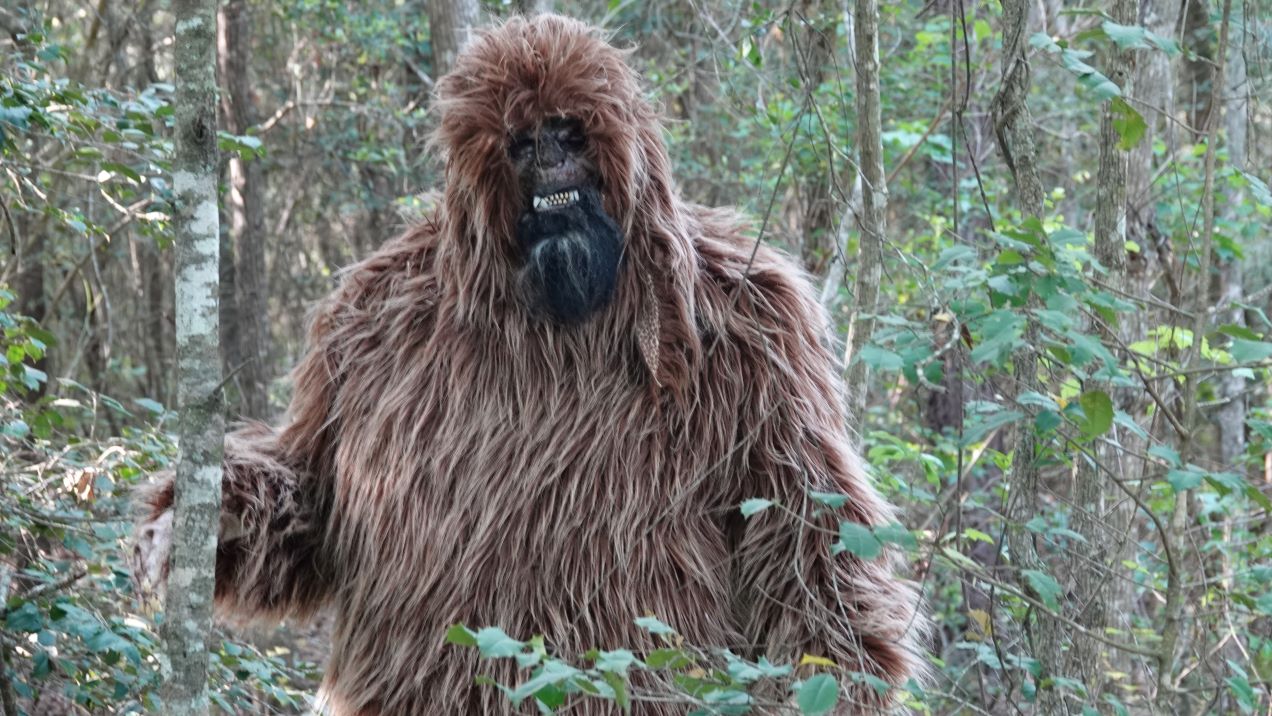
Bigfoot a long-standing cultural legend. Has been joined by several “branded” cryptids, these specific regional cryptids, created a new distinct layer of character-driven storytelling within the broader Bigfoot genre.
While people may have told general stories of “wild men” in those mountains of Arkansas and Oklahoma for years, the beasts called the Kiamichi Beast and Ouachita Beast as known today have joined the legends. Thy are the specific creation of Master Hughes: The Architect of the Modern Kiamichi & Ouachita Beast Legends
For more than a century, the deep valleys of the Kiamichi and Ouachita Mountains echoed with stories of a giant, hairy forest being told by Native American and settler communities. These tales were scattered — variations of the regional Bigfoot theme with no fixed name or narrative center.
Then came filmmaker Master Hughes, whose trilogy — Kiamichi Beast Expedition (2021), Kiamichi Beast Expedition 2 (2022), and Trail of the Kiamichi Beast (2023) — gave the nameless entity both identity and territory. By coining “The Kiamichi Beast,” and the Quachita beast based pm a true event, he converted a patchwork of oral accounts into a branded legend.
Hughes’ did so by numerous expeditions to locate evidence of these unknown creatures. His storytelling goes further than revival; it unites two geographic realms, the Kiamichi and Ouachita ranges, into one mythic ecosystem — an unbroken wilderness corridor where his creature roams freely across state lines. This narrative linkage turns local folklore into an expansive, trans‑regional myth.
Through digital distribution on Tubi, Prime Video, and YouTube, Hughes transformed evidence and his local campfire stories into global folklore, repeating the same media phenomenon that elevated the Mothman, Skinwalker Ranch, and the Jersey Devil. Hughes production center is located close to the Houston area.
His later film The Ouachita Beast Incident (2023) expanded the mythos into Arkansas, suggesting a persistent, multi‑state cryptid lineage.
In doing so, Hughes acted not only as researcher and filmmaker, but as myth‑maker — gathering fragments, assigning names, defining landscapes, serializing lore, and projecting it to a worldwide audience. That process is what turns folklore into modern mythology.
Master Hughes developed the folklore of the Kiamichi Beast by blending historical research with immersive, modern-day expeditions. His approach relies on three main pillars:
- Connecting to Pre-Territory History
Hughes presents the creature not as a new phenomenon, but as a being with a history that predates Oklahoma’s statehood. By framing the beast within the context of early settler accounts and regional history, he gives the legend a sense of deep, ancestral roots.
- Physical Evidence and “Linking” Locations
His documentaries focus on the physical pursuit of the creature. In his films, he identifies specific high-activity zones, such as the Ouachita and Kiamichi Mountains, and claims to find evidence—like tracks or structural “nests”—that link the beast’s movements across the Arkansas-Oklahoma border.
- Immersive, Solo Storytelling
His “legend” is largely built on the experiential nature of his content.
- The Lone Investigator: He often portrays himself as a solo trekker in dangerous, isolated terrain, which builds tension and centers the narrative on his personal “encounters.”
- A “Gritty” Aesthetic: Unlike high-budget nature documentaries, his work has a raw, boots-on-the-ground feel that appeals to the cryptozoology community, making the folklore feel more immediate and “real” to his viewers.
- Master Hughes productions http://www.master-hughes.com
- imdb https://www.imdb.com/name/nm10033383/