

In March of this year, China officially released its 15th Five-Year Plan (FYP) framework. A State Council Information Office press conference held in mid-April further clarified the roadmap for implementing the plan. As the country transitions from the successful conclusion of the 14th FYP to a smooth start of the 15th FYP, and amid rising global trade protectionism and severe challenges to the international economic order, China is solidifying its core position as a “key hub” in global supply chains through institutional opening-up and robust industrial capabilities. As Wang Changlin, Deputy Director of China’s National Development and Reform Commission, stated, the framework emphasizes the need to “actively expand independent opening-up, promote innovative trade development, guide the rational cross-border layout of industrial and supply chains, and build a new, higher-level open economic system.”
Hard Data: Nine Consecutive Years of Growth in Foreign Trade, Solidifying the Supply Chain Hub Position
In 2025, China’s economy withstood external pressures and delivered a remarkable performance. GDP grew by 5%, surpassing the 140 trillion yuan mark. The total value of goods trade reached 45.47 trillion yuan, a year-on-year increase of 3.8%, marking the ninth consecutive year of growth. Exports reached 26.99 trillion yuan, up 6.1%, with China’s share of global exports stabilizing above 14%. In 2025, the value-added of high-tech manufacturing and equipment manufacturing grew by 9.4% and 9.2%, respectively. These figures go far beyond simple “scale growth,” reflecting a profound structural transformation in China’s manufacturing sector—an ascent from “world factory” to “coordinator and organizer” of global supply chains.
Entering 2026, the first year of the 15th FYP, global goods trade growth forecasts have been significantly downgraded to 0.5%. However, as Wang Jun, Deputy Director of the General Administration of Customs of China (GACC), pointed out, China’s institutional advantages, market strengths, comprehensive industrial system, and diversified trade partnerships ensure its foreign trade fundamentals remain solid. The GACC has made promoting stable foreign trade growth a key focus for the 15th FYP period, emphasizing the need to “expand both exports and appropriately increase imports, and expand international circulation,” fully unleashing the dividends of China’s massive market. In the first quarter of 2026, China’s total goods trade value reached 11.84 trillion yuan, a 15% year-on-year increase, surpassing 11 trillion yuan for the first time in a historical first quarter and achieving the highest quarterly growth rate in five years—a strong and positive start.
Ports as Lifelines: An Upgraded Capability from “Corridors” to “Hubs”
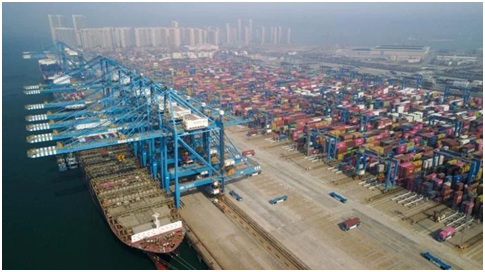
Robust logistics infrastructure serves as the “hard support” for China’s supply chain hub. In 2025, the Port of Shanghai handled over 55.06 million TEUs, a 6.9% increase, ranking as the world’s busiest port for the 16th consecutive year. International transshipment volume reached 7.911 million TEUs, up 10.6%, reflecting the growing reach and influence of this international hub. That same year, the Port of Ningbo-Zhoushan handled over 1.4 billion tons of cargo, maintaining its global top position for 17 years and becoming the world’s first super-port to reach the “1.4 billion tons” milestone.
China’s 15th FYP framework explicitly aims to strengthen the domestic economic cycle and positions modern logistics as its “meridians and vessels.” Provinces and cities are taking vigorous action. Chongqing is fully promoting the construction of “five types” of national logistics hubs, accelerating its transformation from an “inland hinterland” to an “open frontier.” Trains loaded with electronics, auto parts, and other goods, such as the “ASEAN Express,” travel from Hanoi, Vietnam, via the New Western Land-Sea Corridor to Chongqing for transshipment to global markets. Shandong Province’s 15th FYP framework proposes accelerating the construction of international logistics corridors and building high-level China-Europe Railway Express assembly centers in Jinan and Qingdao. Yinchuan, Ningxia, will focus on building a port-side comprehensive logistics hub during the 15th FYP period to promote high-quality development of its open economy. A modern supply chain system, supported by ports, anchored by hubs, and networked by corridors, is embedding China’s supply chain deeper into global trade networks.
Institutional Opening-Up: Unleashing Potential through Rule Connectivity in the 15th FYP Era
If infrastructure represents the “hard power” of China’s supply chain hub, then institutional opening-up is the “soft power” connecting it to the world. At the end of December 2025, the Catalogue of Industries for Encouraging Foreign Investment (2025 Edition) was officially released, containing 1,679 items—a net increase of 205 from the 2022 edition—seen as a key marker of China’s commitment to the 15th FYP. The 2026 Government Work Report further stated the need to “implement the new catalogue to encourage foreign investment and promote reinvestment and localization by foreign enterprises.” The Ministry of Commerce is focusing on expanding market access and opening up in the services sector, including telecoms and medical care, supporting foreign companies in extending their value chains and fully implementing national treatment for foreign investors.
The dividends of institutional innovation are accelerating within open economic platforms. The State Council recently forwarded the GACC’s Several Measures to Enhance the Capacity and Quality of Comprehensive Bonded Zones, outlining 24 specific actions. The 15th FYP framework also explicitly aims to further improve the policy environment for bonded maintenance and remanufacturing, as well as new types of off-shore trade.
At the comprehensive bonded zone in Suzhou Industrial Park, Jiangsu Province, a foreign-funded cochlear implant manufacturer has successfully upgraded from a simple contract manufacturer for its global headquarters to a “global maintenance center” by engaging in global bonded repair services. “The Chinese market has far surpassed its role as just a sales market,” said Zhang Mei, Senior Operations Director of the company. “This presents a tremendous opportunity for us.” Cao Yongxin, Director of the Suzhou Industrial Park Customs, noted that this new form of bonded maintenance shifts the focus from traditional “manufacturing products” and “selling products” to product lifecycle management, retaining high-value-added links within China. “It achieves structural optimization, extends China’s industrial chain in the global market, and enhances the irreplaceability of China’s supply chains.”
Regional Synergy: Accelerating China-ASEAN Supply Chain Integration
ASEAN is a key strategic partner in China’s 15th FYP cooperation landscape. In the first three quarters of 2025, the total trade value between China and ASEAN reached 5.57 trillion yuan, a year-on-year increase of 9.6%, solidifying ASEAN’s position as China’s largest trading partner. The signing of 21 cooperation agreements covering areas such as port supply chains, “Chongqing autos going global,” and agricultural supply chains, along with a 25.57% increase in RCEP certificates of origin issued and a 24.01% increase in their value, has injected strong momentum into regional industrial and supply chain integration.
The implementation of the 15th FYP framework coincides with a critical period of profound adjustment in the global economic landscape. By organically integrating institutional opening-up, industrial upgrading, and infrastructure connectivity, China continues to provide certainty and vitality to global supply chains with an open, inclusive, and mutually beneficial approach.