

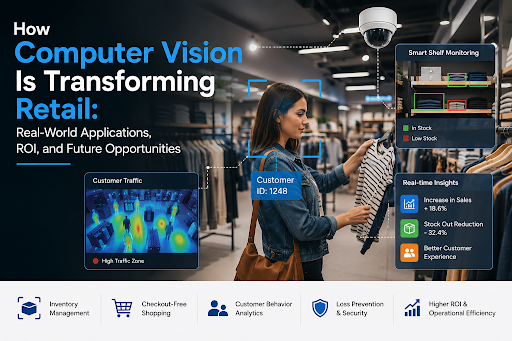
Retail is undergoing a major transformation. Customers expect faster service, personalized experiences, and seamless shopping journeys across physical and digital channels. At the same time, retailers face growing challenges related to inventory accuracy, labor shortages, theft prevention, and operational efficiency.
To address these challenges, many retailers are turning to computer vision.
Computer vision enables machines to interpret and understand visual information from cameras, images, and videos. Combined with artificial intelligence, computer vision helps retailers automate processes, gain real-time insights, and improve customer experiences at scale.
From autonomous checkout systems to intelligent inventory management, computer vision is becoming a key driver of innovation in modern retail.
What Is Computer Vision in Retail?
Computer vision in retail refers to the use of AI-powered visual recognition systems that analyze video feeds and images to identify products, track inventory, monitor customer behavior, and automate store operations.
These systems use technologies such as:
- Deep learning
- Machine learning
- Image recognition
- Object detection
- Video analytics
- Edge computing
Retailers deploy computer vision through cameras, sensors, and AI models that continuously process visual data and generate actionable insights.
Organizations often work with specialized AI Development Services providers to build custom retail computer vision solutions aligned with their business objectives.
Why Retailers Are Investing in Computer Vision
Several factors are driving the rapid adoption of computer vision technologies.
Rising Labor Costs
Retailers are seeking ways to automate repetitive tasks such as shelf monitoring, inventory counting, and checkout operations.
Inventory Accuracy Challenges
Out-of-stock products result in lost sales and dissatisfied customers. Computer vision helps maintain accurate inventory visibility in real time.
Growing Customer Expectations
Modern consumers expect convenience, speed, and personalization during every shopping experience.
Increased Competition
Retailers need data-driven insights to optimize store layouts, pricing strategies, and customer engagement efforts.
Loss Prevention Requirements
Shrinkage and theft continue to cost retailers billions annually. Visual AI helps identify suspicious activities and reduce losses.
How Computer Vision Works in Retail
A typical retail computer vision system follows a structured workflow.
Data Capture
Cameras installed throughout stores continuously capture images and video streams.
AI Processing
Computer vision algorithms analyze visual data to identify objects, products, people, and behaviors.
Pattern Recognition
The system detects patterns such as:
- Product movement
- Shelf availability
- Customer traffic
- Queue formation
- Suspicious activities
Action Generation
Insights are delivered to store managers, inventory systems, or automated workflows for immediate action.
Retailers often combine these capabilities with AI Integration Services to connect computer vision platforms with ERP, CRM, and inventory management systems.
Top Computer Vision Use Cases in Retail
Smart Inventory Management
Inventory inaccuracies create significant operational challenges.
Computer vision automates inventory tracking by:
- Monitoring stock levels
- Detecting empty shelves
- Identifying misplaced products
- Improving replenishment accuracy
Real-time visibility helps retailers avoid stockouts and reduce excess inventory.
Automated Shelf Monitoring
Store shelves change constantly throughout the day.
Computer vision systems can:
- Detect missing products
- Verify planogram compliance
- Monitor product placement
- Identify pricing errors
This enables faster corrective actions and better merchandising performance.
Checkout-Free Shopping
Autonomous retail stores use computer vision to eliminate traditional checkout processes.
Customers can:
- Enter the store
- Select products
- Leave without waiting in line
AI automatically identifies purchased items and processes payment.
This technology reduces friction while improving customer satisfaction.
Customer Behavior Analytics
Understanding customer behavior is critical for retail success.
Computer vision provides insights into:
- Store traffic patterns
- Popular product zones
- Dwell times
- Customer journeys
- Conversion opportunities
These insights help optimize store layouts and product placement strategies.
Queue Management
Long checkout lines negatively impact customer experiences.
Computer vision monitors queue lengths and customer wait times.
Store managers receive alerts when additional checkout counters should be opened.
Loss Prevention and Theft Detection
Retail shrinkage remains a significant concern.
Computer vision helps identify:
- Suspicious behavior
- Unauthorized product movement
- Potential theft incidents
- Employee compliance issues
This improves security while reducing losses.
Personalized In-Store Experiences
AI-powered visual systems can help retailers deliver more personalized experiences.
Examples include:
- Product recommendations
- Digital signage personalization
- Customer engagement insights
- Loyalty program enhancements
Visual Product Search
Customers can upload or scan images to find similar products instantly.
Visual search capabilities improve product discovery and increase conversion rates.
Business Benefits of Computer Vision in Retail
Improved Inventory Accuracy
Real-time inventory visibility enables better demand forecasting and replenishment planning.
Reduced Operational Costs
Automation decreases the need for manual inventory checks and routine monitoring tasks.
Enhanced Customer Experiences
Faster shopping journeys and personalized interactions improve customer satisfaction.
Increased Sales Opportunities
Retailers can optimize merchandising strategies based on customer behavior data.
Better Decision-Making
Computer vision generates actionable insights that support data-driven business decisions.
Stronger Loss Prevention
AI-powered monitoring improves security and reduces retail shrinkage.
Challenges of Implementing Computer Vision in Retail
Despite its advantages, implementation requires careful planning.
Privacy and Compliance
Retailers must comply with data privacy regulations and maintain customer trust.
Integration Complexity
Computer vision systems often need to integrate with:
- ERP platforms
- POS systems
- CRM software
- Inventory management solutions
Infrastructure Investment
Deploying cameras, sensors, and AI processing systems requires initial investment.
Model Accuracy
AI models require continuous training and optimization to maintain high accuracy levels.
Scalability Considerations
Retailers must ensure solutions can scale across multiple stores and locations.
Partnering with experienced AI Consulting Services providers helps organizations address these challenges more effectively.
The Future of Computer Vision in Retail
The next generation of retail innovation will be heavily influenced by AI and automation.
Emerging trends include:
Autonomous Retail Stores
Stores operating with minimal human intervention will continue to expand.
Predictive Retail Analytics
AI systems will anticipate customer needs and inventory requirements before issues arise.
AI-Powered Digital Twins
Retailers will create virtual store environments for simulation and optimization.
Intelligent Retail Agents
Advanced AI agents will assist with inventory management, customer support, and operational decision-making.
Organizations exploring these capabilities are increasingly investing in solutions offered by an Agentic AI Development Company.
How AI Development Services Accelerate Retail Transformation
Building enterprise-grade computer vision systems requires expertise across multiple domains.
Experienced AI teams help organizations with:
- Computer vision model development
- Retail analytics solutions
- Data engineering
- AI infrastructure design
- Deployment and monitoring
- Continuous optimization
Working with specialized AI Development Services providers helps reduce implementation risks while accelerating time-to-value.
Conclusion
Computer vision is rapidly becoming a foundational technology for modern retail operations.
From inventory optimization and shelf monitoring to autonomous checkout and customer analytics, computer vision enables retailers to improve efficiency, reduce costs, and deliver better shopping experiences.
As AI technologies continue to evolve, retailers that invest in computer vision today will be better positioned to compete in an increasingly data-driven marketplace.
The future of retail will be intelligent, automated, and powered by AI-driven visual understanding.
FAQs
How is computer vision used in retail?
Computer vision helps retailers automate inventory management, shelf monitoring, checkout processes, customer analytics, and loss prevention activities.
What are the main benefits of computer vision in retail?
Benefits include improved inventory accuracy, lower operational costs, enhanced customer experiences, better merchandising decisions, and stronger security.
Can small retailers use computer vision technology?
Yes. Cloud-based AI platforms have made computer vision solutions more accessible and cost-effective for small and medium-sized retailers.
How does computer vision improve inventory management?
It continuously monitors shelves and stock levels, identifies shortages, and enables faster replenishment decisions.
What technologies are used in retail computer vision?
Retail computer vision solutions typically use deep learning, machine learning, object detection, image recognition, video analytics, and edge computing.
What challenges are associated with computer vision implementation?
Common challenges include privacy concerns, integration complexity, infrastructure costs, and maintaining model accuracy.
What is the future of computer vision in retail?
Future developments include autonomous stores, AI-powered digital twins, predictive analytics, intelligent retail agents, and highly personalized shopping experiences.