

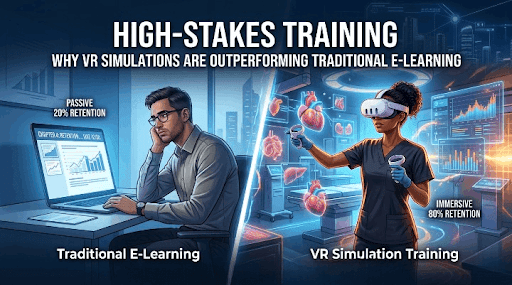
The corporate world is currently witnessing a massive shift in how professional development is delivered. While traditional e-learning—consisting of 2D videos and slide-based quizzes—served its purpose for a decade, it is rapidly hitting a ceiling in terms of engagement and knowledge retention. Today, metaverse app development is providing a “safe-to-fail” environment where employees can master high-stakes skills without real-world consequences.
Whether it is a surgeon practicing a complex procedure, a technician repairing high-voltage equipment, or a sales executive navigating a hostile negotiation, virtual reality (VR) is proving to be the superior medium for behavioral change.
The Retention Gap: 2D Video vs. 3D Immersion
One of the most compelling arguments for moving toward a software development agency that specializes in XR (Extended Reality) is the sheer difference in cognitive load and memory encoding.
- The Passive Problem: Traditional e-learning is largely passive. Research shows that after one week, learners generally remember only 20% of what they read and 30% of what they see in a video.
- The Experiential Advantage: In contrast, VR is experiential. Because the brain processes a 3D simulation as a “lived experience” rather than a “viewed media,” retention rates skyrocket to nearly 75-80%.
- Muscle Memory: Furthermore, 3D immersion allows for the development of muscle memory. In a metaverse environment, learners aren’t just clicking “Next”; they are physically reaching, grabbing, and interacting with objects in a spatial context.
Scaling the Unscalable: Cost-per-Trainee Reduction
Initially, the “sticker shock” of metaverse app development can deter some organizations. However, when analyzed through the lens of long-term scalability, the ROI becomes undeniable.
First, consider the costs of traditional high-stakes training: travel expenses, hiring specialized instructors, and the opportunity cost of taking expensive machinery out of production for practice. Secondly, VR allows for infinite repeatability. Once the environment is built by a competent software development agency, the marginal cost of training the 1,000th employee is nearly zero.
| Metric | Traditional On-Site Training | VR Simulation Training |
| Travel & Lodging | High (per session) | Zero |
| Equipment Downtime | Significant | None |
| Risk/Safety Cost | High (potential for injury) | Zero (Safe-to-fail) |
| Scalability | Limited by physical space | Unlimited global access |
Multi-User Collaboration: The Social Metaverse
A common misconception is that VR is an isolated experience. On the contrary, modern metaverse app development focuses heavily on social presence.
In a shared virtual space, a mentor in London can walk a trainee in Dubai through a complex mechanical repair in real-time. This multi-user functionality fosters teamwork and communication in high-pressure scenarios. Teams can engage in role-playing exercises, joint emergency response drills, and collaborative problem-solving, all while being thousands of miles apart. This “spatial telepresence” is the bridge between lonely home-study and expensive in-person seminars.
Frequently Asked Questions (FAQs)
1. Is VR training only for technical or “hard” skills?
Not at all. While it excels at technical tasks, VR is increasingly used for “soft skills” like diversity and inclusion training, leadership empathy exercises, and high-pressure sales simulations.
2. What hardware is required to start?
Most modern enterprises use standalone headsets like the Meta Quest 3 or Vive Focus 3, which do not require a tethered PC, making them easy to deploy across global offices.
3. How do we track the success of VR training?
Unlike a quiz, VR allows you to track “telemetry data.” You can see exactly where a student looked, how long they hesitated before a decision, and how many precise movements they made to complete a task.
4. Is the metaverse too expensive for small businesses?
While custom app development carries an upfront cost, many agencies offer modular builds or “white-label” environments that make the technology accessible for mid-sized firms looking to scale their training.
5. Can VR be integrated with our existing LMS?
Yes. Most professional software development agencies can ensure the VR application communicates with your Learning Management System (LMS) via xAPI or SCORM to track completions and scores.
Ready to revolutionize your corporate training? Our team specializes in bridging the gap between traditional software and the future of spatial computing. Whether you need a robust software development agency for backend integration or specialized metaverse app development for immersive simulations, the agency NEXT CODERZ can help.