

Why Injection Molding Problems Often Start Early
Injection molding is one of the most important manufacturing processes for producing plastic parts at scale. It is used for consumer products, electronic housings, automotive components, medical parts, packaging, industrial items, and many other applications. The process can produce accurate and repeatable parts, but it also requires careful planning. Small design or process mistakes can lead to serious production problems.
Many injection molding defects do not begin on the factory floor. They often begin much earlier, during part design, mold design, material selection, or process planning. A part may look perfect in a digital model, but once melted plastic enters the mold, the real behavior of the material can reveal hidden weaknesses.
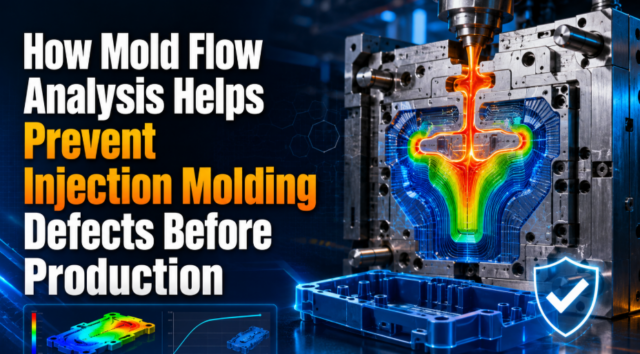
This is where Mold flow analysis becomes valuable. It helps manufacturers study how molten plastic is likely to move inside a mold before production begins. By using simulation to predict filling patterns, pressure, cooling behavior, and possible defects, teams can make better decisions before expensive tooling mistakes happen.
For product teams, this is not just a technical step. It is a way to reduce risk, improve quality, and make the entire injection molding process more predictable.
What Mold Flow Analysis Means
Mold flow analysis is a simulation method used in injection molding to study how plastic material flows through a mold cavity. It helps engineers understand what may happen when molten plastic is injected into a mold under pressure.
The analysis can show how the material fills the mold, where it may slow down, where air may become trapped, where weld lines may form, and whether certain areas may cool unevenly. It can also help identify pressure requirements, gate placement issues, and possible part defects.
In simple terms, mold flow analysis allows manufacturers to test the molding process digitally before cutting the mold or starting production. This is important because molds can be expensive to build and difficult to modify once completed.
Without simulation, teams may rely heavily on experience and trial runs. Experience is still important, but digital analysis adds another layer of insight. It helps confirm whether a design is practical and where improvements may be needed.
Why Flow Behavior Matters in Plastic Parts
Plastic does not simply fill a mold like water filling a glass. Molten plastic is thicker, temperature-sensitive, and affected by pressure, mold geometry, material type, wall thickness, and cooling conditions. It moves through the mold in a specific pattern, and that pattern affects the final part.
If the plastic does not flow evenly, some areas may fill too late or not fill properly. Thin sections may freeze before the mold is completely filled. Thick sections may cool more slowly and create shrinkage. Corners, ribs, bosses, and complex features may create resistance that affects how the material moves.
Flow behavior can influence several important quality factors:
- Part strength
- Surface appearance
- Dimensional accuracy
- Warping risk
- Weld line location
- Air trap formation
- Cooling time
- Overall production stability
When teams understand flow behavior early, they can improve the part design and mold layout before manufacturing begins. This helps avoid defects that would be costly to fix later.
Common Defects Mold Flow Analysis Can Help Predict
Injection molding defects can appear for many reasons, but several common problems are closely connected to material flow. Mold flow analysis helps identify these risks before they become production failures.
One common issue is a short shot. This happens when the mold does not fill completely, leaving missing or incomplete sections. A simulation can show areas where flow may stop too soon because of thin walls, poor gate placement, low pressure, or material cooling too quickly.
Another issue is weld lines. These form when two flow fronts meet inside the mold. In some cases, weld lines are only a visual concern. In other cases, they can create weak points in the part. Analysis helps predict where these lines may appear so designers can adjust the mold or part geometry.
Air traps are another concern. When air cannot escape from the mold cavity, it may create burn marks, voids, or incomplete filling. Mold flow simulation can show where air may become trapped and where venting may be needed.
Warping is also a major problem. It happens when different areas of the part shrink or cool unevenly. Mold flow analysis can help predict cooling imbalance and shrinkage patterns, allowing teams to improve design or process settings.
Better Gate Placement and Mold Design
Gate placement is one of the most important decisions in injection molding. The gate is the point where molten plastic enters the mold cavity. Its location affects flow direction, pressure, weld lines, appearance, packing, and cooling.
Poor gate placement can lead to uneven filling, visible marks, weak weld lines, trapped air, or excessive pressure. Once a mold is built, changing gate location can be difficult and expensive. That is why it should be studied carefully before tooling begins.
Mold flow analysis helps compare different gate positions. Engineers can simulate how material will fill the part from each possible gate location and choose the option that gives the best balance of quality and efficiency.
A good gate location can help:
- Fill the mold more evenly
- Reduce weld line problems
- Improve surface appearance
- Lower injection pressure
- Reduce trapped air
- Support better packing
- Improve part strength
Mold design is not only about creating the cavity shape. It is about guiding material into that shape in the most controlled way possible.
Improving Wall Thickness and Part Geometry
Part geometry has a strong effect on injection molding success. Wall thickness, corners, ribs, holes, bosses, and transitions all influence how material flows and cools. If the design is not suitable for molding, defects may appear even when the mold and machine settings are good.
Uneven wall thickness is one of the most common causes of molding problems. Thick areas cool more slowly and may shrink more, while thin areas cool faster and may restrict flow. This can lead to sink marks, warping, short shots, and uneven strength.
Mold flow analysis helps designers see whether the part geometry supports smooth filling. If a section is too thin, the simulation may show flow hesitation or incomplete filling. If a section is too thick, it may show cooling delays or shrinkage risk.
This allows teams to adjust the design before production. They may change wall thickness, soften transitions, add radii, modify ribs, or adjust feature placement. These changes can make the part easier to mold and more reliable in use.
Good design for injection molding is not only about appearance. It must also consider how material will behave during production.
Reducing Costly Tooling Changes
Tooling is one of the biggest investments in injection molding. A mold can be expensive, especially for complex parts or high-volume production. If a design problem is discovered after the mold is made, the correction may require machining changes, welding, rework, or even a new mold.
These changes can delay the project and increase cost. They can also create pressure between design, engineering, and production teams because everyone wants to move quickly, but quality issues cannot be ignored.
Mold flow analysis helps reduce this risk by identifying potential problems before the tool is built. It gives teams a chance to improve the design, gate layout, runner system, venting, and cooling strategy earlier in the process.
This does not mean simulation removes every possible issue. Real production still requires testing, setup, and process control. However, analysis can reduce uncertainty and help avoid the most obvious and expensive mistakes.
For companies launching new products, preventing one major tooling correction can save significant time and money.
Supporting Better Material Selection
Different plastics behave differently during injection molding. Some flow easily, while others require higher pressure. Some shrink more. Some are more sensitive to temperature. Some need careful drying or processing conditions.
Material selection affects part performance, appearance, cost, and manufacturability. A material may have excellent strength but poor flow for a thin-wall design. Another may fill easily but not provide the required heat resistance or durability.
Mold flow analysis can help compare how different materials may behave in the same part design. This allows teams to choose a material that supports both product performance and molding success.
For example, if a design has thin sections, the analysis may show whether a selected plastic can reach all areas before cooling too much. If the part has large flat surfaces, the simulation may help evaluate shrinkage and warping risks.
This makes material selection more practical. Instead of choosing based only on data sheets, teams can see how the material may behave inside the actual mold geometry.
Improving Cooling and Cycle Time
Cooling is a major part of injection molding. In many cases, cooling time controls how long each production cycle takes. If a part cools unevenly, it may warp. If it takes too long to cool, production becomes slower and more expensive.
Mold flow analysis can help study cooling behavior and identify hot spots. Thick areas, poor cooling channel placement, and uneven mold temperature can all affect part quality and cycle time.
By understanding cooling patterns, engineers can improve the mold design and process settings. They may adjust cooling channels, change wall thickness, improve mold temperature control, or modify part features that cause heat buildup.
Better cooling can lead to:
- Shorter cycle times
- Less warping
- More stable dimensions
- Better surface quality
- More consistent production
- Lower manufacturing cost
In high-volume production, even a small reduction in cycle time can have a major cost impact. This is why cooling analysis is not only a quality concern but also a production efficiency concern.
Helping Teams Communicate More Clearly
One hidden benefit of mold flow analysis is better communication. Product development often involves designers, engineers, mold makers, material suppliers, and production teams. Each group may look at the part from a different angle.
A designer may focus on shape and function. A mold maker may focus on tooling practicality. A production team may focus on repeatability and cycle time. Without a shared view, discussions can become unclear.
Simulation results give teams a visual way to discuss possible problems. Instead of saying that a part “might warp” or “may not fill properly,” the team can review predicted flow patterns, pressure areas, weld lines, and cooling behavior.
This makes decision-making more grounded. It also helps teams agree on changes earlier. When everyone can see the same risks, it becomes easier to improve the design before production begins.
Good communication is especially important when timelines are tight and tooling decisions must be made carefully.
When Mold Flow Analysis Is Most Useful
Mold flow analysis can be helpful for many injection molding projects, but it is especially valuable when parts are complex, expensive, or performance-critical. Simple parts may not always require detailed simulation, especially if the design is familiar and low-risk. However, more demanding projects benefit strongly from early analysis.
It is especially useful when a part has:
- Thin walls
- Thick sections
- Complex geometry
- Long flow paths
- Tight tolerances
- Cosmetic surface requirements
- Multiple gates
- High production volume
- Expensive tooling
- Critical strength requirements
The more risk a project has, the more valuable simulation becomes. A small consumer item may need analysis if appearance is important. A medical, automotive, or electronics part may need it because performance and reliability are critical.
The goal is to use analysis where it can prevent meaningful problems and improve production confidence.
Simulation Still Needs Real Manufacturing Knowledge
Mold flow analysis is powerful, but it should not be treated as a replacement for experience. Simulation depends on accurate input data, including material properties, mold conditions, processing settings, and part geometry. If the data is wrong, the results may be misleading.
Experienced engineers and mold makers are still needed to interpret results correctly. A simulation may show a risk, but human judgment is needed to decide the best solution. Sometimes the answer is a design change. Sometimes it is a gate adjustment, process change, material change, or cooling improvement.
Real-world trials are also still important. Once the mold is built, sampling and process tuning help confirm actual performance. The best results come when simulation and practical experience work together.
Mold flow analysis should be seen as a decision-support tool. It improves visibility, but the final quality still depends on skilled planning and production control.
A Smarter Path to Reliable Molded Parts
Mold flow analysis helps manufacturers reduce uncertainty before injection molding begins. By studying material flow, pressure, cooling, gate placement, and possible defects, teams can improve both part design and mold design before investing heavily in production.
This process supports defect prevention, better simulation-based planning, improved material selection, and more reliable manufacturing outcomes. It can help prevent short shots, weld line issues, air traps, warping, sink marks, and expensive tooling changes.
For product teams, the real value is confidence. Instead of waiting until production to discover problems, they can identify risks earlier and make smarter decisions. In a competitive market where quality, speed, and cost all matter, that kind of early insight can make the difference between a difficult launch and a smoother production process.