

If you’ve ever stared at a worn-out tractor component trying to figure out what to order, you’re not alone. Identifying the correct tractor part number is one of the most common challenges for equipment owners, operators, and shop technicians alike. Order the wrong part and you’re looking at return shipping, downtime, and frustration. Get it right the first time and your machine is back up and running fast.
At Field & Fleet Parts, we supply OEM and aftermarket parts for John Deere, Kubota, Case IH, New Holland, Massey Ferguson, Caterpillar, and more. This guide walks you through exactly how to identify tractor part numbers so you can shop with confidence.
What Is a Tractor Part Number?
A tractor part number is a unique alphanumeric code assigned by the manufacturer to identify a specific component. Think of it as the fingerprint of a part. It tells you the exact make, model compatibility, revision level, and sometimes the manufacturing location. No two parts share the same number — which is why getting it right matters.
Part numbers can range from simple 5-digit codes to complex strings with dashes, letters, and suffixes. For example, a John Deere hydraulic pump might carry a number like RE503710, while a Kubota filter might be HH150-32094. The format varies by brand, but the purpose is universal.
Where to Find Tractor Part Numbers
The first place to look is directly on the part itself. Most manufactured components are stamped, cast, or labeled with their part number. Check these common locations:
- Cast or stamped into metal surfaces on engine blocks, hydraulic cylinders, and gearboxes
- Printed on adhesive labels found on filters, belts, seals, and electrical components
- Engraved on nameplates riveted or bolted to larger assemblies
- Molded into plastic housings on lights, switches, and trim pieces
If the part number has worn off, don’t worry. There are several other ways to track it down.
Using Your Equipment’s Serial Number
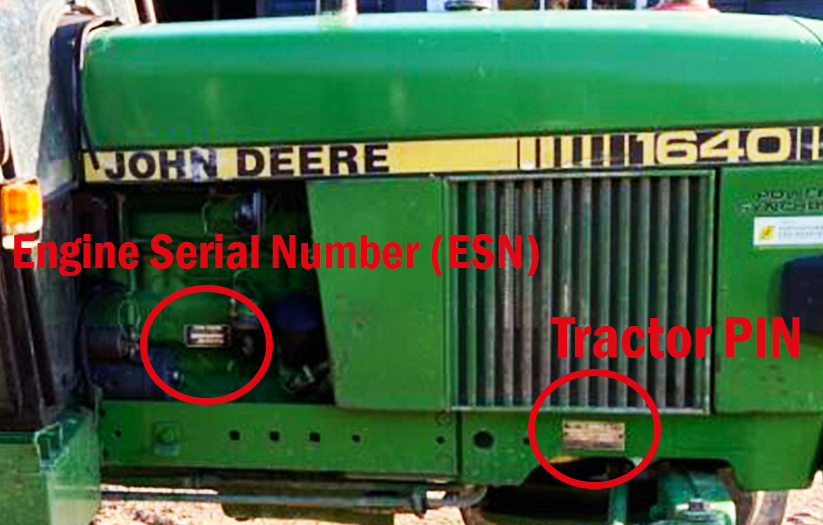
Your tractor’s serial number is the single most important piece of information when sourcing parts. It identifies the exact build of your machine — including the model year, factory options, and mid-production engineering changes. Two tractors with the same model name can require completely different parts depending on their serial number range.
The serial number is typically located on a metal plate on the frame, dashboard, or engine block. On John Deere tractors, check the left side of the frame near the front axle. Kubota serial plates are often near the rear axle or on the dash pillar. Once you have it, use our Search By Model tool at fieldandfleetparts.com to narrow down compatible parts instantly.
Reading the Operator’s Manual and Parts Catalog
Every tractor comes with an operator’s manual, and most manufacturers also publish a separate parts catalog (also called a parts book or IPL — Illustrated Parts List). These documents contain exploded diagrams of every assembly on your machine, with each component labeled with its part number.
You can often find digital versions of parts catalogs on the manufacturer’s website or through online archives. Simply locate the diagram for the assembly you’re working on, identify your component in the illustration, and match it to the corresponding part number in the index table.
Decoding Superseded Part Numbers
Manufacturers frequently update parts during a model’s production run. When a part is revised or replaced, the old number is superseded by a new one. If you search for an old part number and come up empty, it may have been superseded.
When you shop at Field & Fleet Parts, our team and catalog system cross-references superseded numbers automatically. If you enter an older part number, we can identify the current equivalent so you always receive the right component.
When the Part Number Is Completely Missing
Sometimes a part is too corroded, damaged, or worn to read any markings. In that case, use these strategies to identify what you need:
- Take clear, well-lit photos of the part from multiple angles
- Measure critical dimensions: diameter, thread pitch, port size, length, and bolt patterns
- Note any nearby components that are still readable — they can help narrow down the assembly
- Contact our expert support team at Field & Fleet Parts — our staff can often identify parts from photos and measurements
We’re available by phone and WhatsApp to help you get the right answer before you place an order.
Final Tips for Ordering the Right Tractor Parts
Always double-check the part number against your serial number range before ordering. Even identical-looking parts may differ internally. If you’re buying aftermarket, look for parts that list OEM cross-reference numbers — that’s a sign the manufacturer has validated compatibility.
Ready to find your part? Visit fieldandfleetparts.com, enter your part number or browse by brand and model, and get your equipment back in the field fast. We offer fast nationwide shipping on orders over $199 and a 30-day hassle-free return policy.