

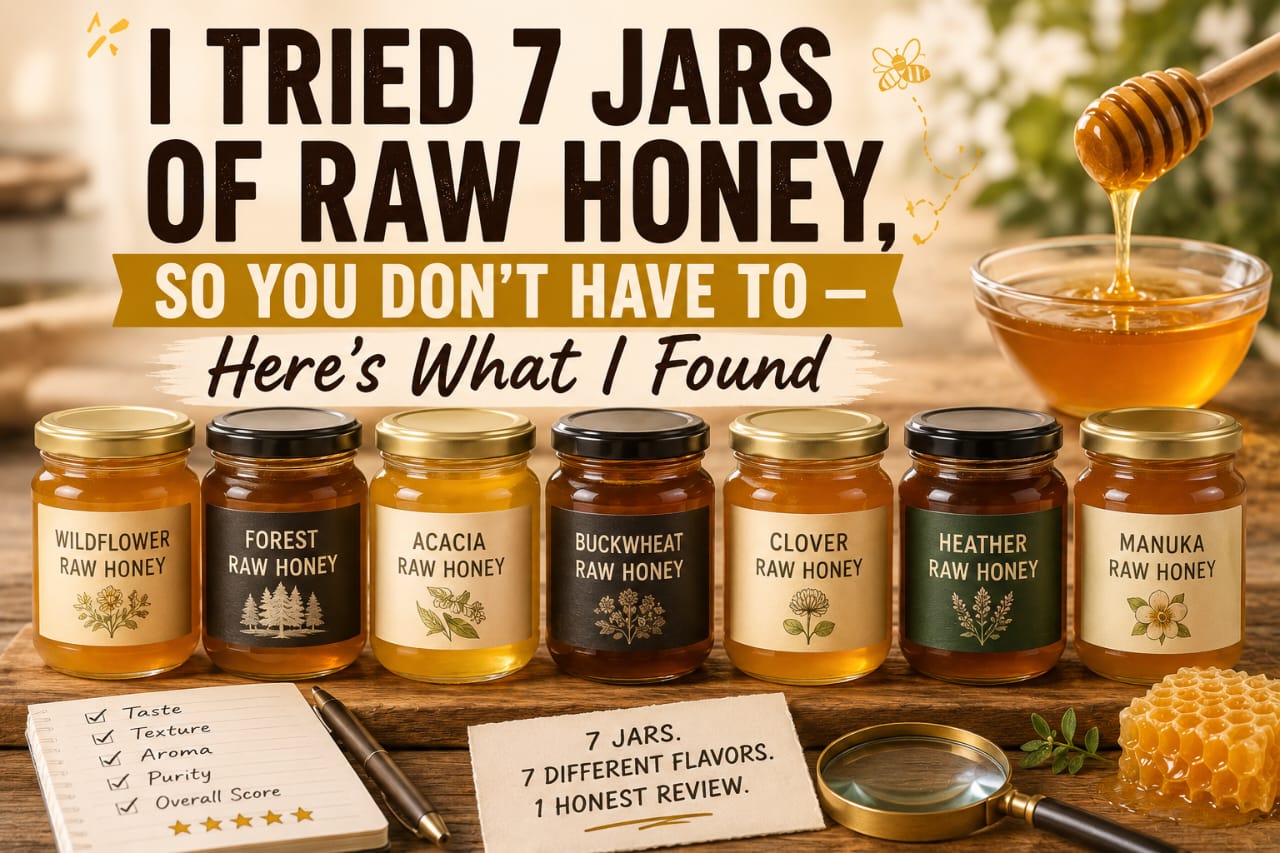
A friend swore by raw honey, not the golden runny stuff from the supermarket, but the thick, cloudy, almost grainy kind that comes in a small jar with a handwritten label. She said it was the only thing that actually helped her through winter. I was sceptical, but desperate enough to give it a go.
That was the beginning of a bit of an obsession.
Over the following months, I worked my way through seven different jars of raw honey from various UK producers, farmers’ markets, and online shops. Some were brilliant. Some were disappointing. A couple were frankly not worth the premium price tag. Here’s an honest account of what I learned., and what you should actually look for if you want the best raw honey UK has to offer.
First, Let’s Clear Up the Confusion
Walk into any health food shop in Britain and the honey section will dazzle you with buzzwords. “Natural.” “Pure.” “Unfiltered.” “Cold-pressed.” “Raw.” They’re often used interchangeably on packaging, but they genuinely don’t mean the same thing.
Raw honey, in the truest sense, is honey that has never been heated above the natural temperature of a beehive, roughly 35 to 40 degrees Celsius. Most commercial honey gets heated well beyond that during processing to make it runnier, clearer, and longer-lasting on a shelf. Convenient for supermarkets, but not great for you.
That heat destroys enzymes like diastase and glucose oxidase that are naturally present in honey. It degrades the antioxidants. It kills off the pollen traces that carry much of the nutritional complexity. What you’re left with is something that tastes sweet but has lost a lot of what made it interesting in the first place.
Genuinely raw honey looks different, too. It’s often cloudy, sometimes opaque, and it crystallises faster than processed honey. A lot of people see crystallisation and assume the honey has gone off, but it hasn’t. It’s actually a sign of quality. Raw honey with a high glucose content will always crystallise eventually, and you can simply warm the jar gently in a bowl of warm water to soften it.
What I Looked for in Each Jar
Before diving into what I tried, here’s the rough checklist I used when evaluating each one:
Origin transparency: Does the label name a specific beekeeper, farm, or region? Or is it vague about where the honey actually comes from? “Produce of more than one country” is a red flag. A named apiary or county is a good sign.
Processing method: Is it genuinely unheated and only coarsely strained? Some brands use “raw” loosely while still putting the honey through fine filters that strip out pollen and propolis.
Harvest date: This matters more than most people realise. Honey is at its enzyme-rich best when it’s fresh. A best-before date stamped on the lid tells you nothing about when the honey was harvested. A proper harvest date does.
Taste and texture: Ultimately, the proof is in the spoon. Good raw honey should have complexity, floral notes, earthy undertones, and a lingering finish. It shouldn’t just taste like sugar.
What the UK Has to Offer
Britain actually produces some genuinely excellent raw honey, though it doesn’t always get the recognition it deserves next to the more aggressively marketed imported varieties.
British wildflower honey is where things get really interesting. The flavour profile changes depending on the region — honey from bees foraging across Exmoor’s meadows and hedgerows will taste quite different from honey produced in the Scottish Highlands, where heather plays a much bigger role. Both are delicious, but in distinctly different ways. Heather honey in particular has an almost jelly-like texture when undisturbed and a rich, slightly tannic flavour that divides opinion but is genuinely unlike anything else.
Urban honey has also had a moment in the UK over the past decade. Producers like Bermondsey Street Bees have shown that cities can produce surprisingly complex and high-quality honey — London’s parks, gardens, and green spaces give bees access to a diverse range of plants, and that diversity shows up in the flavour.
Manuka honey dominates the premium end of the UK market, but it’s worth being clear-eyed about it. Genuine high-grade Manuka from New Zealand does have well-documented antibacterial properties thanks to its methylglyoxal (MGO) content. But the UK market is saturated with products that use the Manuka name without delivering meaningful MGO levels. If you’re buying Manuka specifically for its antibacterial properties, look for a verified MGO rating, ideally MGO 250+ or higher, from a producer who can actually back it up. If you’re buying it simply because it tastes good, a quality British raw honey will do just as well and cost you considerably less.
The Honest Verdict on Buying Raw Honey in the UK
After seven jars and several months of spooning honey onto everything from porridge to cheese, here’s where I landed:
The best raw honey in the UK isn’t necessarily the most expensive or the most exotically sourced. It’s the most transparent. The jars I trusted most were the ones that told me exactly where the honey came from, who kept the bees, when it was harvested, and how it was processed. That level of honesty tends to reflect a producer who genuinely cares about what they’re selling.
Local farmers’ markets remain one of the best places to find genuinely raw, single-apiary honey in the UK. You can often speak directly to the beekeeper, ask about their process, and taste before you buy. That experience is hard to replicate online, and the honey is usually fresher than anything that’s been sitting in a warehouse.
If you are buying online, look for small-batch producers who name their source and publish their harvest dates. Read the label properly before you buy. And if it just says “honey” with a generic countryside scene on the front — put it back.
A Few Ways to Actually Use It
One thing that trips people up: using raw honey in recipes that involve heat largely negates the point of buying raw in the first place. Baking it into a flapjack or stirring it into a curry is perfectly fine, you’ll get the flavour, but the enzymes and antioxidants will be destroyed by the cooking process.
To get the most out of a good jar, use it cold or warm. Drizzle it over Greek yoghurt. Stir it into lukewarm tea. Spread it generously on sourdough with good butter. Take a spoonful when you feel a cold coming on. These are the moments where raw honey earns its place, and where the difference between a jar worth buying and one that isn’t becomes immediately obvious.
The Bottom Line
Good raw honey is out there in the UK, you just have to know what you’re looking for and be willing to look beyond the supermarket aisle. Prioritise transparency, traceability, and taste over branding and health claims.
Once you find a producer you trust, you’ll keep going back. And your kitchen cupboard will never look quite the same again.