

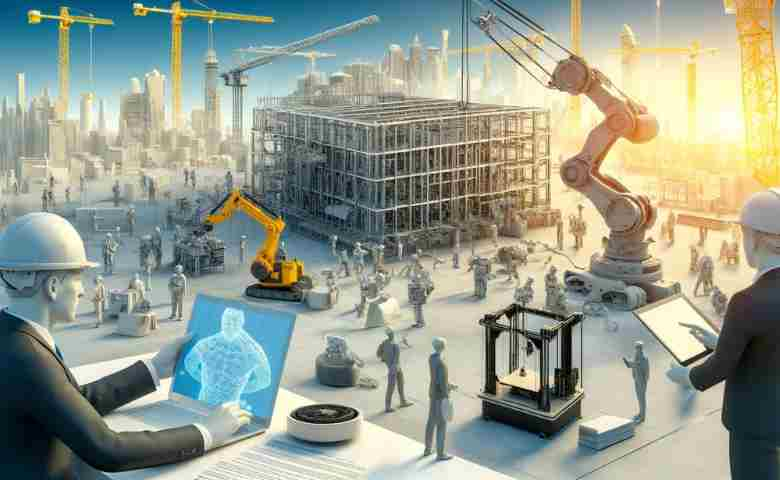
The construction sector in the UAE illustrates how technological advances impact businesses worldwide. The construction industry in the UAE is one of the world’s fastest-growing and is adopting technological innovations. The focus is on project efficiency, safety, and environmental sustainability. The investment in AI, robotics, 3D printing, and Building Information Modelling illustrates that technology is now crucial for competitiveness in the UAE’s ever-changing landscape.
Digital Transformation in the Construction Industry of the UAE
The acceleration of the construction company UAE is directly linked to the government’s agenda for smart city projects. Programs such as Dubai’s Urban Master Plan of 2040 and Abu Dhabi’s Vision 2030 are leading to the growing acceptance of advanced technology. This has also prompted construction firms to upgrade from old to more streamlined and adaptive methods.
The construction industry is transforming in many ways, and one of the critical components is Building Information Modelling or BIM as it is more popularly known. It allows for better cooperation among different specialists in construction by creating detailed digital models, which aid in having accurate shared virtual models of the tangible and operational attributes of the structures. This is exactly why the emirate has made BIM a legal requirement for many big projects in Dubai, as it is essential for modern construction.
Improving Productivity and Saving Money
Using technology increases productivity because it automates repetitive and monotonous work and minimises errors. Construction teams can efficiently manage schedules, finances, and personnel with bespoke project management tools, Procore, or Autodesk Construction Cloud. Real-time drone site inspections and surveys lessen the need for manual inspections and streamline the surveying process.
Moreover, technology, robotics, and advanced machinery enable prefabrication and modular construction, thus reducing construction time and expenses. These construction techniques are particularly emerging in the United Arab Emirates on residential buildings and hospitality projects, where deadlines are stringent and labour costs are elevated.
Technology for Construction Safety and Risk Management
Due to the nature of the work, construction is among the most dangerous industries, and the safety of employees is a predominant issue. Fortunately, technological advancements have developed solutions that lower such risks. Wearable technology can track employee vitals, fatigue, and hazardous material exposure. Structural weaknesses and unsafe conditions that may cause an accident can be prevented with the use of sensors and IoT devices.
Safety walkthrough simulations and training are conducted using AR and VR, allowing employees to interact with lifelike construction scenarios and learn to manage difficult situations without any real danger.
Building and Construction Sustainability in the UAE
In the construction industry of the UAE, technology plays an important role in environmental sustainability efforts. Smart building technologies are capable of meeting the green building standards of Estidama and LEED. Additional technologies include HVAC energy systems, integration of solar energy, as well as smart lighting and automated water systems which respond to occupancy and environmental factors.
Sustainability concerns are being addressed in the construction industry with the adoption of 3D printing. Currently, Dubai holds the record for the largest standalone 3D-printed building. This technology reduces construction waste, lowers the cost of necessary construction resources, and significantly accelerates the construction period, which directly assists construction sustainability efforts.
The Integration of AI and Machine Learning into Construction
The adoption of AI and Machine Learning is transforming construction planning and execution. The technologies can predict delays, allocate resources, and make material forecasts through the analysis of complex data sets. In the UAE, smart AI technologies are being used to pre-simulate complex builds to gain valuable insights that aid in the reduction of expensive on-site error work.
Robotics, like AI, is used for bricklaying, painting, or welding to increase productivity and enhance precision. This shift not only boosts quality but also reduces the need for skilled workers, alleviating workforce manpower issues in the UAE.
Tech Integration Hurdles
The construction industry is lagging in tech integration for a reason. Reluctance to adopt new technology, a shortage of skilled employees, and high upfront investments are a few hurdles in tech adoption. Regardless, UAE construction firms are implementing these solutions with training campaigns, collaborations with tech companies, and innovation-focused government funding.
There is good news, though. A younger and more digitally aligned workforce is willing to embrace these changes in the form of new engineering and project management roles.
Conclusion
Technology is transforming construction companies in the UAE. It aids in operations management, boosts safety measures, supports eco-friendly practices, and drives project success in a flourishing industry. As growth plans continue, construction companies need to keep up by adopting the latest technologies and training employees to make the most of digital change.
In a country that’s always looking to the future, the construction sector must not only build for tomorrow but build with tomorrow, by integrating smart, efficient, and sustainable technologies into every project.