

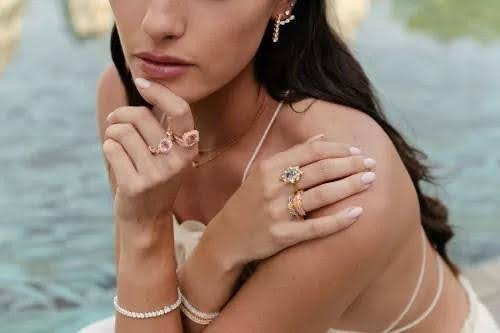
This article isn’t here to lecture you or be overly cautious. It’s here to walk you through the actual science and real-world situations that explain exactly why wearing real diamond jewelry for women to the beach is such a risky call, and what you can do instead to keep your pieces safe without sacrificing style.
Saltwater Is Far More Destructive Than You Think
Most people assume that diamonds, being the hardest natural substance on earth, are basically indestructible. And in terms of scratch resistance, that’s largely true. But hardness and resistance to chemical damage are two completely different things, and this is where a lot of jewelry owners get caught off guard.
Ocean water contains a complex mix of sodium chloride, magnesium, sulfates, and dozens of other minerals and trace elements. When this water comes into contact with the metal settings of your diamond rings or earrings, it begins a process of slow but steady corrosion. Gold alloys, which most fine jewelry settings are made from, contain metals like copper, silver, and zinc that react with chloride ions over time. Even 18 karat gold, which is roughly 75 percent pure gold, still has enough alloying metals to suffer from this kind of salt exposure.
White gold is particularly vulnerable because it typically has a rhodium plating on the surface to give it that bright, reflective finish. Saltwater strips this plating faster than almost anything else. After even a few beach trips, you might notice your white gold diamond rings looking slightly yellowish or dull, and that’s exactly what’s happening underneath the surface.
Worth Knowing
Platinum holds up somewhat better to saltwater than gold alloys, but the prongs and settings that hold your diamond in place can still loosen over time with repeated saltwater exposure. A loose diamond is a lost diamond, and that’s a loss no insurance claim fully makes up for.
What Sand Actually Does to Your Diamond Earrings
Sand might look soft and harmless, but each grain is essentially a tiny rock. Specifically, most beach sand is made up of quartz, feldspar, and other mineral fragments that sit at a Mohs hardness of around 7. A diamond rates a 10 on that same scale, so no, sand won’t scratch the diamond itself.
The problem is everything around the diamond. The metal prongs that hold your stone in place, the setting, the band of your ring, the posts and backings on your diamond earrings, all of these are significantly softer than sand. Tiny abrasions happen with every wave, every time you run your hands through the sand, every shake to dry off. Over months and years, this dulls the finish on your jewelry and, more importantly, slowly wears down the structural integrity of the settings.
A prong that has been gently abraded by sand dozens of times is thinner than it was before. Thinner prongs hold your diamond less securely. It’s a slow process, but it absolutely adds up, and many jewelers will tell you that setting damage from environmental wear is one of the top reasons diamonds fall out of their mountings.
“The beach doesn’t destroy your jewelry in one dramatic moment. It does it quietly, trip by trip, until one day you look down and the stone is just gone.”
Sunscreen and Chlorine: The Double Threat You’re Overlooking
Here’s a detail that almost nobody thinks about: the sunscreen you apply before hitting the beach. You rub it on your arms, your shoulders, your neck, and inevitably some of it ends up on your jewelry. Sunscreens contain a range of chemicals including avobenzone, oxybenzone, titanium dioxide, and various oils and emollients. These substances build up in the tiny crevices of your jewelry settings, around prong bases, and in the grooves of pavé or halo settings.
By itself, this might just cause a dull, grimy buildup on your real diamond jewelry for women. But combine it with saltwater and sand, and you’ve created a paste that traps abrasive particles right against your metal and stone, grinding away with every movement. If you’ve ever noticed that your diamonds look cloudy or lifeless after a beach vacation, this is almost certainly why.
And if you decide to rinse off in a pool or hotel hot tub after the beach, you’re adding chlorine to the equation. Chlorine is particularly harsh on gold alloys and can cause a condition called stress corrosion cracking in karat gold, where microscopic cracks form in the metal over time. You may not see this damage right away, but it weakens the structure of your jewelry in ways that become obvious later.
The Risk of Loss Is Very, Very Real
Beyond the question of damage, there’s the more immediate and devastating possibility of simply losing your jewelry in the ocean or on the beach. Cold water causes your fingers to contract, and a ring that fits perfectly at home can slide off effortlessly when you’re wading into the surf. This is one of the most common ways people lose diamond rings at the beach, and the vast majority are never recovered.
Earring backs are notorious for coming loose in waves. The force of water hitting your ears, combined with the motion of swimming, is often enough to dislodge a butterfly back or push back and send it to the ocean floor. Stud-style diamond earrings are especially at risk because the standard friction back just wasn’t designed to compete with wave pressure.
Rings on toes, anklets, and other jewelry worn lower on the body face similar odds. The beach, honestly, is just not a safe environment for any place you’d be genuinely devastated to lose. And most people wearing real diamond jewelry for women would be genuinely devastated.
| 01
Store your fine jewelry in a small zip pouch in your beach bag before you leave the car. Never leave it in the hotel room unsecured. |
02
If you must wear something to the beach, choose fashion jewelry or costume pieces with similar aesthetics to your real diamond earrings. |
| 03
Cold water causes ring finger shrinkage. Even a well-fitted diamond ring can slip off in ocean water without you feeling it happen. |
04
After any accidental exposure, rinse your jewelry with fresh lukewarm water immediately and have it professionally cleaned as soon as possible. |
Heat, UV Exposure, and What It Does to Colored Stones and Settings
Pure diamonds are generally stable under heat and UV light, but the same can’t be said for everything around them. If your real diamond jewelry for women includes accent stones like sapphires, rubies, or emeralds set alongside the diamonds, prolonged direct sunlight and heat can affect their color over time. Some treated stones are especially vulnerable to this. Beach days typically involve hours of direct sun exposure, which adds up over a season of wear.
More practically, intense heat from lying on hot sand or sitting on a sun-soaked surface can weaken adhesives used in certain setting styles. Some modern jewelry designs use a small amount of jeweler’s adhesive to secure stones in channel or bezel settings. Heat exposure over time can soften or degrade these adhesives, increasing the chance that a stone works itself loose.
The thermal expansion and contraction that happens when metal heats up in the sun and then plunges into cold ocean water is also worth considering. It’s not dramatic enough to visibly warp your jewelry, but it does contribute to cumulative stress on the metal over many beach trips.
So, What Should You Actually Do?
The honest answer is simple: leave your fine diamond jewelry at home on beach days. That doesn’t mean you have to look bare or feel underdressed. The market for beautiful, convincing costumes and fashion jewelry has grown enormously, and there are genuinely stunning options that mimic the look of diamond earrings and diamond rings without any risk.
Stainless steel, sterling silver, or gold-plated fashion pieces look beautiful in beach photos and hold up well to saltwater and sun. There’s also a growing category of waterproof jewelry made specifically for active and outdoor wear, some of which is quite beautiful.
If you have a specific piece that you absolutely want to wear, perhaps because it holds sentimental value and going without it just doesn’t feel right, then at minimum keep it away from the water. Wear it to the oceanside restaurant at sunset, take your photographs, and take it off before you get near the waves. That’s a compromise most jewelers would still consider too risky, but it’s far better than swimming with it on.
Getting your fine jewelry inspected and cleaned by a professional jeweler every 6 to 12 months is also just good practice regardless of beach habits. This lets a trained eye catch any prong wear, loose settings, or structural issues before a stone goes missing. Many jewelers offer this as a free service for pieces purchased from them, and it’s worth taking advantage of every single time.
A Note on Insurance That Most People Skip
This feels like a slightly separate topic, but it fits in here naturally. If you do own significant real diamond jewelry for women, whether it’s a family heirloom, an engagement ring, or a set of diamond earrings you saved up for years to buy, please make sure it’s properly insured. Standard homeowner’s or renter’s insurance often has a very low sublimit for jewelry loss, sometimes as low as $1,000 to $1,500 for a single item.
A dedicated jewelry insurance policy through a specialty insurer like Jewelers Mutual or through a rider on your existing policy will cover you for loss, theft, and damage, often including mysterious disappearance, which is what they call when a stone simply vanishes, and you don’t know exactly how. Beach losses would almost certainly fall under this category. It’s not expensive relative to the value of what you’re protecting, and peace of mind is worth it.
The Bottom Line
Your diamond jewelry is beautiful, valuable, and in most cases irreplaceable in some way, whether financially or emotionally. The beach is one of the most hostile environments you can put it in, between saltwater, sand abrasion, sunscreen buildup, the physical risk of loss in the waves, and heat cycling.
Leaving your diamond rings and diamond earrings at home on beach days isn’t overly precious about jewelry. It’s just being smart about protecting something that matters to you. The beach will always be there. Your grandmother’s diamond earrings, once they hit the ocean floor, are gone forever.
Wear your fine pieces to dinner after the beach. Wear them to the sunset walk along the boardwalk. But when the waves are calling, leave them somewhere safe and let yourself enjoy the water without that quiet anxiety in the back of your head. That’s a pretty good trade.