

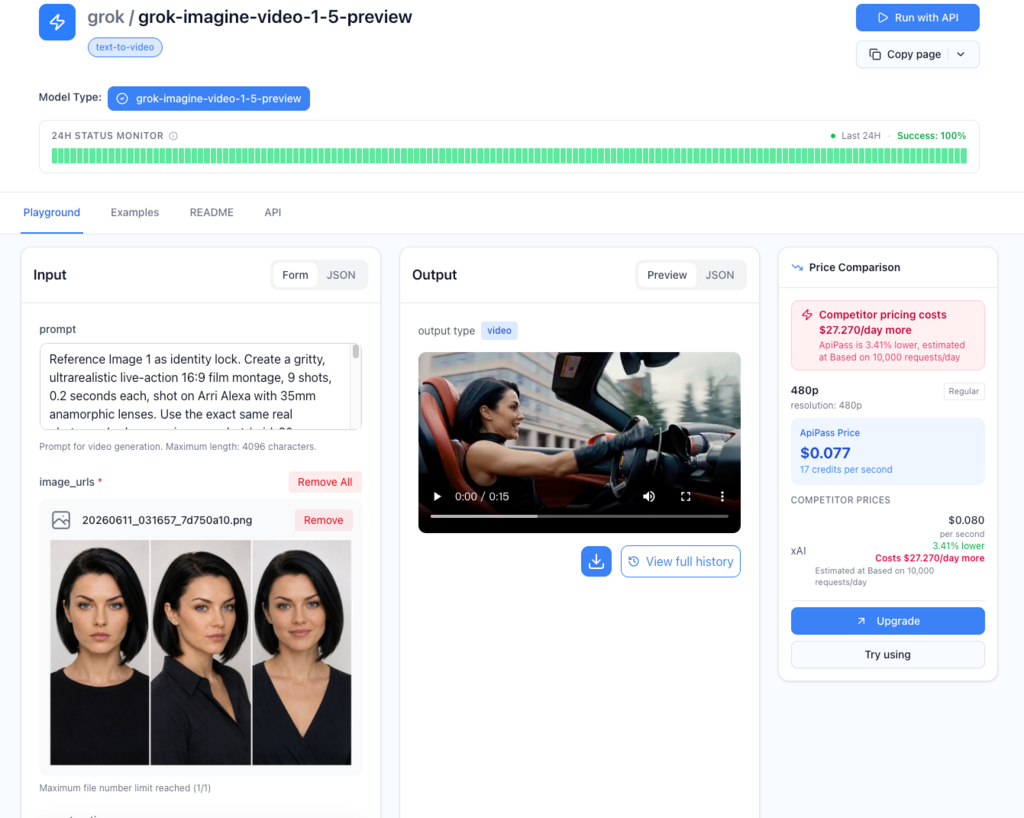
Introduction
The landscape of generative AI is evolving at a rapid pace. New, powerful models like Grok Imagine API push the boundaries of creative possibility every day.Developers increasingly integrate these sophisticated AI capabilities into core products. This rapid adoption creates a massive demand for reliable, efficient, and cost-effective access layers.
This guide delves into the top 10 AI model API proxy services dominating the tech ecosystem in 2026. We focus heavily on how each platform supports and optimizes access to the groundbreaking Grok Imagine API.We assess everything from onboarding ease to overall cost predictability. Our goal is to ensure you find the perfect partner for your enterprise AI endeavors.
Quick Comparison Table: Top 10 AI Model API Proxies for Grok Imagine API
| Platform | Pricing Model Type | Grok Imagine Image Cost | Grok Imagine Video Cost | Special Features |
| ApiPass | Pay-As-You-Go ($) | $0.020 per run | $0.009 per sec | Unified Endpoints, Audio-Visual Sync |
| Fal AI | Request-Based ($) | $0.020 per image | $0.050 per second | Containerized Sandbox, Fine-grained Edits |
| Replicate | Request-Based ($) | $0.050 per image | $0.070 per second | Community Models, Massive Open Infrastructure |
| WaveSpeed | Pay-As-You-Go ($) | $0.025 per run | $0.020 per second | High-throughput, Multi-Model Swapping |
| Crun | Token / Instance | $0.015 per run | $0.015 per second | Custom Model Deployment, Corporate Security |
| Poyo | Tiered Subscription | $0.028 per run | $0.030 per second | Visual Pipeline Focus, Vision Layering |
| AtlasCloud | Pay-As-You-Go ($) | $0.030 per run | $0.025 per second | Automated Multi-Region Load Balancing |
| ApiFrame | Credit-Based ($) | $0.022 per run | $0.020 per second | API Gateway Management, Security Auditing |
| ApiMart | Pay-Per-Request ($) | $0.023 per run | $0.025 per second | Unified Cross-Utility Corporate Billing |
| Kie | Pay-As-You-Go ($) | $0.035 per run | $0.035 per second | Developer-Centric Open Source Library |
Detailed Breakdown
Let us dive deeper into each platform, examining their unique architectural offerings and how they empower developers with Grok Imagine API access.
1.ApiPass
Features
ApiPass stands out as a premium overseas AI API proxy site. It simplifies developer access to cutting-edge AI foundation models. It provides a highly optimized unified endpoint. This single gateway drastically reduces the software engineering complexity of integrating multiple separate AI providers.
For the Grok Imagine API, ApiPass offers seamless, direct access. You can leverage the proxy infrastructure instantly using a single, unified authorization token.
Its robust global network infrastructure is carefully engineered for high reliability and ultra-low latency. This ensures your downstream AI applications perform consistently.The platform focuses heavily on the overall developer experience. They offer extensive, well-structured documentation that guides users effortlessly through integration.
Pros
- Unified API for Grok Imagine API simplifies your system architecture.
- Genuine Pay-As-You-Go pricing yields predictable rates with zero hidden fees.
- Superior developer onboarding provides easy-to-follow technical documentation with multiple SDKs.
- High reliability ensures consistent uptime and global edge performance optimization.
Cons
- Potential minor regional latency challenges depending on user location.
- Fewer niche, community-trained checkpoint weights compared to open-source code repositories
Pricing
- Grok Imagine Text to Image: $0.020 per run
- Grok Imagine Text to Image (Pro): $0.027 per run
- Grok Imagine Image to Video: $0.009 per second
- Grok Imagine Text to Video: $0.009 per second
- Grok Imagine Video 1.5 Preview: $0.015 per second
Best For
Developers, fast-moving startups, and established enterprises seeking a seamless, cost-effective pathway. It is ideal for teams valuing transparent billing.
ApiPass is the clear winner for overall developer experience and frictionless access to cutting-edge generative AI models.
-
Fal
Features
Fal provides an optimized, completely serverless GPU infrastructure. It is tailored specifically for running complex, heavy diffusion AI models efficiently.The platform specializes in on-demand, high-performance inference. This architecture makes it exceptionally well-suited for highly dynamic or unpredictable user workloads.
For Grok Imagine API, Fal offers an isolated containerized sandbox environment. Models execute rapidly without requiring you to manage underlying hardware stacks.
Pros
- Pure serverless, on-demand raw GPU access layers.
- Incredible inference generation speeds for heavy visual assets.
- Massive library of popular pre-integrated open generative models.
Cons
- Overall monthly pricing can become highly unpredictable with highly variable client GPU usage.
- Requires a foundational understanding of serverless lifecycle and deployment concepts.
Pricing
- Grok Imagine Video (480p): $0.050 per second
- Grok Imagine Video (720p): $0.070 per second
- Grok Imagine Image (Standard): $0.020 per image
Best For
Developers needing flexible, deeply scalable GPU inference power for rapid prototyping and containerized deployments in a serverless cloud environment.
-
Replicate
Features
Replicate focuses on running, hosting, and fine-tuning open-source machine learning models directly within a managed cloud platform.It provides an intentionally simple API gateway to run models. This abstracts away the heavy lifting of infrastructure maintenance and hardware provisioning.
For Grok Imagine API equivalents, Replicate allows teams to spin up powerful image and video pipelines with minimal code overhead.
Pros
- Vast, community-driven catalog of open-source models and customized weights.
- Clean, hyper-focused API designed specifically for machine learning pipelines.
- Scales your underlying server count automatically with incoming consumer demand.
Cons
- Primary operational focus is open-source weights.
- Production costs can fluctuate rapidly based on raw execution duration.
Pricing
- Grok Imagine Image (1k): $0.050 per image
- Grok Imagine Image (2k): $0.070 per image
- Grok Imagine Video: $0.070 per second
Best For
Researchers, independent developers, and hobbyists who want rapid cloud access to a massive variety of community-maintained AI model variations.
-
WaveSpeed
Features
WaveSpeed is built from the ground up for high-throughput, real-time AI model inference performance.The architecture aims to drastically minimize packet latency for demanding, enterprise-scale production applications.
For Grok Imagine API integrations, this infrastructure focus means delivering finished image or video payloads back to your users with impressive speed.
Pros
- Extremely high-speed packet processing and minimal network latency.
- Fine-tuned specifically for real-time user-facing applications.
- Highly reliable infrastructure performance even under massive concurrent stress.
Cons
- Can prove significantly more costly for casual, low-volume, or hobbyist projects.
- Intense focus on pure performance limits advanced visual custom-tuning interfaces.
Pricing
- Grok Imagine Image: $0.025 per run
- Grok Imagine Video: $0.020 per second
Best For
Mid-market enterprises requiring lightning-fast, highly responsive model inference for real-time visual creation platforms and automated high-volume content workflows.
-
Crun
Features
Crun positions its platform as an enterprise-grade AI management solution. It offers robust tools for deploying models at massive scale.The service places immense operational emphasis on corporate security compliance, data privacy protection, and customized model deployments.
For Grok Imagine API, Crun provides an exceptionally secure, fully governable proxy environment for smooth corporate system integrations.
Pros
- Deep enterprise focus featuring strict security, auditing, and compliance structures.
- Dedicated custom model orchestration and resource management dashboards.
- Highly resilient, scalable infrastructure built for massive corporate operations.
Cons
- Possesses a significantly higher financial entry barrier for early-stage teams.
- Onboarding can require tedious vendor compliance and setup processes.
Pricing
- Grok Imagine Image: $0.015 per run
- Grok Imagine Video: $0.015 per second
Best For
Large organizations with stringent compliance and internal governance standards needing secure corporate integration for advanced generative model tools.
-
Poyo AI
Features
Poyo AI specializes heavily in the visual AI domain. They offer a tailored suite of tools focused on image generation and video analysis.For Grok Imagine API users, Poyo AI provides streamlined pipeline routing. It allows you to layer advanced visual analysis tools directly on top of raw outputs.
Pros
- Deep, specialized product focus on advanced computer vision ecosystems.
- Curated pre-trained secondary models accelerate complex multi-stage asset development.
- Unified pipeline handling for image manipulation, tagging, and synthesis.
Cons
- Offers weak infrastructure support for text-only or non-visual LLM tasks.
- Complex bundled subscription billing makes granular single-call pricing difficult.
Pricing
- Grok Imagine Image: $0.028 per run
- Grok Imagine Video: $0.030 per second
Best For
Creative design agencies and production studios seeking a comprehensive visual ecosystem where Grok Imagine acts as a piece of a larger pipeline.
-
AtlasCloud
Features
AtlasCloud provides an intelligent multi-cloud AI infrastructure layer. It allows companies to route heavy AI workloads across diverse cloud hardware vendors dynamically.This multi-cloud orchestration helps optimize operations for local egress charges, hardware availability, or regional regulatory compliance laws.
For Grok Imagine API deployment, this allows teams to easily leverage the lowest global routing fees through a centralized management proxy.
Pros
- Incredible multi-cloud flexibility protecting against single-vendor outages.
- Inherent automated cost-optimization routing built directly into the gateway.
- Completely abstracts complex underlying hyperscaler account networks.
Cons
- Structuring and debugging multi-cloud pipelines introduces architectural complexity.
- Requires software teams to understand nuanced cloud provider data transfer fee differences.
Pricing
- Grok Imagine Image: $0.030 per run
- Grok Imagine Video: $0.025 per second
Best For
Scalable software platforms with massive daily volumes requiring highly resilient, multi-region fallback protection and optimized infrastructure routing.
-
ApiFrame
Features
ApiFrame operates as a robust, centralized API gateway management solution built specifically to govern diverse AI dependencies.The platform provides standard enterprise management features like edge caching, active rate-limiting, secure authentication tokens, and real-time usage analytics.
Integrating Grok Imagine API through ApiFrame grants you immediate visibility into consumption metrics across your entire software ecosystem.
Pros
- Centralized dashboard governance for all your third-party AI assets.
- Enhanced operational security protocols, active tracking, and error logging.
- Highly standardized request/response formats across completely different AI providers.
Cons
- Adds an intermediate proxy hop layer to your software application.
- Edge caching requires careful developer tuning to avoid stale asset delivery.
Pricing
- Grok Imagine Image: $0.022 per run
- Grok Imagine Video: $0.020 per second
Best For
Product managers and lead engineers overseeing complex application ecosystems who require tight administrative control and analytics for their AI spend.
-
ApiMart
Features
ApiMart operates as an expansive developer API marketplace hub. It allows software teams to discover, buy, and manage hundreds of distinct software utilities.For Grok Imagine API access, ApiMart serves as a consolidated billing portal. It allows you to combine your AI spend alongside other business APIs.
Pros
- Convenient centralized billing for completely unrelated production development utilities.
- Simple portal interface simplifies early technical discovery and sandboxed testing.
- Built-in marketplace consumption analytics and simple keys.
Cons
- Functions primarily as a broker rather than a dedicated high-performance AI proxy.
- Direct technical customization options for Grok Imagine are highly limited.
- High-volume scaling capabilities require intensive pre-production manual configuration.
Pricing
- Grok Imagine Image: $0.023 per run
- Grok Imagine Video: $0.025 per second
Best For
Prototyping teams and internal tools developers who want to keep all vendor billing inside a single unified marketplace account.
-
Kie
Features
Kie is an explicitly developer-centric proxy service. They focus on making highly advanced foundation models accessible via simple integration strategies.The platform promotes transparent model serving, detailed step-by-step code tutorials, and robust community forum interaction.
For Grok Imagine API pipelines, Kie offers straightforward API endpoints. These help engineers push products from development to production rapidly.
Pros
- Highly responsive developer tools and copy-paste ready documentation.
- Minimal system setup overhead facilitates rapid product experimentation.
- Vibrant community forum providing crowd-sourced troubleshooting assistance.
Cons
- Lacks deep, customizable enterprise compliance frameworks for legacy corporate networks.
- High-volume scaling capabilities require intensive pre-production manual configuration.
Pricing
- Grok Imagine Image: $0.035 per run
- Grok Imagine Video: $0.035 per second
Best For
Independent software creators, agile development sprint teams, and researchers who prioritize direct documentation and zero platform friction.
Strategic Best Practices for Integrating Grok Imagine API via Proxies
To ensure high availability and cost-efficiency when routing Grok Imagine API requests, implement the following four foundational practices:
IP Rotation & Anti-Throttling
xAI enforces strict rate limits per IP address. Route requests through a distributed pool of residential or data center proxies to prevent cascading 429 Too Many Requests errors. Use round-robin routing alongside randomized delays to mimic organic traffic distribution across endpoints.
Smart Caching & Storage Optimization
Because the Imagine API bills per generation, processing duplicate prompts wastes budget. Implement a Redis-backed caching layer that hashes prompt strings and styling parameters. If a match exists, serve the cached image URL directly instead of hitting the xAI endpoint.
Failover & Automated Retry Policies
Network hiccups shouldn’t break your user experience. Configure an automated circuit breaker pattern. When a proxy node fails, the gateway should instantly retry the request using a clean proxy from a backup zone before throwing a client-side timeout.
Secure Header Management
Never expose your primary xAI API keys to proxy logs or client applications. Strip all sensitive metadata at your internal gateway, inject the authorization tokens securely on the server side, and enforce TLS 1.3 across all proxy hops to safeguard payloads in transit.
Final Thoughts
Integrating a proxy layer with the Grok Imagine API is not just about avoiding rate limits—it is a prerequisite for production-grade stability. By shifting traffic management, caching, and credential isolation to a dedicated proxy architecture, you protect your system budget and ensure a seamless, resilient media-generation workflow at scale.
For developers targeting cutting-edge motion generation pipelines, choosing a proxy that natively supports advanced infrastructure nodes is vital. For teams requiring an optimal balance of frictionless setup, clear verified pricing, and elite developer support, ApiPass establishes the premium gold standard for 2026. This is especially true when deploying the high-performance Grok Imagine Video API node, which simplifies video asset pipeline orchestration down to a predictable, simple per-second utility.