

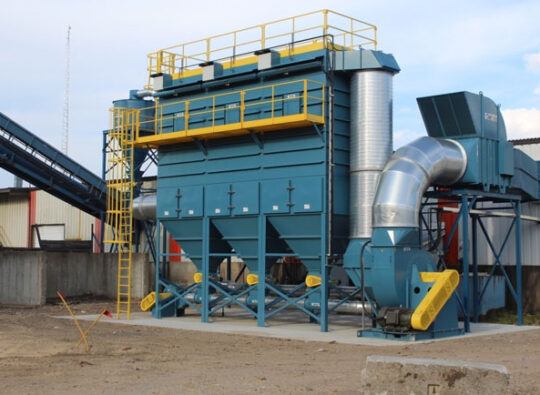
Industrial dust collectors that sometimes called environmental protection dust collectors are systems that capture and filter airborne particulates from factory processes. These collectors are essential for industries like cement, metal and power generation to protect worker health and meet strict air-quality regulations. As a leading industrial dust collector manufacturer and dust collection system supplier we Senotay tracks major market shifts. By 2025, six key trends that from smart IoT systems to greener designs it will shape how dust collection equipment is built and used.
Core Value of dust collector system
- Smart Automation and IoT: Dust collectors are becoming part of the Industrial IoT (IIoT) revolution. Sensors with cloud connectivity and predictive algorithms now enable real-time monitoring with a predictive maintenance and remote control of dust collection systems. In fact, the broader IIoT market is booming (projected to reach about $154.1 billion by 2025), and we see that reflected in connected dust collectors. Companies like Donaldson and Camfil now offer “smart” filtration services (e.g. Donaldson’s iCue system) that track fan power, filter status and emissions in real time. These IoT-enabled dust collectors reduce downtime and improve efficiency and turning filtration into an automated and self-optimizing process.
- Energy Efficiency: With electricity costs and sustainability targets rising, manufacturers demand dust collectors that use less power. Cutting-edge designs use variable-frequency drives (VFDs) on blower fans and heat-recovery measures to reduce consumption. For example, simply recirculating pre-conditioned air instead of exhausting it outdoors can save a plant on the order of $126,000 per year and hundreds of tons of CO₂. In any case, the fan motor is by far the biggest power draw in a dust collector, so companies focus on precise airflow control and low-resistance filter media. Industry sources report that poor filter maintenance can increase a fan’s energy use by 20–55%, so modern systems combine better filters with energy-optimizing controls to hit aggressive efficiency targets.
- Advanced Filtration Materials: New filter media are with transforming performance. Nanofiber and membrane technologies now enable far higher capture efficiency and longer filter life. Market analyses note “advancements in nanofiber filter materials and membrane filtration technologies” that boost efficiency and extend service life. In practice that is switching to a nanofiber cartridge filter can dramatically reduce pressure drop and energy use while trapping sub-micron dust. For real example, the electrospun nanofiber layers surface-load dust (particles stay on the filter face) is leading to 50% lower pressure drop and fewer cleaning cycles. These breakthroughs translate into longer filter life, fewer change-outs and significant operating-cost savings. Filter technology continues to advance: PTFE-coated and HEPA-grade media are also gaining popularity for ultra-fine and hazardous dust applications.
- Environmental Compliance: Stricter air-quality regulations are a major driver. Governments worldwide are tightening particulate emission standards in factories then mines and power plants are forcing retrofits and upgrades. Market reports emphasize that “stringent government regulations aimed at environmental compliance” compel industries to adopt effective dust collection systems. In the mean practice, this means dust collectors must meet lower emissions thresholds and support ESG goals. Manufacturers and end-users alike now budget for certified filtration solutions to avoid fines and reduce pollution. As example here in China and India have dramatically cut allowable PM2.5 levels in industrial exhaust and the EU’s Industry 4.0 initiatives similarly push for zero-emission plants. As a result do investment in advanced and compliant dust collectors is accelerating in 2025.
- Modular and Portable Designs: Flexibility and rapid deployment are in demand. Many buyers now prefer skid-mounted or modular dust collection units that can be easily expanded or reconfigured. The market is seeing growing use of plug-and-play and portable collectors. These modular systems – including mobile units for shipyards or temporary construction sites – offer cost-effective scalability. In fact, the portable dust collector segment is forecast to grow at roughly a 6.0% CAGR over the mid-2020s. This trend is fueled by lean manufacturing practices: plants want to move dust collectors to different lines or add capacity without overhauling infrastructure. Vendors now offer customizable modules (with quick connections for ductwork and power), making installation much faster. As a dust collection system supplier we Senotay is responding by providing modular baghouse and cartridge units that can be combined into larger systems as needed.
- Global Sourcing and Localization: this industires Supply chains and sourcing strategies are shifting. Recent trade policies and logistics challenges have led many companies to diversify suppliers and localize production. As a example, Donaldson opened a new dust-collector plant in Pune, India in 2022 to serve South Asian customers more efficiently. Similarly, Camfil is expanding factories outside Europe. For Senotay as a Chinese manufacturer, this trend means both exporting to new markets and adapting products for regional requirements. We see dust-collector buyers in the Americas and Europe increasingly looking for Chinese suppliers with local support. In turn, Senotay maintains warehouses abroad and international logistics networks (as shown by its overseas exhibitions and export services) to meet global demand.
Data Proof
Market research confirms that the industrial dust collector market is robust and growing.one analysis estimates the global market at about $9.6 billion in 2024 that rising to $12.9 billion by 2030 (about 5.2% CAGR). Asia-Pacific dominates this sector: in 2024 it accounted for roughly 36.7% of revenue that led by China’s massive manufacturing base. (See chart above.) This growth is driven by new factories, infrastructure projects and rising environmental standards worldwide.
Industry analysts also note that the emerging trends are already showing up in product rollouts. A recent report highlights that 2023–2025 will see “innovative and sustainable systems… leveraging cutting-edge tech like IoT sensors, advanced filtration, [and] energy-efficient designs”. Leading vendors have announced new models reflecting these trends. For instance, Camfil’s 2023 Gold Series X-Flo dust collector incorporates a novel internal baffle to extend filter life, and Nederman’s 2023 SAVE system dynamically adjusts airflow to cut blower energy. Similarly, filter manufacturers tout nanofiber cartridge media that deliver 99.9% particulate efficiency at lower pressure drop. On the software side, connected filtration services like Donaldson’s iCue (launched in 2021) can continuously monitor a collector’s performance and fan energy usage, issuing predictive alerts.
These innovations are backed by actual demand. The Fortune Business Insights report shows dust collector suppliers (e.g. Donaldson, Nederman, Camfil) heavily investing in smart-filtration R&D. Donaldson, for example, expanded production in India in 2022 to better serve the local market. Senotay’s own activity underscores the trend: on its website Senotay highlights new energy-saving baghouse collectors and electromagnetic diaphragm valves that improve efficiency (see Senotay “News” and “Products” sections). In fact, Senotay stresses ISO 9001/14001/45001 certification and a high-tech R&D team, confirming its focus on quality and innovation.
Future Outlook
Looking beyond 2025 to the dust collection industry will continue evolving toward full intelligence and sustainability. Experts predict that by 2030 most systems will be AI-driven and fully connected: IoT sensors and AI analytics will enable dust collectors to self-optimize filter cleaning intervals and airflow in real time. We also expect advances in greener technology: for example, some firms are exploring solar-powered dust collectors and energy-recovery systems to minimize carbon footprints. Nanotechnology and bio-based filter materials may emerge to capture even finer particles with less waste. Environmental concerns will intensify: rising ESG commitments mean future dust collectors must use recyclable filter media and low-energy designs. Geographically, growth will remain fastest in Asia (with China and India leading), but new markets in Africa and Latin America will open up as industrialization spreads.
Senotay is already positioning itself for this future. The company emphasizes R&D and innovation in its “Senotay Story,” supported by advanced imported equipment. By 2030, Senotay plans to offer more modular IoT-enabled units and next-gen filter options that meet the highest efficiency and eco-standards. In short, we expect dust collectors to become smarter (integrating with factory automation), cleaner (zero-waste operation), and more adaptable (plug-and-play deployment). These developments will help all manufacturers – Senotay included – to satisfy both regulatory demands and customer priorities for sustainable and automated industrial filtration.
Conclusion
In summary, the dust collection industry in 2025 is defined by six core trends – automation/IoT, energy efficiency, advanced filters, compliance, modularity and global supply – all of which are rapidly gaining momentum. For manufacturers and end-users, embracing these trends means better air quality, lower operating costs, and future-proof operations. As a trusted dust collection system supplier in China, Senotay leads the way on each front. We hold multiple international quality and environmental certifications (ISO 9001/14001/45001) with maintain a high-tech R&D team focused on environmental equipment innovation, and use advanced imported machinery to ensure product excellence. With nearly a decade of export experience our Senotay’s products serve customers worldwide and consistently win praise.
Call to action: Contact Senotay today to discuss your dust collection needs. Whether you require a customized baghouse, cartridge collector, or a full turnkey system, Senotay’s experienced engineers and global service network will ensure you get a high-quality, certified solution. Partner with Senotay – a leading industrial dust collector manufacturer – to keep your facility clean, compliant and ready for the future.
Also if you are interested in any other services like cnc machining and machine parts manufacturing then visit this
“MetalworksPlus: Your Partner in Precision.
We specialize in Custom Metal Fabrication and Precision CNC Machining Services () (including Milling, Turning, and Prototyping), offering high-quality CNC Precision Parts and Machine Parts.
If you are interested in these services or products, please visit us!”