

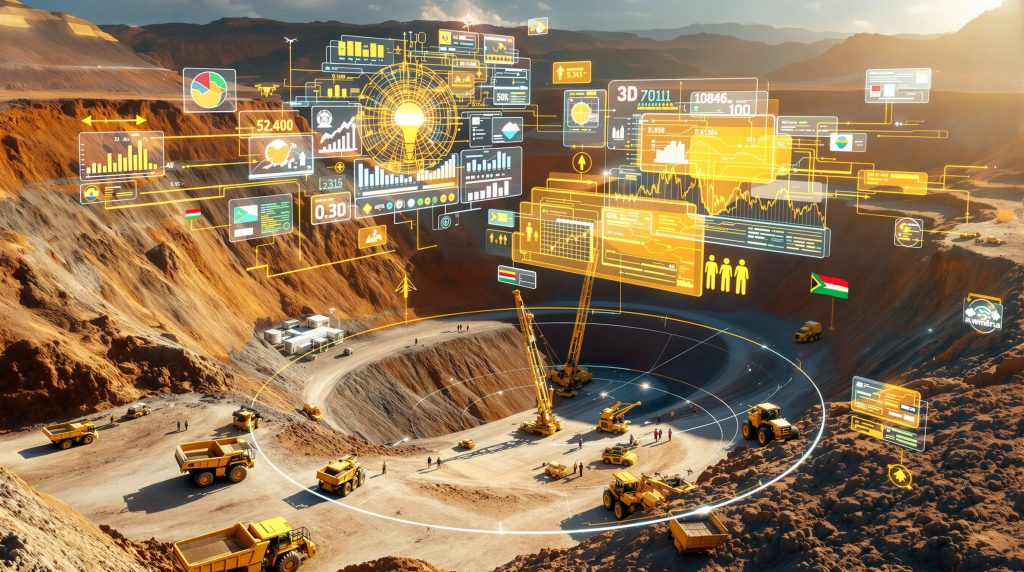
Mining sites running manual checks often produce delayed reports, resulting in unexpected equipment failure, safety incidents, and a net loss in production hours. Fragmented systems collecting data from different sources hinder cost control and strategic planning.
However, modern mining leaders are voicing their concerns for the adoption of sophisticated natural resource solutions to overcome the aforementioned issues. These solutions blend the latest in digital mining technology, coupled with automated analytics, to streamline sensor data across equipment to a unified dashboard. Furthermore, the advent of robotic process automation lifts routine tasks from teams, enhancing their efficiency and reducing redundant tasks.
Cloud services aid critical decision-making abilities and boost production KPIs through insight sharing across multiple devices. This collection of comprehensive digital mining technology solutions enables safer and efficient operations while lowering costs and driving higher uptime.
Transformative Natural Resource Solutions: Bringing Digital Innovation and Intelligent Insights Together
Digital transformation is gaining traction across industries at a rapid pace, bringing forth actionable insights that streamline operations and boost efficiency. The following section shall shed light on the crucial touchpoints driving digital transformation solutions in the modern mining industry:
Real-Time Data and Predictive Maintenance
The current state of mining operations requires companies to perform reactive fixes on mining equipment, boosting control costs while unable to meet targets. Uninterrupted equipment availability is a business imperative that drives operations in the current mining industry. This can be achieved through the inclusion of real-time data and predictive maintenance frameworks.
A suite of sensors on conveyor belts, crushers, and drills can feed live performance metrics and guide them into a central platform. Doing so eliminates manual data entry and associated errors, supporting natural resource solutions capable of optimizing asset utilization.
Modern companies can also employ mining consulting services that use complex analytics models to evaluate historical and real-time readings for processes. Upon approaching risk thresholds, the system can then issue proactive alerts, alerting maintenance teams to act before a catastrophic chain breakdown happens.
Boosting Workforce Productivity Through Automation
Process automation has marked a pivotal shift in legacy operation frameworks. The global mining automation market size is projected to reach a staggering $8,705.3 million by 2030 at a CAGR of 7%. The current projection stands at $6,207.2 million. This projection highlights the need for extensive process automation across the mining industry for efficient extraction and monitoring of equipment and resources.
To achieve efficiency and production outcomes, mining companies must employ mining industry solutions for the automation of repetitive tasks. Robotic automation for ore sampling and conveyor adjustments can allow workers to shift from redundant tasks to strategic analysis and process improvement. Furthermore, mining technology solutions like machine vision systems can further scan for ore quality and employ methodologies to refine the sample further. This reduces waste while maintaining a steady output.
Continuous quality inspection coupled with robotic process automation is reducing resource burnout on redundant tasks while boosting quality metrics.
Breaking Silos With a Unified Digital Platform
Legacy mining operations suffer from fractured systems that hide critical data across different departmental silos, further slowing decision-making and increasing costs. Hence, it is imperative for mining companies to invest resources towards building a platform capable of end-to-end visibility and collaboration opportunities across logistics, extraction, and processing departments.
Furthermore, companies must employ mining consulting services that use a custom interface that unites extraction, processing, and logistics data. Doing so will allow site managers to take inventory for stock levels, observe delivery schedules, and assess equipment health in one location.
Hence, emphasis should also be put on the consolidation of data bits from different sources. This will improve collaboration between teams, resulting in better procurement procedures and efficient shipping. By implementing the aforementioned mining industry solutions, companies can eliminate handoff delays.
Advanced Analytics for Yield Optimization
Mining companies struggle under constant pressure to maximize yield while minimizing operational costs. However, suboptimal energy utilization and inconsistent ore quality continue to erode margins. One way to alleviate this consistent pressure is to employ a suite of digital mining technology solutions comprising predictive modeling and real-time resource adjustments. This shall help mining companies increase recovery rates, reduce energy consumption, and improve profitability.
By employing comprehensive Machine Learning algorithms, mining companies can analyze drill and blast patterns for efficient ore recovery. This results in better yields and lower energy use. The use of predictive modeling is key here as it enables smarter consumption of energy, saving operational costs while providing critical business outcomes for sustainability.
Bottom Line
The age of digital innovation is steadily capturing industries, changing the fabric of legacy methodologies. Natural resource solutions in the mining industry are the need of the hour as they aid companies in cutting downtime, optimizing inventory, and enhancing crew safety. By employing process automation and predictive analytics, mining companies can drive stronger yields while saving costs on redundant frameworks. Actionable insights drive better decisions that eventually lead to favorable business outcomes.