

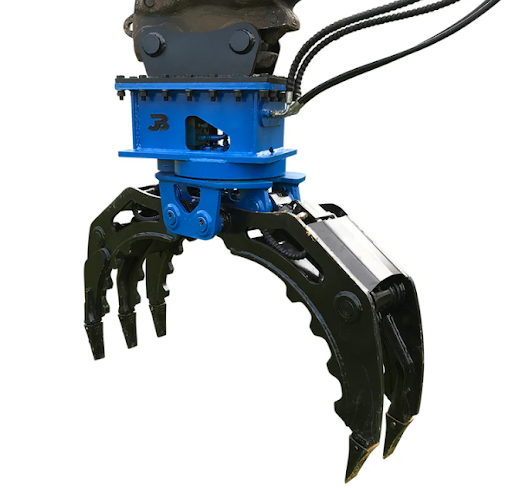
Swap a bucket for a hydraulic grapple for excavator work, and something shifts pretty quickly on site. Not just in output — in the whole rhythm of how a job gets done. The machine stops fighting awkward material and starts handling it. Ground crew step back. Skips fill smarter. That kind of change does not come from a minor upgrade. It comes from finally using the right tool for what the work actually demands.
Buckets Were Not Built for This
A bucket does one thing well: scooping loose, predictable material. Throw a demolished wall, tangled rebar, or green timber into the picture, and a bucket just pushes things around. It cannot grip. It cannot rotate. It cannot sort. So the operator compensates — repositioning the machine, making extra passes, watching material scatter. None of that is billed time. It is dead time, and it adds up faster than most site managers want to admit.
Rotation Changes Everything
Most conversations about grapples focus on clamping force. Fair enough — it matters. But the feature that quietly reshapes daily workflow is continuous rotation. When the head spins freely, the operator stops moving the machine to align a load. Materials go where they need to go, placed with real precision, without reversing or resetting. On a tight urban site where swinging the arm even a metre the wrong way is a problem, that capability is worth more than most people budget for.
Sorting on the Spot
Australian demolition and construction sites are under growing pressure to divert waste from landfill. A hydraulic grapple for excavator operations makes that sorting practical rather than theoretical. Timber gets pulled away from concrete. Steel comes out clean. Brick goes in its own pile. All of it done from the cab, without a ground worker pulling material apart by hand in a dangerous zone. The skip gets used better, recycling rates improve, and the compliance conversation gets a lot easier.
Tine Design Is Often Overlooked
People tend to buy grapples based on jaw opening size and leave it there. Tine configuration actually does more work than that number suggests. A sorting grapple with wider-spaced tines lets fine debris fall through while holding larger pieces — handy when clearing rubble without dragging half the soil along with it. A heavier demolition grapple holds dense, awkward loads without flexing. Pick the wrong tine style for the material type and the attachment starts working against the operator, not with them.
Fewer Workers Near the Face
Manual sorting puts people uncomfortably close to moving machinery. It is one of those site practices that gets normalised over time, even though the risk profile never goes away. A well-matched hydraulic grapple attachment removes much of that exposure. When the machine does the gripping and placing, fewer workers need to be near the working face. That is a safety shift with real consequences — for incident rates, for insurance conversations, and for the kind of site culture that actually retains good workers.
What Forestry Got Right First
Forestry operators adopted grapples well ahead of general construction. Logs are round, dense, and roll unpredictably — a bucket is genuinely dangerous around them. What the construction sector picked up from that experience is that grapples reward precision over brute force. Operators who learn the attachment develop a touch for it that looks almost casual. Loads placed cleanly, materials stacked properly, no wasted movement. That kind of efficiency is not accidental.
Match the Attachment to the Machine
An oversized grapple on an undersized excavator creates hydraulic flow problems — slow response, sluggish performance, extra wear on components. An undersized grapple on a large machine wastes capacity. A supplier worth dealing with will ask about the carrier model and primary use case before recommending anything. If that conversation skips straight to price, take note.
Conclusion
Getting value from a hydraulic grapple for excavator applications comes down to selection, matching, and operator familiarity. It is not a plug-and-play upgrade — it is a considered one. Sites that get those details right move faster, sort cleaner, and keep workers safer. The attachment does not transform site performance on its own. Paired with the right machine, the right tine choice, and an operator who understands what it can do, it absolutely earns its place.