

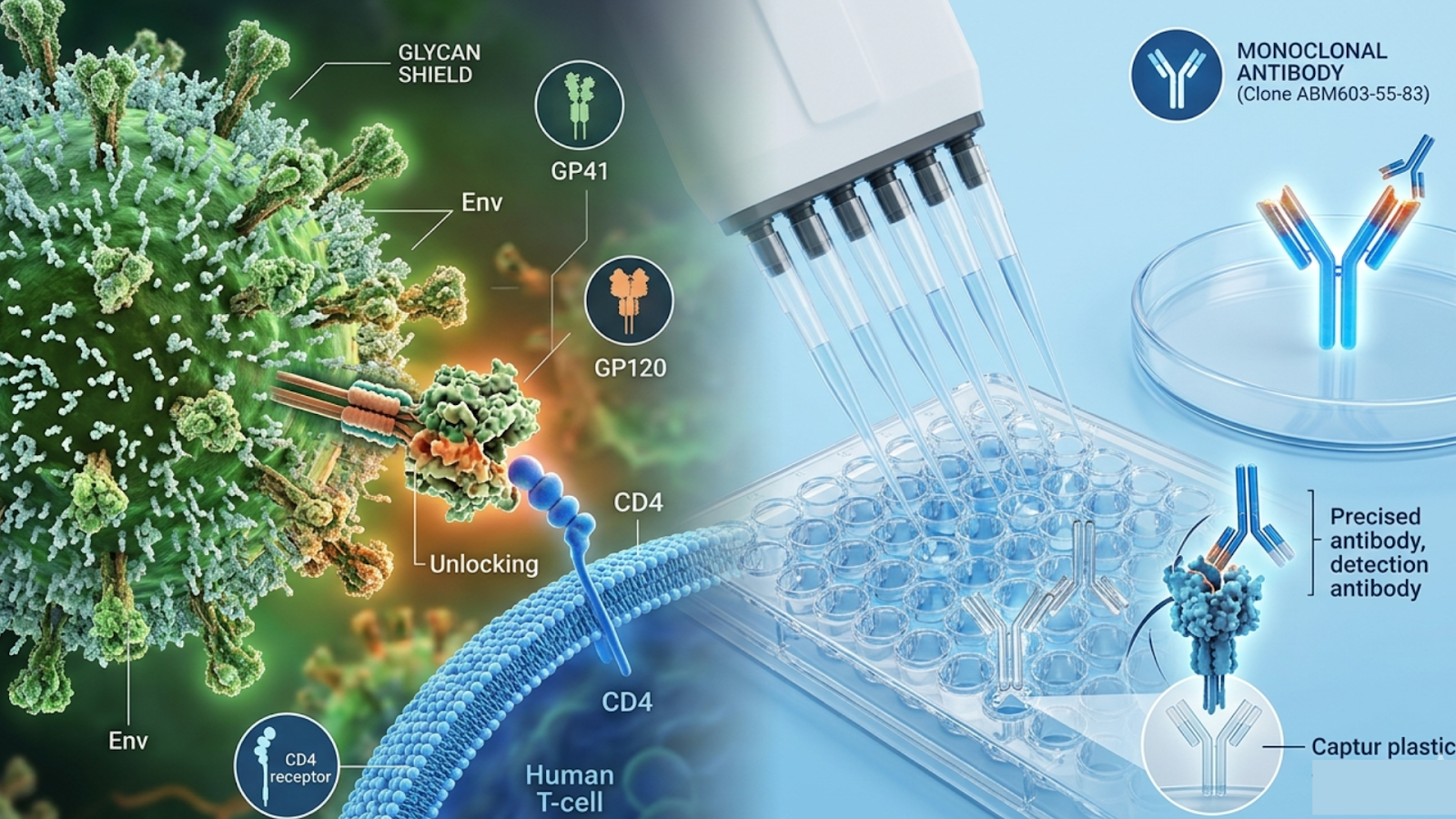
Although humans have been battling with the human immunodeficiency virus (HIV) for half a century, it still remains one of the most formidable challenges in modern medicine. Because to this day, researchers and scientists have not been able to develop a cure or a vaccine.
The greatest difficulty lies in how the virus is structured, how it operates, and its alarmingly brilliant ability to hide within the human immune system.
However, determined to find the cure, vaccine research for HIV has now shifted to focusing on the outer shell of the virus, specifically a protein complex known as the GP160 and its child viruses, specifically GP120. Still, it isn’t a easy process.
Understanding the GP120 Mechanism
Before diving into how the anti-HIV antibody is used in the vaccine research, it is important to understand how an infection starts in the body. For this, you have to pay attention to the outer “spikes” on the surface of the HIV virus.
These spikes are made of a precursor protein called GP160. Before the virus can actually infect a person, this protein is sliced into two parts: GP41, which anchors the spike to the virus, and GP120, which sits on the very outside (as mentioned before).
GP120 is effectively the “key” that HIV uses to unlock human cells. Its primary target is a receptor called CD4, found on the surface of our most important immune cells.
The infection process is a calculated three-step move:
- Attachment: GP120 bumps into a CD4 receptor and “snaps” onto it.
- Shape-Shifting: Once attached, GP120 physically changes its shape to reveal a second “hook” that grabs a co-receptor on the cell.
- Fusion: This final connection allows the virus to drill into the cell and dump its genetic material inside.
The Challenge: Why Can’t Our Bodies Stop It?
Now, the logical question is that if GP120 is so exposed on the surface of the virus, why doesn’t our immune system just create antibodies to block it?
Well, it might’ve been the case, but the problem is that GP120 is a master of disguise. It is covered in a “glycan shield”—a thick layer of sugar molecules that human immune cells recognize as “self,” allowing the virus to drift through the bloodstream undetected.
Furthermore, the parts of GP120 that stay the same (the conserved regions) are tucked deep inside the protein, only opening up for a split second during the infection process. By the time the body realizes it needs to produce an anti-HIV antibody, the virus has already integrated into the host’s DNA.
What Are Monoclonal Antibodies and How They Work
To overcome these natural challenges, scientists use lab-engineered tools known as monoclonal antibodies. Unlike the mix of antibodies our bodies produce, a monoclonal antibody is a precision instrument, which is designed to recognize and bind to one specific, unchanging part of the GP120 or GP160 protein.
Here is how these specialized antibodies help move vaccine development forward:
1. Mapping the “Vulnerable” Spots
By using a standardized anti-HIV antibody in the lab, researchers can perform “Structural Mapping.” In this process, they mix the antibody with the virus and use high-powered imaging to see exactly where the antibody sticks. If an antibody successfully blocks the virus from entering a cell, researchers know they have found a “site of vulnerability.” The goal of a vaccine is then to teach the human body to produce its own antibodies that target that exact same spot.
2. Monitoring Vaccine Success in Clinical Trials
Researchers use techniques like ELISA (Enzyme-Linked Immunosorbent Assay) and Immunohistochemistry (IHC) to ensure that the HIV spikes are expressed correctly during testing of a new vaccine. Specifically, monoclonal antibodies are used to detect the presence of GP120 in tissue samples or cell cultures. If the antibody “finds” the protein, the experiment is moving in the right direction.
3. Neutralization Assays
A “Neutralization Assay” is a test to see if an antibody can stop the virus in its tracks. Researchers use high-affinity clones to set a benchmark. By comparing how well a natural human response performs against a lab-engineered anti-HIV antibody, scientists can measure exactly how much more potent a vaccine needs to be to achieve “Sterilizing Immunity”—the point where the virus is killed before it can infect a single cell.