

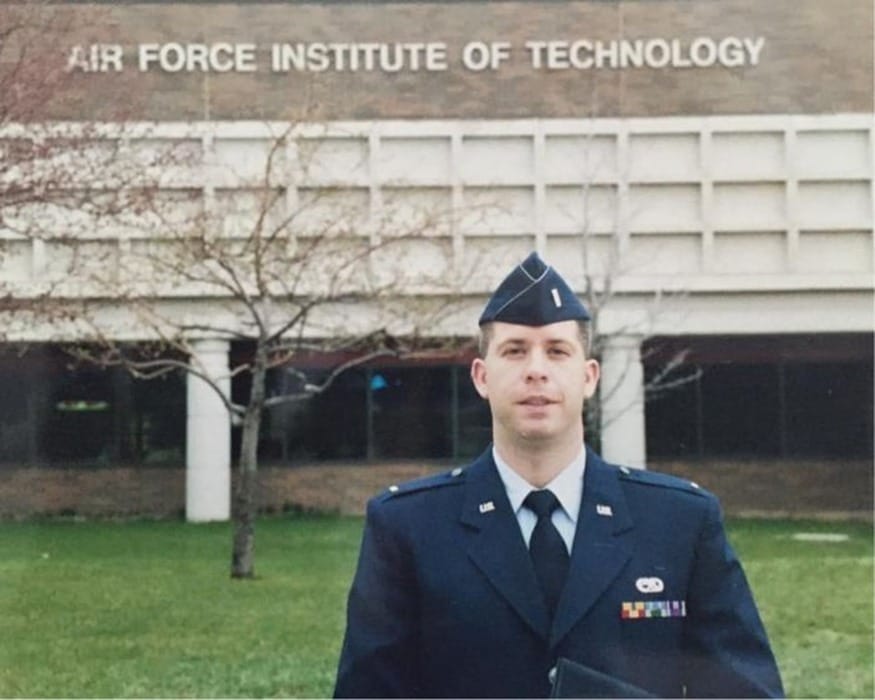
ALT: Jeff Thornburg at the Air Force Institute.
The development and progress in modern aerospace engineering have heavily depended on the contributions and innovations of individuals who are able to bring together the military and civilian aspects of innovation in the field. Developments in the field of rocket propulsion systems, orbital maneuvers, and the development of spacecraft have all been spearheaded by individuals who were trained in the highly structured and disciplined environment provided in the military before moving on to assume leadership roles in the civilian and government aspects of the field. The late 1990s and the present day have witnessed tremendous developments in the field of propulsion systems, especially in the areas of liquid engines and hydrogen-powered systems.
Jeff Thornburg, born on July 29 in Kansas City, Missouri, pursued a Bachelor of Science in Aerospace Engineering at the University of Missouri, Rolla, completing the degree in 1996. He subsequently earned a Master of Science in Aeronautical Engineering from the Air Force Institute of Technology in 2000. Following his graduate studies, Thornburg began his career as a commissioned officer in the United States Air Force, where he was assigned roles that combined operational responsibility with technical oversight. At MacDill Air Force Base, he served as a flight commander and aircraft maintenance officer for KC-135R tanker aircraft, overseeing both flight operations and maintenance programs. These positions provided Thornburg with direct experience in large-scale aviation systems and operational readiness protocols.
Following his early operational assignments, Thornburg joined Edwards Air Force Base, connecting his work to the Air Force Research Laboratory’s liquid rocket engine branch. Thornburg led this team in the development of the Integrated Powerhead Demonstration engine, a collaborative effort between the Air Force and NASA. Thornburg’s mission was to prove the concept of a hydrogen full-flow staged combustion cycle engine, aiming for greater efficiency and better performance than traditional engines.
Upon leaving the military service, Thornburg entered the field of civilian aerospace. His first position was at Aerojet as the engineering director for liquid engine turbomachinery. His task was to oversee the development and direction of the complex turbomachinery systems used in liquid-fueled rockets. Thornburg was also the lead propulsion engineer for the NASA J-2X engine program at the Marshall Space Flight Center. The J-2X engine was part of the next generation in launch vehicle technology. It required the highest performance turbomachinery systems and the utmost care in the overall engineering aspects in order to meet the very specific operational parameters required. Thornburg’s early career in the military and then in the civilian sector helped him develop the necessary skill set in the field of propulsion engineering.
His experience in the Air Force provided the operational overview, and his experience at Aerojet and NASA provided the hands-on technical management necessary in the field of systems engineering. His experience in the field of hydrogen-fueled engines and turbomachinery, and the use of the staged combustion cycle, was then applied to his involvement in the field of commercial space ventures. This is the type of industry coverage that describes the classic example of the use of bridging perspectives in the field of aerospace projects.
The shift from military service to engineering leadership in the civilian sector illustrates the ways in which engineers like Thornburg help propel the advancement of experimental engineering and the practical side of aerospace technology. In the case of the AFRL and NASA, the work of the engineer involved partnerships with government labs, contractors, and university entities. At Aerojet, the work involved supervising personnel, project planning, and component testing. This illustrates the ways in which engineers like Thornburg help propel the advancement of experimental engineering and the practical side of aerospace technology.
From the start of his career, Thornburg focused on propulsion systems designed for the future mobility and reliability of spacecraft. This illustrates the ways in which the knowledge base of the engineer is critical to the advancement of experimental engineering and the practical side of aerospace technology. Other aerospace engineers with similar perspectives have noted the importance of these engineers as they help propel the advancement of experimental engineering and the practical side of aerospace technology. This illustrates the ways in which the career of Thornburg is connected to the advancement of experimental engineering and the practical side of aerospace technology.
By looking at how the career of Thornburg is associated with the advancement of experimental engineering and the practical side of aerospace technology, it is possible to begin to understand the ways in which the career of the engineer is associated with the advancement of the practical side of aerospace technology. The career of Jeff Thornburg represents the intersection of his military training, his work in government research, and his work in engineering leadership in the aerospace industry. His work in liquid propulsion systems, engine cycles, and turbomachinery helped to shape his knowledge of spacecraft propulsion systems. His earlier work represents how his professional experiences in different sectors of society helped to inform his later work in advanced propulsion systems and commercial space initiatives.