

Most people assume that getting a medical marijuana card in Texas works the same way it does in California, Colorado, or Ohio. It does not — and that misunderstanding causes confusion, delays, and missed access for thousands of qualifying patients every year.
Texas has one of the most unique — and most misunderstood — medical cannabis programs in the United States. The state calls it the Compassionate Use Program (CUP), and it operates under a completely different set of rules than nearly every other state MMJ system.
If you are a Texas patient wondering whether you qualify, what the process looks like, or why you never received a physical card in the mail — this guide answers all of it honestly. No fluff, no confusion, just the facts most patients never get told upfront.
Truth #1 — Texas Does Not Issue a Physical MMJ Card
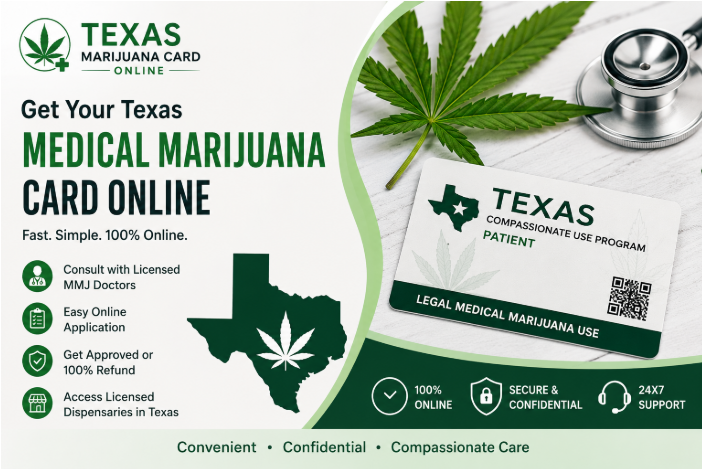
This is the first thing that surprises most new applicants. Unlike Ohio, California, or Florida — where patients receive a wallet-sized medical marijuana identification card — Texas does not issue a physical card to patients at all.
Instead, Texas uses a fully digital registry called the Compassionate Use Registry of Texas, known as CURT. When a licensed physician certifies you as a qualifying patient, your prescription is entered directly into the CURT database by your doctor.
When you visit a licensed dispensary, the pharmacist verifies your eligibility by looking you up in the CURT system using your last name, Texas ID number, date of birth, and the last five digits of your Social Security Number. No physical card required — and none will ever be mailed to you.
This trips up many patients who apply and then wait weeks for a card that never arrives. The system is entirely digital — and that is by design.
Truth #2 — Texas Has a Strict and Specific List of Qualifying Conditions
Texas does not have a broad or flexible qualifying conditions list like many other states. The Compassionate Use Program covers a specific set of diagnoses, and patients must have one of them to be eligible.
As of 2026, qualifying conditions under the Texas CUP include:
- Epilepsy and seizure disorders
- Post-Traumatic Stress Disorder (PTSD)
- Chronic pain that would otherwise be treated with opioids
- Multiple Sclerosis and spasticity
- Amyotrophic Lateral Sclerosis (ALS)
- Autism
- Parkinson’s Disease
- Terminal and non-terminal cancer
- Huntington’s Disease, Spinal Muscular Atrophy, Friedreich’s Ataxia, Charcot-Marie-Tooth Disorder
- Dementia, Neuropathy, Motor Neuron Disease, and other incurable neurodegenerative diseases
- Any condition approved by Texas Health and Human Services for research purposes
Chronic pain is one of the most widely applicable qualifying conditions in Texas. If you are currently managing pain with opioid medications — or if opioids have been recommended but you want an alternative — you may qualify under this category.
Truth #3 — You Cannot Smoke Medical Marijuana in Texas
This is another fact that shocks many patients. Even with a valid prescription in the CURT system, smoking cannabis is not legal in Texas — even for medical use.
Texas law defines medical marijuana as low-THC cannabis products that can be ingested — meaning edibles, tinctures, capsules, oils, and similar consumption formats. Smokable flower is not part of the Texas medical cannabis program.
Additionally, the THC content of legal medical cannabis products in Texas is capped at 1% THC or less, with a minimum CBD content of 10%. This is considerably more restrictive than most other state programs.
Home cultivation is also entirely prohibited. Even certified patients cannot grow their own cannabis plants regardless of their medical status.
Truth #4 — The Physician Must Be Registered in the CURT System
Not just any doctor can certify a Texas MMJ patient. The physician must be specifically registered with the Compassionate Use Registry of Texas and licensed to enter prescriptions into the CURT database.
This is a separate credentialing step beyond having a standard Texas medical license. Doctors who are not CURT-registered cannot legally certify patients, even if they are fully licensed physicians who believe cannabis would benefit their patient.
When choosing a telemedicine platform for your Texas MMJ consultation, always confirm the platform connects you with CURT-registered physicians. Many Texas residents prefer Texas Marijuana Card Online because of its fully online consultation process and patient-focused approach — with verified CURT-registered doctors available without appointments, from any device, at a time that works for you.
Ready to get started? Connect with a licensed Texas MMJ doctor today — the consultation is fully online and takes just minutes.
Truth #5 — There Is No State Fee — But There Is a Consultation Fee
Texas does not charge patients a state registration fee to be entered into the CURT system. The physician enters your prescription directly — there is no separate state application process or government payment required on the patient’s side.
What you do pay is the doctor’s consultation fee charged by the telemedicine platform you use. This fee covers your evaluation with a CURT-registered physician and the submission of your prescription to the registry.
As of 2026, standard Texas MMJ consultation fees are approximately $199. Most reputable platforms offer a money-back guarantee — if your recommendation is not accepted by the state for any reason, you receive a full refund.
Before booking any consultation, confirm the platform’s refund policy clearly. A legitimate provider will stand behind their service.
Truth #6 — The Entire Process Can Be Done Online in One Day
One of the most underutilized facts about the Texas MMJ process is how fast and accessible it actually is in 2026.
You do not need to visit a clinic, schedule an in-person appointment, or travel anywhere. The complete process is digital from start to finish:
- Fill out a short online pre-qualification form with your medical details
- Complete a virtual consultation with a CURT-registered Texas physician
- Receive your physician’s prescription entered directly into the CURT system
- Visit any licensed Texas dispensary with your identification to access your prescription
There are currently three state-licensed cannabis dispensaries operating in Texas — Compassionate Cultivation, Surterra Wellness (operating as Goodblend Texas), and Texas Original. Each operates under strict state oversight and can verify your CURT registration at point of sale.
Truth #7 — Texas MMJ Is Strictly Medical, Not Recreational
Texas has not legalized recreational marijuana and has no current legislative pathway to do so in the near term. Adult-use cannabis remains fully illegal under Texas state law.
The Compassionate Use Program exists exclusively for patients with documented qualifying medical conditions. It is a healthcare pathway — not a consumer product program — and is regulated accordingly.
For patients who genuinely qualify, that structure is a feature — it provides legal protection, documented medical oversight, and access to consistently produced, lab-tested products from licensed dispensaries.
Frequently Asked Questions
Q1: Will I receive a physical Texas MMJ card in the mail?
No. Texas does not issue physical medical marijuana cards. Your prescription is stored in the CURT digital registry. Dispensaries verify your eligibility using your ID and personal details — no card needed.
Q2: How long does it take to get into the CURT system after my consultation?
Once your CURT-registered physician approves your prescription, it is entered into the registry immediately or within the same business day. You can typically visit a licensed Texas dispensary the same day or the next day.
Q3: Can I get a Texas MMJ prescription for anxiety or insomnia?
Not directly. Anxiety and insomnia are not standalone qualifying conditions. However, if you are managing chronic pain, PTSD, or a neurological condition that includes these symptoms, you may qualify under a broader diagnosis. Consult with a CURT-registered physician to assess your full medical picture.
Q4: Is the Texas MMJ online consultation process private?
Yes. All legitimate Texas MMJ telemedicine platforms operate under HIPAA compliance standards. Your personal and medical information is encrypted and protected at every stage.
Q5: What if I move to another state — can I use my Texas MMJ prescription there?
No. The Texas CURT registry is a state-specific system with no reciprocity agreements. Your Texas MMJ prescription is only valid within Texas at licensed dispensaries. If you relocate, you will need to apply under the medical marijuana program in your new state of residence.
Final Thoughts: Texas MMJ Works — If You Know How It Actually Works
The Texas Compassionate Use Program is unlike any other state’s medical marijuana system. No physical card, no smokable products, strict qualifying conditions, and a fully digital registry — it is a program designed around medical oversight, not consumer access.
But for patients who qualify, it is a legitimate, legal, and increasingly accessible pathway to cannabis-based treatment. The key is understanding the real process before you apply — and working with a physician platform that knows the Texas system inside and out.
Texas Marijuana Card Online offers a fully online, HIPAA-compliant consultation with CURT-registered physicians, a transparent fee structure, and a money-back guarantee if your prescription is not accepted by the state. No appointments, no waiting rooms, no confusion.
If you have a qualifying condition, the truth is simple: legal cannabis access in Texas is closer than most patients realize.