


Most business owners find out what SEO tools cost the same way they find out anything is more expensive than expected: by accident. You Google a tool someone mentioned in a marketing newsletter, click through to the pricing page, and your first thought is something along the lines of “that cannot be right.” For a lot of well-known platforms, it very much is right. But the story does not end there. The search for cheap SEO solutions has pushed an entire generation of more accessible tools into the market, and many of them are genuinely strong. However, before you can assess these tools realistically, you need to get a clear idea of the overall landscape: what is the cost of popular SEO optimization tools, why do these tools have these prices, and where the alternatives lie?
This is that picture. No inflated comparisons, no affiliate-driven rankings dressed up as editorial. Just a practical guide to how this market is priced and how to navigate it without either overpaying or shortchanging your strategy.
Where the Sticker Shock Comes From
SEO platforms at the premium end were not built for small businesses. That’s not a complaint; that’s the origin story. Tools like Semrush, Ahrefs, and Moz Pro were developed to serve the needs of agencies and large marketing organizations, where thousands of keywords were tracked across dozens of websites at the same time, weekly competitor intelligence reports were run, and teams of analysts needed to access the same data at the same time. The pricing models reflect that original customer base.
Semrush is priced at around $140/month for its basic ‘Pro’ package, which offers five projects at any given time, 500 keyword positions, and site crawling up to 100,000 pages. Ahrefs charges approximately $129 per month for its Lite tier, which includes a narrower window of historical data and limited seats. Moz Pro starts closer to $99 monthly but with more restricted competitive analysis at that level. These are monthly figures; annual billing reduces them by roughly 15 to 20 percent on most platforms, which matters when you are doing the math across a year.
For a properly staffed marketing team handling multiple clients, that spend makes sense. The data depth, reporting infrastructure, and integration capabilities justify the line item. For a founder running a single e-commerce store or a local service business trying to rank in their city, paying $140 a month to track 500 keywords they will never actually research is a different conversation entirely.
The Mid-Range: Where Value Starts Making More Sense
Between $30 and $85 per month is a tier that does not get enough attention. It is less glamorous than the enterprise platforms and less talked about in the communities where SEO professionals hang out, but for many small and growing businesses it represents a genuinely good fit.
SE Ranking starts at around $44 per month with daily position updates, unlimited audits, and decent backlink data for its price. Mangools offers a bundle of five different tools, including keyword research, rank tracking, backlink checks, and SERP analysis, all for a price of around $29/month. Ubersuggest has a freemium model that turns into a paid version at about $29/month after you start hitting the free version query limits.
The honest trade-off here is database size and data freshness. Keyword volume estimates are less reliable than on premium platforms. Backlink indices are smaller. In high-competition verticals or for businesses tracking volatile national rankings, those gaps show up. For local businesses, niche content operations, or early-stage startups building authority in a defined space, they rarely matter enough to change the outcome.
What Is the Cost of Popular SEO Optimization Tools in the Affordable Tier

This is where the market has changed most noticeably. Three or four years ago, sub-$50 SEO tools were mostly keyword research utilities with thin interfaces and questionable data. That category has been transformed by the arrival of AI. What is the cost of popular SEO optimization tools at this level today? Typically between $20 and $50 per month, and increasingly, that price buys you something that goes well beyond research.
The platforms sitting in this range now commonly handle keyword discovery, content brief creation, long-form article generation, internal link management, and direct CMS publishing to WordPress, Webflow, Shopify, or Ghost. That breadth of functionality used to require multiple tools working in combination. Consolidating it into one affordable subscription changes the cost-per-outcome calculation entirely for a small business running its own content-led SEO strategy.
Businesses searching specifically for affordable SEO tools for small businesses are responding to this shift. The search volume for that phrase has grown precisely because the affordable tier now offers real functionality rather than a compromise version of what enterprise tools do. The expectation has changed because the product has changed.
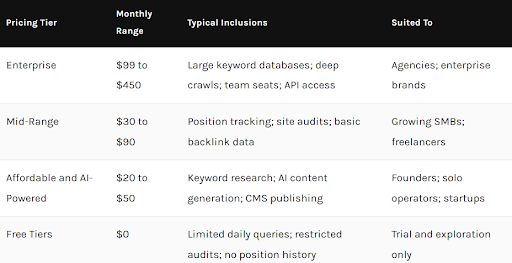
Asking what the cost of popular SEO optimization tools is really asking two questions: what does the software charge, and what does it actually cost to run a proper SEO strategy using it? Those numbers are not always the same.
Free Tiers: Useful Starting Points, Not Long-Term Strategies
Every serious SEO practitioner should be using Google Search Console and Google Analytics from day one. They are free, they access data directly from the source, and they provide data that cannot be replicated with any other tool: your impressions, your click-through rates, your crawl errors, and your indexed pages. Building on top of these two is the base requirement; everything else is additional.
Beyond Google’s own properties, free tiers from commercial platforms are useful for evaluating interfaces and testing output quality before you pay. They are not designed to sustain ongoing SEO work. Query limits, project restrictions, and audit caps make them impractical as primary tools. Use them to shortlist candidates, not to run your strategy.
How Businesses Actually Choose Between the Tiers

The businesses that make smart SEO tool decisions share one habit: they define their actual requirements before looking at pricing pages. This sounds obvious. In reality, it’s not common. Most users land on a pricing page, look at the features of the comparison columns horizontally across the pricing plans, and then opt for the middle option because it’s the safest option. Such an approach results in a great deal of waste.
A more grounded process starts with three specific questions. First: how many websites do you need to manage under one account? One or two websites point firmly toward the affordable or mid-range tier. Five or more suggests you need the headroom of an enterprise plan. Second: how actively will someone in your business be logging into the tool and acting on what they find? An unmanned subscription is pure overhead. If the answer is “occasionally,” a platform with strong automation reduces the cost of inaction. Third: do you need the tool to produce content or just analyze and report?
That third question increasingly separates the tiers more usefully than price does. Traditional SEO platforms are analysis and reporting engines. They tell you what to do; they do not do it. Newer AI-powered platforms in the affordable range execute: they research, write, optimize, and publish. SEOZilla.ai is a working example of this model: Their AI agents will analyze your niche and site, create optimized long-form content up to 4,000 words, handle internal linking, and schedule your content directly to your CMS. Plans start at $19.99/month. The optional human editor feature, where experienced SEO writers review all your content before publication, is available for businesses at $99.99/month.
The combination of price and automation essentially closes the gap for a small business owner who needs constant organic content but does not have the time to produce it or the money to outsource it at agency prices. The price of SEO tools for small businesses that will win in this scenario are the ones designed around the assumption of lean teams, limited hours in the day, and the need to deliver constant organic growth that continues to work while the owner is distracted elsewhere.
The Right Tool Is the One You Will Actually Use
If you spend any amount of time with digital marketers, you will eventually hear this story, or variations on it. A marketer signed up for Semrush, thinking it would be their magic ticket for increasing organic traffic, and used it religiously for three weeks before gradually forgetting to log in as other tasks consumed their attention. Twelve months later they cancelled and had nothing to show for a year of subscription fees.
The tool that builds rankings is the one that fits into your actual workflow at your actual team size, not the one with the most impressive feature list. For a large agency, that number is probably $140 and above. For a small business building its first real SEO strategy, affordable SEO tools for small businesses in the $20 to $50 range deliver more sustainable value because the cost stays proportionate to the return and the workflow stays manageable over time. That proportionality is what makes the investment last long enough to compound into something real.