

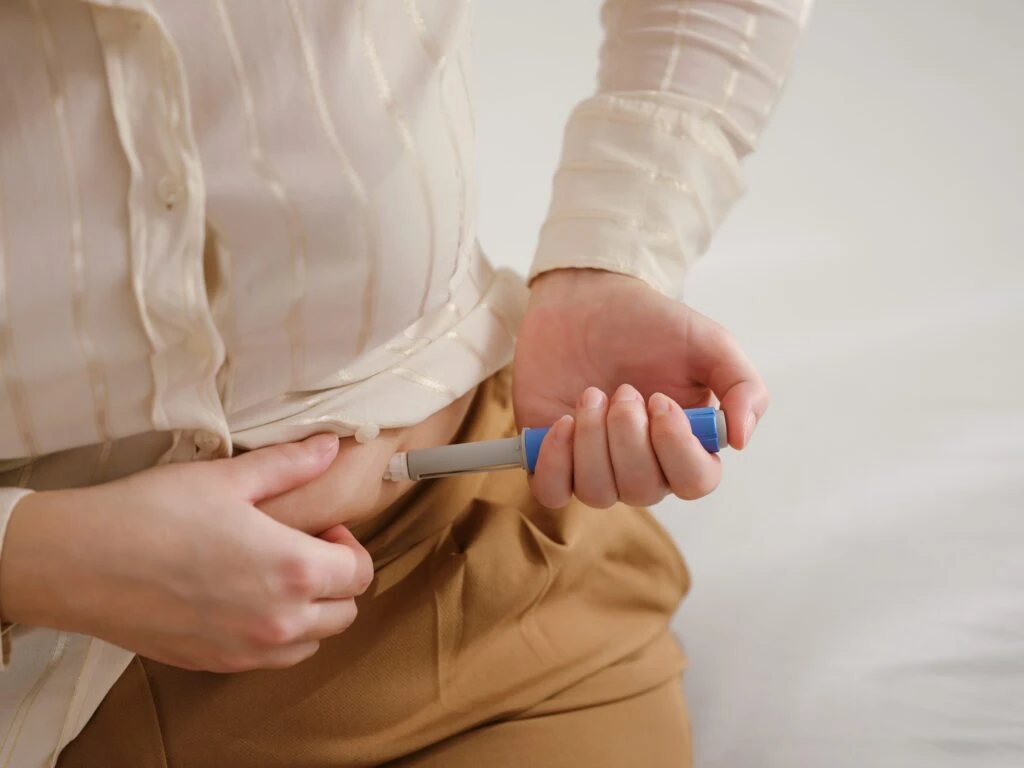
The first few weeks on semaglutide or tirzepatide feel almost unfair in the best way. Your appetite drops. The cravings that used to run your evenings go quiet. The number on the scale moves down week after week without the kind of suffering you expected.
Then somewhere around month four, five, or six, everything stops.
The scale does not budge. Maybe it creeps up a pound, then back down, then sits still again. You are still taking your injection on schedule. You are still eating less than you did before. But the progress that felt so reliable has completely flatlined.
If this is happening to you right now, the first thing worth knowing is that you have not broken anything. You have not failed. And the medication has not stopped working. What you are experiencing has a clinical name and a biological explanation, and understanding both of those things is the difference between panicking and pushing through.
What a Plateau Actually Is
A true weight loss plateau is a period of four or more weeks where your body weight does not change despite sticking with your medication and your eating habits. A week or two of the scale not moving is not a plateau. That is just normal fluctuation. Water retention, digestion timing, hormonal shifts, and even how much sodium you had yesterday can all move the number up or down by two or three pounds without any real change in your body fat.
Clinical trials back this up. In the STEP trials studying semaglutide at the 2.4 mg dose, weight loss continued for roughly 60 weeks before stabilizing. The average total loss at that point was around 15 percent of body weight. In the SURMOUNT trials for tirzepatide, peak weight loss came at around 72 weeks. After that, weight held steady rather than continuing to drop. That leveling off was observed in every major trial, not just in a few unlucky participants. It happened across the board.
So when your weight stalls at month five or month nine, you are not an outlier. You are following the exact trajectory the clinical data predicted.
The Biology Behind the Stall
Your body is not a passive participant in weight loss. It actively fights back. This is not a design flaw. It is a survival mechanism that kept your ancestors alive during famines. The problem is that your biology cannot tell the difference between a famine and an intentional calorie deficit supported by modern medicine.
Here is what happens as you lose weight. Your resting metabolic rate drops. A smaller body burns fewer calories at rest. Research published in the International Journal of Obesity showed that for every 10 percent drop in body weight, your resting metabolic rate decreases meaningfully. That caloric deficit that drove rapid loss in month one has now narrowed or closed entirely because your body got smaller and more efficient.
Your hunger hormones start pushing back too. Leptin, the hormone that tells your brain you have enough energy stored, decreases as fat mass shrinks. Meanwhile ghrelin, the hormone that triggers hunger, often increases. Even with GLP-1 medication blunting appetite signals, these hormonal shifts create a subtle headwind that did not exist when you started.
There is also a phenomenon called metabolic adaptation. This goes beyond the expected drop in metabolic rate from losing weight. Your body can actually slow its metabolism more than the weight loss alone would predict. It becomes unusually efficient at conserving energy. Researchers sometimes call this the “energy gap,” and it is one of the main reasons weight regain is so common without ongoing treatment.
None of this means the medication is failing. It means your body has reached a temporary equilibrium where the calories going in roughly match the calories going out at your new, lower weight.
The Muscle Problem Nobody Talks About Enough
One of the quieter contributors to GLP-1 plateaus is muscle loss. When you eat significantly less, and especially when you eat less protein, your body does not only burn fat for energy. It breaks down muscle tissue too. Less muscle means a lower metabolic rate, which means fewer calories burned at rest, which makes that plateau even stickier.
Research from DXA and MRI sub-studies found that roughly 25 to 45 percent of total weight loss on semaglutide and tirzepatide comes from lean mass rather than fat. That sounds alarming until you compare it to what happens with calorie-restricted diets without medication. The ratio is actually similar. Keith Baar, a professor at UC Davis who studies muscle physiology, has pointed out that much of the reported lean mass loss actually comes from the liver rather than skeletal muscle. But the broader point still holds. If you are not actively working to preserve muscle while losing weight, your metabolism will slow faster than it needs to.
This is fixable. Protein intake in the range of 1.2 to 1.6 grams per kilogram of body weight daily makes a measurable difference. So does resistance training two to four times per week. A 2025 case series published in PMC found that patients on GLP-1 medications who performed resistance training three to five days per week with adequate protein intake actually gained lean tissue while losing fat. That is body recomposition in real time, and it is one of the most powerful tools available for breaking through a plateau.
Calorie Creep Is Real
Here is something that catches a lot of people off guard. When your appetite is suppressed and you are eating less frequently, it is easy to assume you are automatically in a calorie deficit. But eating less often does not always mean eating fewer total calories. A smaller number of meals can still add up quickly if those meals include calorie-dense foods like cheese, cooking oils, creamy sauces, sugary drinks, or processed snacks.
Early in treatment, the appetite suppression is strong enough that calorie creep rarely matters. You are eating so much less overall that even imprecise eating produces a deficit. But as your body gets smaller and your metabolic needs drop, the margin for error shrinks. A few hundred extra calories per day, the kind that barely registered at your starting weight, can now be enough to erase your deficit entirely.
This does not mean you need to count every calorie for the rest of your life. But spending a week or two tracking your intake honestly can reveal patterns you did not realize were there. A lot of people discover they have been eating more than they thought, not because they are doing anything wrong, but because portion sizes drifted upward without them noticing.
What Actually Works to Break Through
If you have been in a genuine plateau for four weeks or more, here are the strategies that have the strongest evidence behind them.
Prioritize protein at every meal. This is the single highest-impact nutritional change you can make during a stall. Protein preserves muscle, has the highest thermic effect of any macronutrient (your body burns 20 to 30 percent of protein calories during digestion alone), and keeps you fuller longer. Greek yogurt, eggs, chicken breast, fish, cottage cheese, and lean ground meat are all practical options. If appetite suppression makes it hard to eat enough, a protein shake can fill the gap without requiring a large meal.
Add resistance training. You do not need a gym membership or an elaborate program. Bodyweight exercises like squats, push-ups, lunges, and planks performed consistently two to three times per week will help preserve and rebuild lean tissue. If you have access to weights or bands, even better. The goal is not to become a bodybuilder. The goal is to send your body a signal that muscle is being used and should not be broken down for energy.
Increase your daily movement outside of formal exercise. This is called NEAT, or non-exercise activity thermogenesis, and it can account for 200 to 500 extra calories burned per day. Walking more, taking stairs, standing instead of sitting, doing household chores, parking farther from the entrance. These small movements add up significantly and are often easier to sustain than adding another workout to your week.
Check your hydration. When people eat less, they often drink less too. Dehydration can slow digestion, contribute to constipation (a common GLP-1 side effect that adds scale weight), and reduce energy levels. Adequate water intake is simple but frequently overlooked.
Talk to your provider about dosing. If you are still on a lower dose and have not yet reached the therapeutic range, the plateau might simply mean you need to titrate up. Dose changes should always be made with medical guidance, not on your own. In some cases, switching medication types can also help. Some patients respond better to tirzepatide’s dual receptor action after plateauing on semaglutide, or vice versa.
What Not to Do
Do not crash diet. Dropping your calories dramatically might feel intuitive when the scale is stuck, but it backfires. Severe restriction accelerates muscle loss, tanks your metabolic rate even further, and makes the next plateau harder to escape.
Do not stop your medication. The STEP trials showed clearly that patients who discontinued semaglutide regained roughly two-thirds of their lost weight within a year. A plateau while on medication is your body maintaining a lower weight. Stopping the medication removes the biological support that is keeping the weight off.
Do not judge your progress only by the scale. During a plateau, your body may still be losing fat and gaining muscle simultaneously. Your waist circumference might be shrinking even if your weight stays the same. Your blood pressure, cholesterol, blood sugar, energy levels, and sleep quality may all be improving. These are not consolation prizes. These are the actual health outcomes that matter.
The Bigger Picture
Obesity is a chronic condition. GLP-1 medications treat the underlying biology of that condition, but they do not cure it. Just like blood pressure medication keeps blood pressure down without eliminating the reason it was high in the first place, GLP-1 medications manage appetite and metabolic signaling on an ongoing basis. Plateaus are a normal chapter in that long-term story, not the final one.
Most patients who stay consistent through a plateau see progress resume. Sometimes it takes a dosing adjustment. Sometimes it takes a nutritional shift. Sometimes the body just needs a few weeks to recalibrate before the next phase of loss begins. The patients who do best are the ones who use the plateau as a window to strengthen their habits rather than as evidence that something went wrong.
If your weight loss has stalled and you are not sure what to adjust, that is exactly the kind of situation where medical guidance matters. A provider who understands GLP-1 therapy can evaluate whether your dose needs changing, whether your nutrition plan needs updating, or whether other factors like sleep, stress, or concurrent medications might be contributing.
TrimRX offers licensed provider consultations specifically for patients navigating GLP-1 treatment, including those dealing with plateaus. Compounded semaglutide starts at $199 per month and compounded tirzepatide at $349 per month, both with ongoing medical support built into the program. If you are stuck and want a clinical perspective on your next step, starting a conversation with a provider is the most productive move you can make right now.