


VAT in Europe explained starts with one rule: tax follows the place of consumption.
If you sell from Germany into the european union, you need three core resources before you send your first invoice: current EU VAT rates, a valid VAT number process, and a reliable way to switch between VAT-inclusive and VAT-exclusive prices. This page works as a VAT guide for businesses and a quick VAT guide for shoppers who want to understand the final price.
We will cover this in a clear order. First, you will learn how value added tax (VAT) works, then compare rates, review VAT calculation examples, choose practical VAT online tools, and finish with the compliance rules that matter most in Germany.
Key Takeaways
- The EU standard VAT rate cannot fall below 15%. Current official tables list Germany at 19%, France at 20%, Italy at 22%, Hungary at 27%, and Luxembourg at 17%.
- The modern One Stop Shop began on July 1, 2021. IOSS covers imported consignments up to €150, and the EU-wide threshold for many cross-border distance sales of goods and TBE services is €10,000.
- For Germany, the Federal Central Tax Office (BZSt) issues the separate USt-IdNr. used for EU trade. German advance VAT returns are due by the 10th day after the reporting period, and the filing cycle can be quarterly or monthly depending on your case.
- VAT in the digital age is already on the rollout path. The EU adopted the ViDA package on March 11, 2025, and Germany already requires domestic B2B businesses to be able to receive structured e-invoicing from January 1, 2025.
VAT in Europe Explained: What is VAT in Europe?
Value-added tax is a consumption tax charged on most goods and services sold in the european union. Your business collects it on sales, deducts eligible VAT paid on business purchases, and remits the difference to the tax authority.
What does VAT mean?
VAT stands for Value Added Tax. In EU law, the main legal framework sits in the EU VAT Directive 2006/112/EC, while each member state applies its own national rules inside that framework.
That is why your tax setup should start with the transaction, not with the country list. Before you issue an invoice, check the customer’s country, whether the buyer is a business or a consumer, the product category, and whether your price is net or gross.
- VAT number or VAT ID no.: used to identify businesses for cross-border VAT treatment.
- Rate source: needed because European VAT rates explained on a blog are useful, but the invoice must still match the current official category.
- Invoice rules: VAT on invoices must reflect the correct rate, exemption note, or reverse charge wording.
- Filing route: domestic return, VAT One Stop Shop, or Import One Stop Shop depends on the type of sale.
How does VAT work across the EU?
Maurice Lauré introduced the modern VAT model in France in 1954. Today all 27 EU member states use it, and the Council states that VAT represented 7.2% of EU GDP and 15.7% of total government tax revenue in 2023.
The final consumer bears the cost, while businesses pass the tax through the chain. A seller based in the United States can still face EU VAT duties if it sells to EU customers, which is why customer location often matters more than company location.
- You buy stock or services and pay input tax.
- You sell goods or services and charge output VAT.
- You subtract eligible input VAT from output VAT on the return.
- You pay the balance, or claim a refund if your input tax is higher.
Overview of European VAT Rates
Rate comparison is the fastest way to avoid pricing errors. Even a small mistake in the standard VAT rate Europe or a reduced VAT rate Europe category can erase margin on low-profit products.
What are the standard VAT rates in Europe?
The EU standard VAT rate cannot be lower than 15%. In the OECD’s 2024 Consumption Tax Trends report, the average standard VAT rate across the EU countries in the OECD is 21.9%.
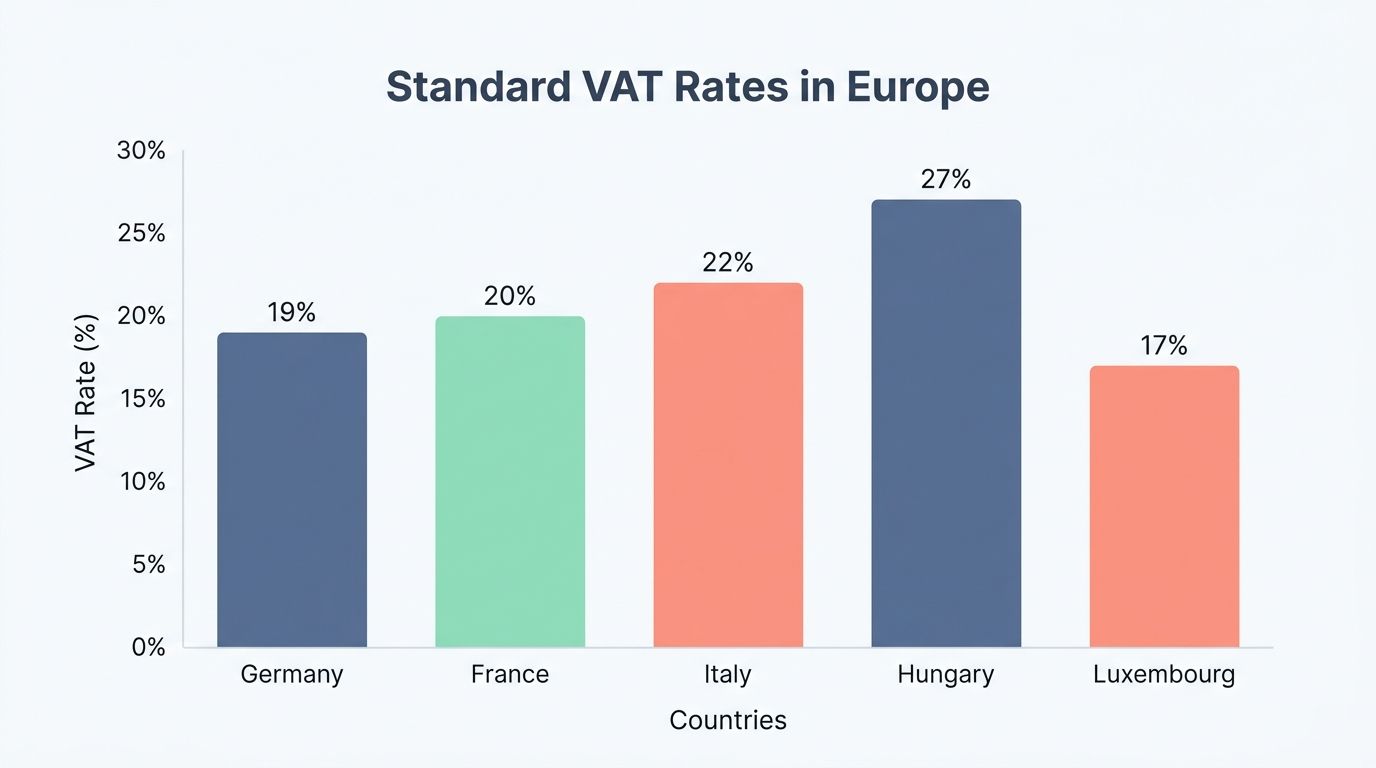
| Country | Standard rate | Reduced or special rates | Why it matters |
|---|---|---|---|
| Germany | 19% | 7% | A solid baseline for German checkout, invoicing, and margin planning |
| France | 20% | 5.5%, 10%, 2.1% | Common destination market with more category splits |
| Italy | 22% | 5%, 10%, 4% | Special categories can change the final consumer price quickly |
| Hungary | 27% | 5%, 18% | The highest standard rate in the EU, which puts pressure on gross pricing |
| Luxembourg | 17% | 8%, 3%, 14% | The lowest standard rate in the EU, useful in a VAT rate comparison Europe review |
Use a table like this inside your pricing workflow. It is much easier to spot a bad assumption before the invoice leaves your system.
Which goods and services have reduced VAT rates?
Since the April 2022 reform of EU VAT rates, member states may apply up to two reduced rates as low as 5%, plus one super-reduced rate below 5% and one zero rate for a limited set of basic-needs categories.
- Germany: a 7% reduced rate commonly applies to items such as many foods and books.
- France: 5.5% and 10% show why you should never treat all lower-rate goods as one bucket.
- Italy: 5% and 10% can apply alongside a 4% super-reduced rate, which makes product mapping more important.
- Digital services: official EU guidance notes that reduced rates usually do not apply to electronically supplied services, so SaaS sellers should assume the standard rate unless a specific rule says otherwise.
The action point is simple: classify each SKU before launch. Do not rely on a generic label like “food” or “media” once real invoices are involved.
What items are subject to zero VAT rates?
Zero-rated sales are different from exempt sales. With a zero rate, the customer pays 0% VAT and the seller can still deduct related input VAT.
If your finance team treats a zero-rated sale as an exempt sale, input tax recovery can be wrong even when the customer paid nothing at checkout.
The EU now allows one zero rate for a narrow list of basic-needs categories. For live transactions, confirm the exact treatment in national rules or the Taxes in Europe Database before you promise a 0% invoice.
VAT Examples in Europe
The quickest way to understand VAT is to work through real numbers. These VAT examples Europe show how the same net price produces different final prices across countries and transaction types.
How is VAT applied to goods and services?
Start with the tax base, then apply the local rate. A change of only a few percentage points is enough to alter your gross price, profit, or advertised retail price.
| Sale | Net price | VAT rate | VAT amount | Gross price |
|---|---|---|---|---|
| Germany, standard-rated goods | €100 | 19% | €19 | €119 |
| Germany, reduced-rate goods | €100 | 7% | €7 | €107 |
| France, standard-rated goods | €100 | 20% | €20 | €120 |
| Italy, standard-rated goods | €100 | 22% | €22 | €122 |
This is the format you want in a spreadsheet, ERP review, or online store QA check. It shows the tax logic in one glance.
How does VAT affect cross-border transactions?
Cross-border VAT depends on customer status and destination. The same product can be taxed in very different ways depending on whether the buyer is a business with a valid VAT ID or a consumer.
- B2B Germany to France: if the French buyer gives a valid EU VAT number, you will usually invoice without German VAT and use the reverse charge procedure.
- B2B without a valid number: you will usually charge VAT at your own country’s rate.
- B2C distance sales: an EU-wide threshold of €10,000 applies to distance sales of goods and TBE services. Below that amount, eligible sellers can often keep home-country VAT. Above it, destination-country VAT applies and OSS becomes the practical filing route.
- Imported low-value goods: IOSS can simplify VAT collection for consignments up to €150.
A useful pro move is to validate the buyer’s number in VIES and save the result with the order. The European Commission also notes that VIES is a search engine, not a database, so very new registrations can take time to appear.
What are industry-specific VAT rules?
Some sectors need a special workflow because the standard product-times-rate formula is not enough.
- Digital services: since 2015, VAT is generally based on the customer’s location, which is why software, e-books, and online courses need location evidence at checkout.
- Travel businesses: margin schemes can change the taxable base, so a normal gross-up formula may overstate deductible input tax.
- Farmers: some member states use flat-rate schemes that reduce paperwork but change recovery logic.
- Small businesses: from January 1, 2025, the EU SME scheme opened cross-border VAT exemption to eligible small businesses established in another member state, with an EU-wide turnover ceiling of €100,000 for access to the cross-border exemption.
How to Calculate VAT
You do not need complex software to understand the math. You need the right base, the right rate, and a clear distinction between net and gross prices.
What is the basic formula to calculate VAT?
VAT calculation for beginners starts with three formulas. Keep them on your invoice template, price sheet, or online VAT calculation tool settings page.
- VAT amount = Net price × VAT rate
- Gross price = Net price + VAT amount
- Net price from a VAT-inclusive total = Gross price ÷ (1 + VAT rate)
| Net price | Rate | VAT amount | Gross price |
|---|---|---|---|
| €100 | 19% | €19 | €119 |
| €100 | 7% | €7 | €107 |
| €100 | 20% | €20 | €120 |
How to differentiate VAT-inclusive and VAT-exclusive prices?
A VAT-exclusive price is your net amount. A VAT-inclusive price is the total the customer pays.
- If your net price is €100 in Germany at 19%, multiply by 1.19. The gross price is €119.
- If your gross price is €119, divide by 1.19. The net price is €100 and the VAT is €19.
- At Germany’s 7% reduced rate, a gross price of €107 gives a net price of €100 and VAT of €7.
This matters because many B2C storefronts display VAT-inclusive prices, while many B2B quotes begin with net amounts. If you mix the two, every later report will be wrong even if the rate itself is correct.
What are common VAT calculation errors to avoid?
Most VAT errors come from setup choices, not from the multiplication step. The math only fails after someone picks the wrong country, rate, or customer type.
- Using an old rate table: your calculation tool needs date-stamped rate updates.
- Treating gross prices as net: this inflates VAT and distorts profit.
- Skipping VAT ID checks: keep proof of VIES validation for B2B intra-EU sales.
- Missing invoice details: in Germany, invoices need the core legal fields in §§ 14 and 14a UStG if you want clean input tax recovery.
- Ignoring VIES timing: a newly issued number can appear invalid at first, so recheck before you rewrite the invoice with domestic VAT.
The safest sequence is: classify the sale, validate the buyer, calculate the rate, then lock the invoice.
Online VAT Calculation Tools
This is where VAT online tools save time. A good tool does more than add a percentage, it stores the logic behind the number and helps you prove why the invoice was right.
For German-speaking users, a mehrwertsteuer rechner is useful for quick net-to-gross checks, gross-to-net checks, and simple invoice reviews before the final VAT treatment is confirmed.
What features should a VAT calculator have?
- Current rate database: the tool should show where the rate came from and when it was last updated.
- Country and customer logic: it should distinguish domestic sales, intra-EU B2B, intra-EU B2C, and imports.
- VAT ID validation: useful for reverse charge and tax exemption checks.
- VAT-inclusive and VAT-exclusive modes: essential for quoting, checkout, and invoice correction.
- Bulk or API support: helpful if you issue many invoices or sync with ERP and e-commerce systems.
- Audit trail: you want timestamps, tax assumptions, and stored results, not just a final number.
What are some popular online VAT calculators?
| Tool | Best use | Strong point | Watch-out |
|---|---|---|---|
| Taxes in Europe Database (TEDB) | Checking official VAT rates and categories | Based on member-state data used in the EU system | It is a verification source, not a checkout engine |
| VIES | Checking whether a VAT number is valid | Pulls data from national VAT databases on request | It validates numbers, but it does not calculate VAT |
| Stripe Tax | Online stores and SaaS billing | Calculates tax in all EU countries and monitors thresholds | You still need correct product mapping and registrations |
| Avalara Managed VAT Reporting | Larger compliance teams | Guided workflows for registration, return prep, filing, and data mapping | More process-heavy than a simple calculator |
| VATComply | Developers who need an API | Offers EU VAT rates and VIES-based validation across all 27 member states | Best for technical setups, not for filing returns |
Why use online tools for VAT calculation?
A good online VAT calculation tool reduces manual errors and keeps your price logic consistent across invoices, carts, and reports. That is the real benefit.
- It switches between VAT-inclusive and VAT-exclusive prices quickly.
- It applies destination-country logic for cross-border sales.
- It gives support teams a clear VAT breakdown at checkout.
- It keeps rate updates out of risky spreadsheet formulas.
A simple mwst rechner can also support shoppers, freelancers, and small businesses that need a fast VAT breakdown without opening accounting software.
For many small teams, the smartest stack is simple: TEDB for rate checks, VIES for validation, and one tax engine inside your billing or e-commerce platform.
VAT Compliance in Europe
Compliance starts before the first invoice. You need the right registration, the right filing route, and records that still make sense months later during a review or audit.
How do businesses register for VAT?
Start with the transaction type. Do not confuse Germany’s local VAT registration process with the EU-wide €10,000 distance-sales threshold, because they solve different issues.
- In Germany, you first complete tax registration with your local tax office.
- Then the Federal Central Tax Office (BZSt) issues the separate USt-IdNr. used for EU cross-border trade.
- New German businesses can request the USt-IdNr. inside the tax registration questionnaire, and the number is issued by post once the underlying registration data reaches the BZSt.
- Since November 2024, Germany has also been rolling out the W-IdNr., but it does not replace the USt-IdNr. for EU VAT transactions.
If you sell B2C across the european single market, OSS can keep you from registering in multiple member states. If you import low-value goods from outside the EU, IOSS can do the same for consignments up to €150.
What are the VAT reporting requirements?
Your filing calendar should be built into your process before your first sale. In Germany, § 18 UStG sets the advance return deadline at the 10th day after each reporting period.
| Route | Typical timing | What you report | Why it matters |
|---|---|---|---|
| German advance return | Quarterly by default | Output VAT, input tax, and net payable or refundable amount | The standard filing cycle for many businesses |
| German advance return | Monthly if prior-year VAT exceeded €9,000, and usually for new businesses in their first two years | The same core VAT figures, reported more often | Gives tax authorities and finance teams faster visibility |
| German relief from advance returns | Possible if prior-year VAT was no more than €2,000 | Annual return still applies | Reduces admin for very small filings |
| OSS return | Quarterly | Cross-border B2C sales broken down by member state of consumption | One portal instead of multiple foreign returns |
| IOSS return | Monthly | Distance sales of imported goods up to €150 | Shows VAT at checkout and smooths delivery |
Also keep OSS records for 10 years. That rule catches many teams that assume the portal removes the documentation burden.
What happens if businesses fail to comply with VAT rules?
Late or incorrect VAT filings can trigger interest, penalties, and denied deductions. The cost is bigger with OSS because repeated failure can remove the shortcut your process depends on.
- Wrong invoices can block input tax recovery.
- Missing or invalid VAT numbers can force domestic VAT on a sale you expected to treat as intra-EU B2B.
- Persistent OSS non-compliance can lead to exclusion, and the scheme carries a two-year quarantine period before re-entry.
- Audit costs rise fast when invoices, returns, and bookkeeping do not match.
VAT for Consumers
VAT for consumers usually appears inside the final retail price, which is why European shopping often feels different from a U.S. sales tax checkout.
How is VAT charged on purchases?
For B2C sales, the advertised total often already includes VAT. That makes the final price easier to read, but it also means sellers must calculate the tax correctly before the customer clicks pay.
- Domestic B2C sales: the final displayed price normally includes VAT.
- Cross-border EU online sales: once the seller is above the €10,000 threshold, the VAT rate of the destination country usually applies.
- Imports from outside the EU: VAT is due at import, and customs duty or excise can also apply.
- IOSS orders: VAT can be collected at checkout on low-value imports up to €150, which reduces surprise charges on delivery.
If your price changes after you enter a French, Italian, or German shipping address, that is often destination-country VAT in action, not a hidden fee.
How does VAT impact retail pricing?
Retailers usually work backward from the gross price. That is why a VAT rate change affects shelf labels, checkout rules, discount math, and margin targets all at once.
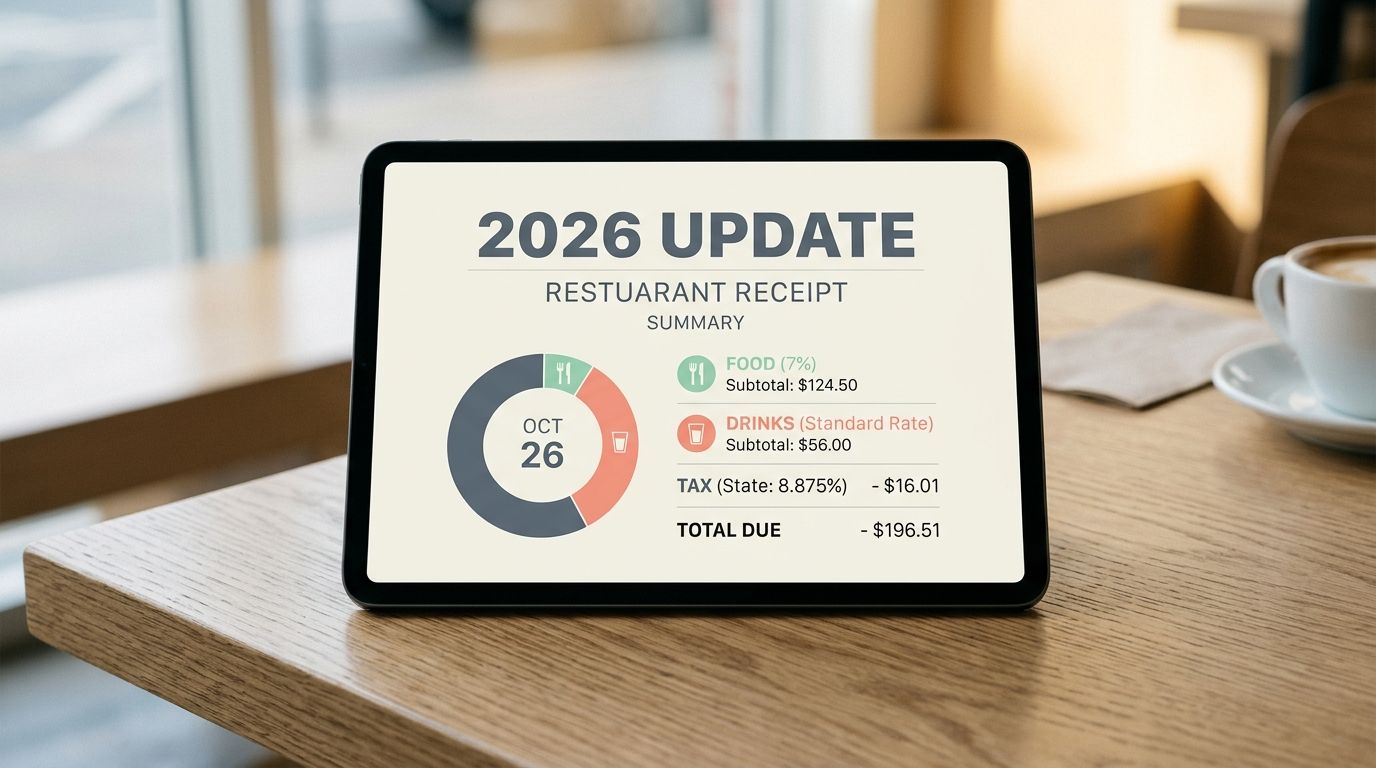
In the German Federal Ministry of Finance update for 2026, restaurant and catering food moved to 7% VAT from January 1, 2026, while drinks stayed at the standard rate. A mixed order can therefore carry two VAT rates on one receipt.
For shoppers, VAT-inclusive pricing improves transparency. For merchants, it means every receipt still needs an accurate VAT breakdown.
VAT for Businesses
VAT for companies is less about the percentage itself and more about process control. Once your records, invoice rules, and filing route are stable, the tax becomes much easier to manage.
What is the difference between input VAT and output VAT?
Input VAT is the tax your business pays on purchases. Output VAT is the tax your business charges on sales.
| Step | Net amount | VAT | Effect |
|---|---|---|---|
| Buy materials in Germany | €100 | €19 input VAT | Potentially deductible |
| Sell finished goods | €200 | €38 output VAT | Collected from the customer |
| Net VAT due | Difference only | €19 | €38 minus €19 |
You can usually reclaim input tax only when the purchase supports taxable business activity and the invoice is valid. Exempt activities and some non-business costs can block recovery.
How can businesses claim VAT refunds?
Businesses may also recover VAT paid in another EU country. The normal route is an online claim filed through the tax authority in the country where the business is established.
- Collect the invoice and confirm that the supplier used the correct VAT treatment.
- File the refund request through your home-country portal, not directly with every foreign tax office.
- Keep evidence that the purchase served taxable business activity.
- Match the claim to bookkeeping and returns, because refund authorities check consistency.
A refund is different from zero rating. A refund deals with VAT already charged to you, while a zero-rated sale means the customer was charged 0% from the start.
Why is proper VAT record-keeping important?
Good records turn VAT into a controlled system instead of a monthly guess. They also make e-invoicing, refunds, and audits far less painful.
- Store supplier and customer names, addresses, invoice dates, and invoice numbers.
- Keep the VAT rate, net amount, VAT amount, and the reason for any exemption or reverse charge note.
- Save VAT ID validations for intra-EU B2B sales.
- Keep transport proof for exports and intra-community deliveries.
- As of March 2026, the German Federal Ministry of Finance says domestic B2B businesses must be able to receive structured e-invoices from January 1, 2025. Paper or simple PDF invoices remain possible only during transition periods, which run through the end of 2026 for all issuers and through the end of 2027 for issuers with prior-year turnover up to €800,000.
If you are building a German workflow now, choose an invoice format aligned with EN 16931. That saves a second migration later.
Challenges with VAT in Europe
VAT feels difficult because several rules overlap at once: the rate, the place of supply, the customer’s status, the invoice format, and the proof you keep. One wrong assumption can change the whole result.
What makes VAT rules complex in Europe?
- Country rates differ: Germany uses 19% and 7%, France uses 20% with several reduced bands, and Hungary applies 27% at the standard rate.
- Regional exceptions exist: official EU tables do not cover some special regions such as the Canary Islands or the Azores.
- Digital supplies add extra checks: reduced rates usually do not apply, and customer location matters.
- Invoice form still matters: the tax result can be right while the deduction still fails because the invoice or evidence is incomplete.
This is why a plain calculator is never enough on its own. You also need a process that decides which rule applies before the rate is ever entered.
How to handle cross-border VAT compliance?
The cleanest method is to review transactions in the same order every time.
- Classify the customer: business or consumer changes the VAT rule.
- Set the place of supply: for goods, look at where transport ends. For many services, look at where the customer belongs.
- Validate the VAT ID: use VIES or the BZSt confirmation route for German teams.
- Choose the filing channel: domestic return, OSS, IOSS, or refund portal.
- Archive evidence: keep invoices, transport proof, and validation records together.
This sequence is simple, and that is the point. It removes many of the mistakes caused by jumping to the calculator too early.
How does VAT fraud and evasion occur?
VAT fraud includes underreported sales, fake invoices, and missing-trader or carousel schemes. In the European Commission’s 2025 VAT gap release, EU VAT revenue reached €1.223 trillion in 2023, yet the compliance gap was still estimated at €128 billion, or 9.5% of liability.
| Jurisdiction | 2023 VAT compliance gap | What it tells you |
|---|---|---|
| EU average | 9.5% | Controls still matter even in mature systems |
| Germany | 9.7% | Ordinary process failures still cost real money |
| France | 5.6% | Strong compliance still leaves a material gap |
| Italy | 15.0% | Higher-risk environments need tighter documentation |
| Romania | 30.0% | Large gaps explain the push for faster digital controls |
For businesses, the lesson is practical: verified VAT numbers, clean invoices, and timely digital filing are now fraud controls, not optional admin work.
Future of VAT in Europe
The future points in one direction: more digital reporting, more structured invoice data, and fewer chances to correct mistakes late. That affects tax teams, marketplaces, and ordinary online sellers.
How is VAT adapting to the digital economy?
E-invoicing and digital reporting are moving from nice-to-have tools into the core tax process. If your workflow still depends on manual exports and spreadsheet fixes, the next round of EU changes will feel expensive.
| Date | Change | Why it matters |
|---|---|---|
| March 11, 2025 | The Council adopted the ViDA package | The reform moved from proposal stage to rollout stage |
| January 1, 2027 | Minor legislative clarifications for OSS and IOSS users start | Portal users need updated process notes |
| July 1, 2028 | Platform rules for short-term accommodation and passenger transport, plus single VAT registration measures | Platforms and marketplaces face broader VAT duties |
| July 1, 2030 | Digital reporting requirements for cross-border B2B trade begin | Structured invoice data becomes much more important |
| January 1, 2035 | Member states with domestic digital reporting must align with EU standards | National systems should become more consistent over time |
What changes to VAT rules are being proposed?
The biggest proposal phase ended in 2025. The real issue now is implementation.
- Single VAT registration: intended to reduce the number of foreign VAT registrations businesses need in some cases.
- Platform economy rules: more VAT liability will shift onto certain platforms in accommodation and passenger transport.
- Digital reporting and e-invoicing: tax authorities will receive transaction data faster, which means slow corrections will become more costly.
- VAT Expert Group: the group entered a new three-year mandate on September 29, 2025, which matters because the European Commission uses it to test practical guidance before major changes reach businesses.
Conclusion
VAT in Europe explained becomes manageable once you sort every sale by customer type, place of supply, rate, and filing route.
Use current EU VAT rates, validate the value-added tax identification number, show the correct VAT on invoices, and move qualifying cross-border sales through the One Stop Shop or IOSS. If your base is in Germany, make BZSt registration and e-invoicing part of your workflow now, before the next return is due.
FAQs
1. What is VAT in Europe and how do rates vary?
VAT in Europe is a consumption tax added to most goods and services across member states. Rates vary by country and by product, with lower rates for basic goods and higher, standard rates for most items.
2. How do I calculate VAT for a sale?
Multiply the net price by the applicable VAT rate to get the VAT amount. Use online calculation tools to show totals, taxes, and examples fast.
3. Are there examples of reduced or zero rates?
Yes, many member states apply reduced rates to basic goods, printed materials, and medical supplies, and zero rates to exports. Check examples from official lists to see which items qualify in each place.
4. Do I need special tools or help to follow VAT rules across Europe?
Use online calculation tools to save time, compare rates, and test examples. Get advice from a tax professional for cross-border sales and complex rules.