

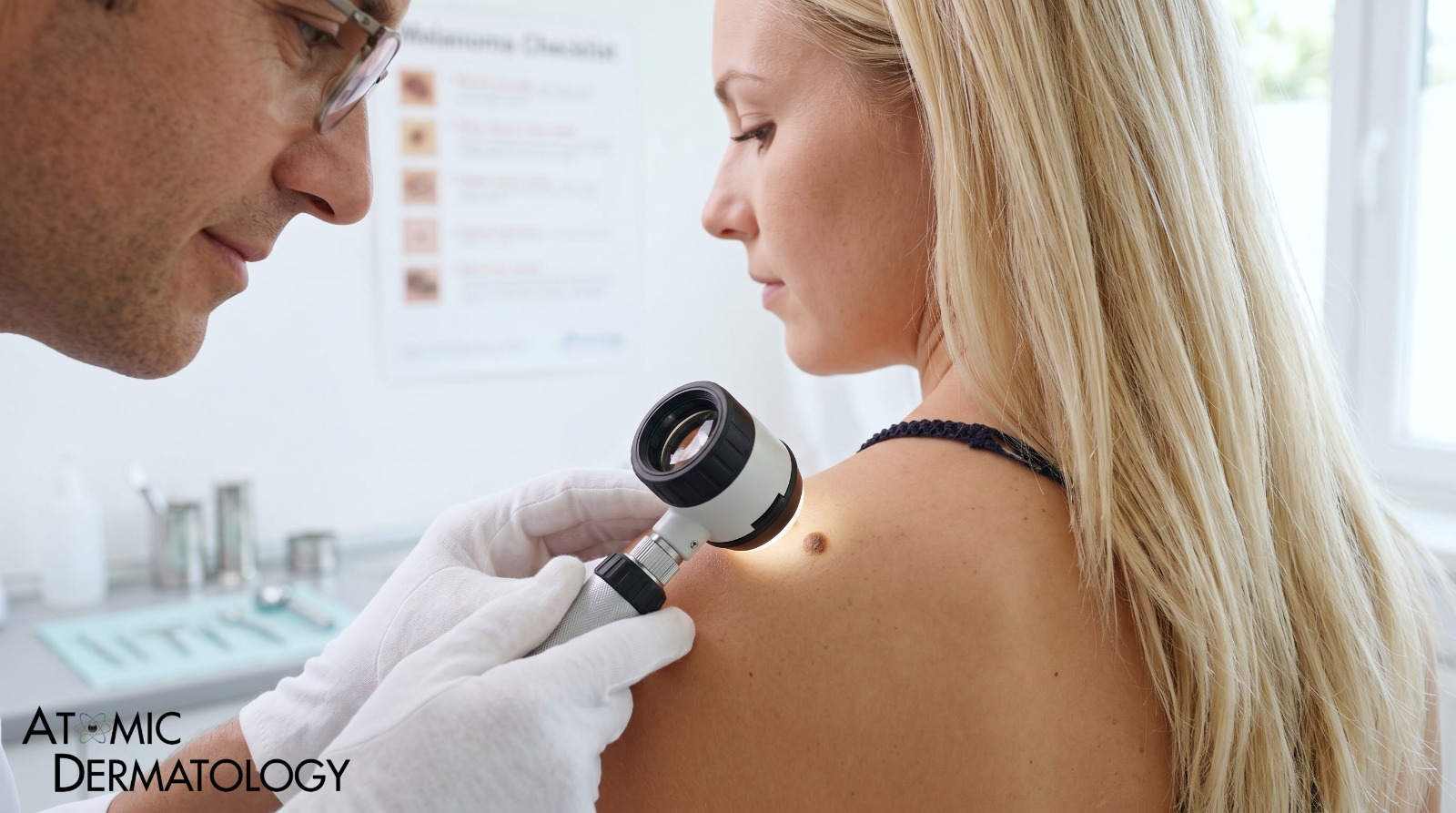
Most people have had that small, uneasy moment: a spot on the skin looks unfamiliar, a mole seems darker than before, or a sore keeps reopening after it should have healed. The first instinct is often to watch it for a while, which can make sense for stable, harmless-looking spots.
The harder question is knowing when watching turns into waiting too long. For patients in Pasco, Walla Walla, the Tri-Cities, and the Walla Walla Valley, Atomic Dermatology provides skin evaluations for spots, moles, lesions, and other changes that deserve a closer look.
A Concerning Spot Does Not Always Look Obvious
Many people expect a suspicious skin spot to look dramatic. In reality, early skin changes can be subtle enough to dismiss as irritation, dryness, or an old blemish that will eventually clear.
A spot may deserve evaluation if it appears without a clear cause, changes in color or texture, bleeds without injury, or refuses to heal. Some concerning lesions show up as rough patches, pearly bumps, pink areas, or recurring sores rather than dark, irregular moles.
That is why behavior often tells you as much as appearance. A small spot that keeps changing or reopening can deserve more attention than a larger mark that has looked the same for years.
Changes That Should Move a Spot From “Watch It” to “Schedule It”
Not every bump or mole needs immediate concern, but certain changes make professional evaluation the more sensible next step. The goal is not to assume the worst, but to avoid guessing when the skin is clearly behaving differently.
A new growth with no obvious explanation should be checked if it persists beyond a few weeks, especially when there was no injury, bite, or irritation in that area. New spots are not automatically dangerous, but persistence gives providers a reason to look more closely.
A mole that changes in size, shape, color, or texture also deserves evaluation. A mole that stayed stable for years and then begins evolving should not be treated as ordinary skin behavior.
A sore that does not heal is another important signal. Lesions that crust over, reopen, bleed, or remain raw for several weeks can point to changes that need medical assessment.
Rough, scaly patches are also worth noting, especially on sun-exposed areas such as the face, scalp, ears, forearms, hands, and neck. These areas often carry more cumulative UV damage, which can make persistent texture changes more meaningful.
A pearly, shiny, or translucent bump should not be ignored simply because it looks small or painless. Some skin cancers can grow slowly and quietly, which is exactly why people sometimes overlook them.
Ongoing pain, tenderness, itching, or irritation in one specific spot can also justify a visit. Skin that keeps drawing your attention is usually worth having examined, even if the change seems minor.
The ABCDE Rule Helps, But It Has Limits
The ABCDE rule is a useful way to think about melanoma warning signs. It stands for asymmetry, border irregularity, color variation, diameter larger than about 6 millimeters, and evolution, meaning a spot is changing.
If a mole fits several of those warning signs, scheduling an evaluation is reasonable. The rule gives patients a simple way to notice suspicious changes before they become harder to address.
The limitation is that not all skin cancers look like classic melanoma. Basal cell carcinoma and squamous cell carcinoma may appear as non-healing sores, scaly patches, pink bumps, or irritated areas that do not match the ABCDE pattern.
A spot can look small, pale, or symmetrical and still need attention because of how it behaves. That is why the ABCDE rule is helpful as a starting point, but not enough to replace a professional skin cancer evaluation.
Different Types of Skin Cancer Can Look Different
Skin cancer is the most common form of cancer in the United States, and it does not appear the same way in every patient. Some forms are slow-growing, while others need faster evaluation and treatment.
Actinic keratosis often appears as a rough, scaly, or sandpaper-like patch on sun-exposed skin. It is considered precancerous because some lesions can develop into squamous cell carcinoma if left untreated.
Basal cell carcinoma may look like a pearly bump, a pink patch, or a sore that heals and then returns. Because it often grows slowly, patients may mistake it for irritation or a stubborn blemish.
Squamous cell carcinoma can appear as a firm bump, a scaly patch, or a sore that does not heal. It may develop on sun-exposed areas, but it can also appear in other locations.
Melanoma usually receives the most attention because it can be more serious. It may develop as a new dark spot or as an existing mole that changes in shape, color, border, or size.
Merkel cell carcinoma is rare but more aggressive. It can appear as a fast-growing, flesh-colored, red, or bluish nodule, which is why prompt evaluation is important when a new lesion changes quickly.
These descriptions can help with awareness, but they cannot confirm what a spot is. Some benign lesions can mimic concerning ones, and some concerning lesions can look deceptively mild.
What Happens During a Skin Evaluation
A skin evaluation usually begins with a conversation about what changed and when you noticed it. Details such as bleeding, itching, growth, crusting, pain, sun exposure, and personal or family history can help guide the exam.
At Atomic Dermatology, providers perform skin exams and assess concerning lesions to determine whether monitoring, biopsy, or treatment planning may be appropriate. Evaluations are performed by trained medical providers experienced in identifying skin changes that may need further attention.
If a lesion looks suspicious, a biopsy may be recommended. A biopsy removes a small sample of tissue so it can be tested and identified more accurately.
This step does not mean the spot is definitely cancerous. It gives the provider clearer information, which helps guide the next decision instead of relying on appearance alone.
When Waiting Becomes the Riskier Choice
Monitoring can be reasonable when a spot is stable, longstanding, and unchanged. That approach becomes less sensible when a lesion is actively growing, bleeding, crusting, changing color, becoming painful, or failing to heal.
A professional exam does not automatically commit you to treatment. In many cases, it simply clarifies whether the spot needs monitoring, biopsy, or another next step.
The spots that cause problems later are often the ones that seemed easy to explain away early on. If a lesion keeps behaving differently from the surrounding skin, waiting rarely gives you better information.
How to Reduce Risk After a Skin Concern Is Addressed
Long-term skin health depends on daily habits as much as individual appointments. Once a concerning spot has been evaluated, prevention and monitoring become part of the bigger picture.
Atomic Dermatology recommends practical sun protection habits, including daily SPF 30 or higher sunscreen, avoiding tanning beds, wearing hats and sun-protective clothing, and seeking shade during peak sun hours. These habits reduce cumulative UV exposure, which is one of the most preventable contributors to skin damage.
Monitoring moles and scheduling annual professional skin checks can also help catch changes earlier. A single visit can address one concern, but regular awareness helps protect your skin more consistently.
The Practical Decision
If a skin spot is new, changing, bleeding, crusting, painful, rough, or not healing, a professional exam can clarify what the skin is doing. The same applies when a mole looks different enough that you keep checking it.
Atomic Dermatology evaluates concerning skin changes for patients in Pasco, Walla Walla, the Tri-Cities, and the Walla Walla Valley. Their providers can examine suspicious spots, perform biopsies when needed, and guide next steps based on what the findings show.
You do not need to panic over every mark on your skin. You also do not need to keep guessing when a spot is changing or refusing to heal.